





NASA will delay the launch of itsnext space shuttle mission until July in order to replace potentially faultyfuel sensors inside the orbiter's massive external tank, the agency's shuttleprogram chief said Tuesday.
Wayne Hale, NASA's shuttle programmanager, told reporters that the shuttle Discovery and its STS-121return to flight mission will now launch no earlier than July 1,weeks later than its earlier May10-22 flight window.
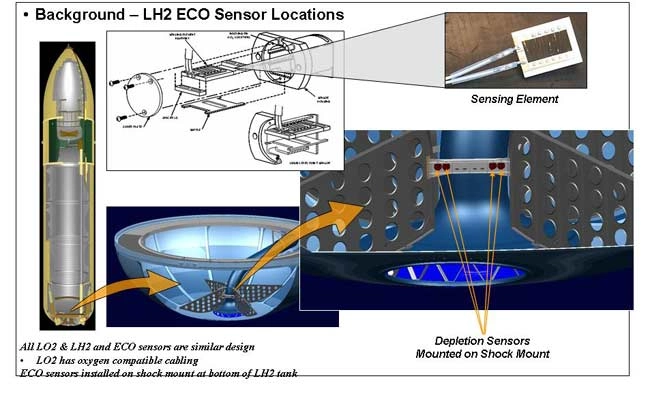
The extra time will allow for aninvasive, three-week swap of four engine cut-off (ECO) sensors inside theliquid hydrogen portion of the orbiter's 15-story fuel tank, he said.
"This is not a decision aboutschedule," Hale said of the delay during a press conference at NASA's JohnsonSpace Center in Houston, Texas. "This is a question of safety."
Discovery's STS-121 mission,commanded by veteran astronaut StevenLindsey, is the second shuttle flight set to fly since the 2003 Columbia disaster thatkilled seven astronauts. It is also the second test flight before NASA returnsto its International Space Station (ISS) construction launch schedule.
Hale said he remained optimisticthat NASA could launch three shuttle flights - STS-115 aboard Atlantis in lateAugust and STS-116 in the fall - by the end of 2006.
Critical sensors
ECO sensorsare designed to monitor shuttle fuel tank levels and shut down an orbiter'sthree main engines before its fuel tank runs dry.
But recent studies found that wiringdefects in the manufacturing of some sensors could lead them to falsely reporta dry tank, which could force an early engine shut down before a shuttlereaches its proper orbit, Hale said, adding that one such sensor on Discovery'sexternal tank has also been returning some errant readings.
"If a number of these sensors failto the 'dry' state they would shut the engines down early, prematurely, whichis not a good thing in spaceflight," Hale said, adding that the chances of thatoccurring is admittedly remote. "This is what we call a criticality one, lifeor death, kind of situation in that you want those sensors to work properlyeither way...we need to have a good set."
Errant ECO sensor readings scrubbedthe attempted July 13 launch of NASA's first post-Columbia mission - STS-114 also aboard Discovery -though the orbiter launched13 days later without incident. Problems with the sensors also cropped up on aseparate tank during an April2005 fueling test.
Hale said that unrelated problemshave led shuttle engines to shut down early in a previous orbiter launch duringNASA's STS-51F mission in 1985. A hydrogen leak impaired engine performance during1999's STS-93 mission launch, he added.
Sensor swap
Tank engineers will replace all fourliquid hydrogen fuel ECO sensors on Discovery's External Tank-119 (ET-119)which now sits inside NASA's 52-story Vehicle Assembly Building at the KennedySpace Center in Cape Canaveral, Florida.
The tank will be hoisted into thevertical position, where engineers will remove its foam covered surface and pryopen a manhole at its bottom to gain access to the liquid hydrogen tank, Halesaid. After swapping out the old ECO sensors - which were built in 1996 - withnew ones, engineers will then close out the tank and set it back in ahorizontal cradle to reapply the foam insulation, he added.
"There are certain risks that youmight damage the tank," Hale said of the sensor swap operation.
Extra time
Discovery's launch window, whichruns from July 1 to July 19, also allows shuttle workers about six additionalweeks to close out several issues that have cropped up in the last few weeks.
Engineers will now be able to repairDiscovery's damagedrobotic arm - which was dinged inside the shuttle's hangar-like OrbiterProcessing Facility on March 4 while workers tried to clean up broken glassfrom a light bulb that fell into the orbiter's payload bay. The arm isinstrumented to evaluate its performance in the upcoming flight, and would havehad to be replaced with an un-instrumented arm with out the extra work time, Halesaid.
Hale also said shuttle workers willbe able to replace outer windows on Discovery's cabin and remove additionalfoam from ice frost ramps on the orbiter's fuel tank.
NASA has been working to reduce theamount of foam insulation aboard shuttle fuel tanks since 2003, when a chunk offoam fell from Columbia's tank and breached the heat shield along its left wingleading edge, leading to the orbiter's Feb. 1, 2003 destruction. The problemcropped up again during Discovery's launch when cameras caught unacceptablylarge pieces of foam falling from the tank, primarily from a protectiveramp that has since removed from current and future tanks.
All of the work to be completed onDiscovery and its external tank should be completed well before the July launchwindow, especially since the agency was pushing hard to make the May launchwindow, Hale said.
"We were racing very hard to get tothe mid-May launch period," Hale said, adding that the extra six weeks couldallow some shuttle workers to take weekend rests in what has been a dailyeffort to reach the May launch window. "I would expect it will allow us toslacken the pace is other areas."
