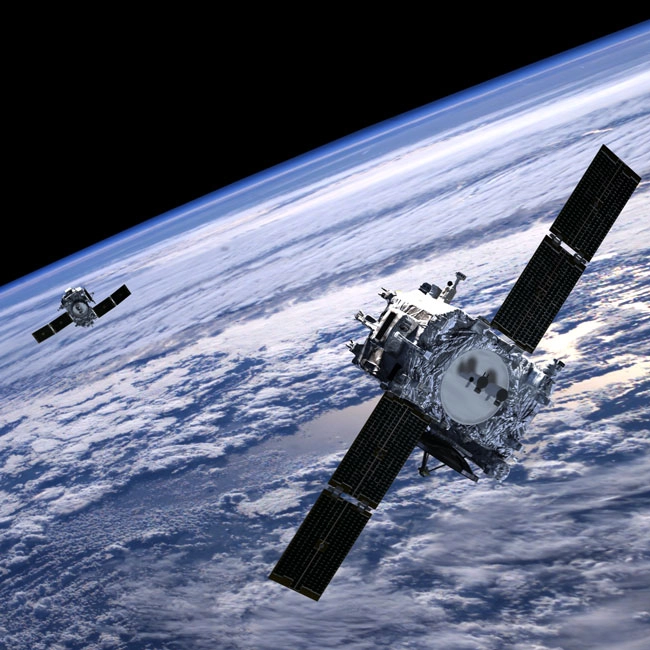
A set ofspacecraft twins destined to stare at the Sun is alternately baking andfreezing in a preflight test.
Built tosnap three-dimensional (3D) images of the Sun's most powerful eruptions forNASA's STEREOmission, the two probes are undergoing endurance checks in a vacuum chamberwhere temperatures can reach up to 122 Fahrenheit (50 degrees Celsius) and dropdown to -13 degrees Fahrenheit (-25 degrees Celsius), NASA officials said.
"Thesatellites are very nearly done," Jim Adams, STEREO deputy project manager atNASA's Goddard Space Flight Center (GSFC), told reporters Monday at the 2006 meeting of American Meteorological Society in Atlanta,Georgia. "We're taking the best instruments from NASA's fleet of solar observingsatellites over the years and putting them into STEREO."

DubbedSTEREO A and B by their handlers, the two spacecraft carry five telescopes each,as well as a suite of instruments to monitor the Sun for coronalmass ejections (CMEs) - massive explosions that hurl clouds of charged particlesacross the Solar System. The particles can interfere with the regular operationsof satellitesand power grids, as well as pose a danger to astronauts in Earth orbit andoutside the planet's protective magnetic field.
"Becausewe have a flat view of the sky, we can't tell when they're coming towards us or[moving] away from us," said Alex Young, a STEREO scientist at GSFC, of CMEs. "Thesesolar storms actually create currents that cause the magnetosphere of Earth toring like a bell."
In1989, a strong solar storm knocked out power in Quebec, Canada, while a severestorm slammedinto the Earth in 1859, shorting out telegraph lines in the U.S. and UnitedKingdom and starting fires.
"It has astrong effect on our daily lives," Young said of space weather. "Today'ssociety is extremely dependent on technology affected by them...we need tounderstand when these things are occurring, and when they are coming towardsus."
TheSTEREO mission - shortfor Solar TErrestrial RElations Observatory - will place one satellite in anorbit ahead of Earth while its counterpart trails the planet, NASA officials said.Both satellites are designed to watch the Sun simultaneously, givingresearchers a 3D view once the data is integrated on Earth, they added.
The $500million mission is set to launch on June 24 atop a Boeing-built Delta 2 rocket,NASA officials said. Once thermal vacuum chamber tests are complete, bothSTEREO probes will be weighed, and then tested to ensure that their individualelectronic components do not interfere with each other, they added.
- Double Vision: STEREO Spacecraft to Scan Sun in 3D
- Speed Limit Found For Solar Storms
- The Great Storm: Solar Tempest of 1859 Revealed
- Live Sun Cam
