





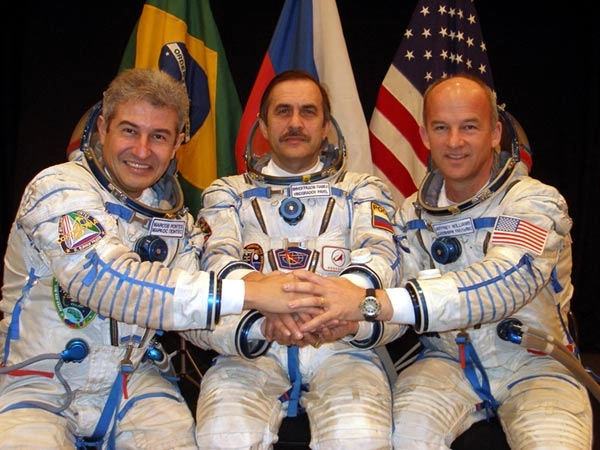
HOUSTON - Brazil's first astronaut and two veteranspacefarers are eagerly awaiting their chance to launch toward the InternationalSpace Station (ISS).
ISS Expedition13 commander Pavel Vinogradov, flight engineer Jeffrey Williams and ISSvisitor MarcosPontes - Brazil's first astronaut - are set to ride their Soyuz TMA-8spacecraft into orbit in a 12:43 a.m. EST (0543 GMT) launch from Kazakhstan's Baikonur Cosmodrome on March 22.
"I've beenwaiting for this opportunity for seven years and now finally it comes," Pontessaid during a press conference here at NASA's Johnson Space Center, adding that he originally trained to fly to the ISS aboard a NASA shuttle. "Besides allthe scientific objectives for us from Brazil, it will be a very strong step forour space program."
Pontes, alieutenant colonel in the Brazilian Air Force, will spend eight days performinga series of science studies that include nanotechnology tests and student experimentsfrom Brazilian schools. He will return to Earth with the station's current crew- Expedition12 commander Bill McArthur and flight engineer Valery Tokarev.
"[Expedition]13 will be a new page in the history of the International Space Station,"Vinogradov said during a press conference here at NASA's Johnson Space Center. "We will be looking forward to ThomasReiter who possibly will join us onboard...after more than three years offlying two-person crews we may finally come to fly with the full capacity of athree-person crew."
ISS crewswere limited to two membersfollowing NASA's 2003 Columbiashuttle accident due to the subsequent drop in orbiter flights and supplylimitations. The space shuttle Discovery and its STS-121crew is expected to launch toward the ISS no earlier than May 2006with Reiter, a German astronaut with the European Space Agency (ESA),though the orbiter flight hinges on the results of shuttlefuel tank modifications currently underway at NASA's Michoud AssemblyFacility in New Orleans, Louisiana.
Vinogradovand Williams are hopeful to receive at least one shuttle crew, and possiblytwo, during their six-month stay aboard the ISS. They will relieve theExpedition 12 astronauts, who have lived aboard the ISS since their arrivalin October 2005.
BothExpedition 13 astronauts are spaceflight veterans, though only Vinogradov hasflown a long-duration mission.
As a cosmonautfor Russia's Federal Space Agency, Vinogradov racked up 198 days aboard theRussian space station Mir in 1997. Williams, a NASA astronaut and U.S. Armycolonel, flew a 10-day mission aboard the Atlantis orbiter during STS-101mission to the ISS May 2000.
"I'mparticularly looking forward to this flight for the Soyuz," Williams said. "It'sobviously a very unique experience from shuttle."
Williamssaid at least one spacewalk in U.S. spacesuits is slated for the Expedition 13crew. Two additional spacewalks in Russian-built Orlan spacesuits are scheduledfor later in the mission.
"The scheduleis very busy up there," Williams said, adding that three spacewalks, potentiallytwo shuttle visits and absorbing a third crewmember makes for little down time."But I personally know that it's important to get the word out to the public."
Despite atight timeline, Williams said he hopes to spend some of his free time relatinghis spaceflight experience to the public through journals and log entries.
Pontes andthe Expedition 13 crew will spend two days chasing the ISS after launch beforedocking at the orbital platform on March 24. After eight days of jointoperations, the Brazilian astronaut and the Expedition 12 crew will cast offfrom the station aboard their TMA-7 spacecraft for a March 31 landing on thesteppes of Kazakhstan.
But Ponteshopes that the end of his science mission will mark a new beginning for hishomeland's space program.
"Although Iam the first [Brazilian] astronaut there, I don't want to be the last one,"Pontes said. "Hopefully, there will be another selection and we will have otherparticipants in the program."
- NASA Announces Next Space Station Crew
- Russia Agrees to Launch Brazil's First Astronaut to ISS
- Complete Coverage: ISS Expedition 12
- Complete Coverage: ISS Expedition 13
