


Thisstory was updated at 5:41 p.m. EST.
Engineers investigatinga debris shedding problem with NASA's shuttle fuel tanks have found a series ofhairline cracks in the same area where foam popped free during the July launchof the Discovery orbiter, agency officials said Tuesday.
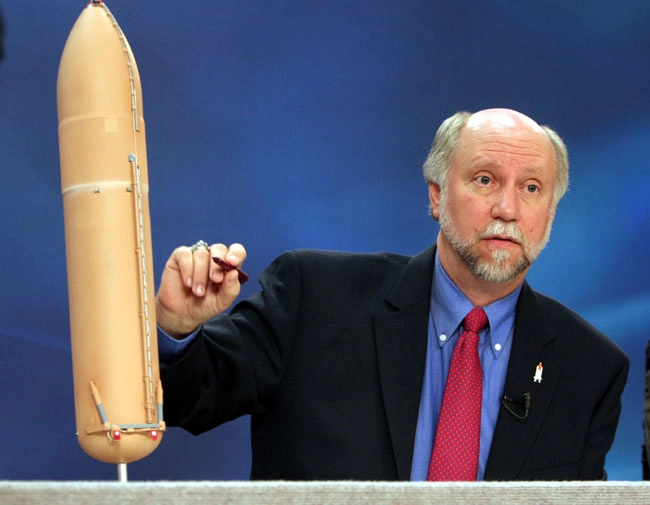
A total ofnine cracks - only two of them visible on the surface - were detected along aprotective foam ramp on NASA's External Tank120 (ET-120), one of several under scrutiny at the agency's Michoud AssemblyFacility in New Orleans, tank officials said during a briefing at the agency'sJohnson Space Center in Houston.
"We'restill trying to figure out what this means," said NASA's John Chapman, externaltank project manager at Marshall Space Flight Center in Huntsville, Alabama. "Iwouldn't consider that a Eureka [moment] or smoking gun at all."
Originally tappedto fuel Discovery's STS-114 liftoffbut later replaced,ET-120 was one of three tanks sent back to Michoud from NASA's Kennedy SpaceCenter in Florida and the only one of them to hold the supercooled liquid fuelused during shuttle launches.
Shuttleprogram manager Wayne Hale added that, while the engineering assessment of thecracks is still pending, it appears that the thermal and pressurization changesinvolved in fueling the tank during two testsmay be one potential cause.
"It doesappear that that's a factor," he told reporters.
Hale saidthat if everything proceeds as expected, NASA could be ready to launchDiscovery on STS-121, the agency's second return to flight mission, in May2006, but stressed that the external tank work - not a schedule - comes first.
Safeguardingshuttles
Preventingthe loss of potentially harmful chunks of external tank foam during a shuttlelaunch has been a major focus of NASA since the loss of the Columbia orbiter and its seven-astronautcrew during reentry Feb. 1, 2003.
A1.37-pound chunk of foam critically damaged Columbia's heat shield at launchleaving it vulnerable to the searing hot atmospheric gases during its descent,investigators later found.
NASA spenttwo and a half years and some $200 million to reduce the amount of large foamdebris during shuttle launches, but was surprised when an onboard camera caughta one-pound chunk fall from a protective ramp thought to be safe.
The crackson ET-120 were found on the same ramp - known as a Protuberance Air Load (PAL)ramp - designed to protect fuel length cabling from the aerodynamic pressuresof launch.
Hale saidthat while initial shuttle fuel tanks designed in the late 1970s required PALramps, newer containers have been improved and strengthened over time. Plansare underway to streamline foam applications on the PAL ramp - which consists of22 pounds of insulation foam - as well as strip it from future tanks altogether,he added.
"It ispossible that we may get there for the first flight," Hale said, referring toSTS-121. "It is more likely that it may take us until the fall to complete thatwork."
Orbiterwork
Whileengineers continue their work on shuttle fuel tanks, other workers arepreparing the orbiters themselves for flight.
Steve Poulos,head of NASA's orbiter project office, said that engineers have determined thatfaulty stitching caused a nose-mounted thermal blanketto balloon outward during Discovery's STS-114 flight.
"We'veinspected 486 blankets on both Discovery and Atlantis," Poulos said, addingthat 40 blankets will be replaced aboard Discovery and 60 on Atlantis."
Shuttleworkers have also pored over Discovery's heat-resistant reinforced carboncarbon (RCC) panels that its nose and wing leading edges to determine whichneed replacement or repair.
Poulosadded that new adhesion processes are also in hand to glue ceramic cloth gap fillersbetween the heat tiles that line a shuttle's underside.
DuringDiscovery's STS-114 flight, orbitalphotographs showed two gap fillers jutting out of the orbiter's tile-linedbelly, raising concern that they may lead to hotter reentry temperatures alongthe shuttle's aft. STS-114 astronaut Stephen Robinson plucked the offending gapfillers from Discovery's hull during the flight'sthird spacewalk.
"At the endof the day, we will have checked every gap filler on the vehicle," Poulos said.
- NASA Tackles External Tank Tests, Aims for May '06 Shuttle Launch
- Special Report: NASA's STS-114 Return to Flight Shuttle Mission
