





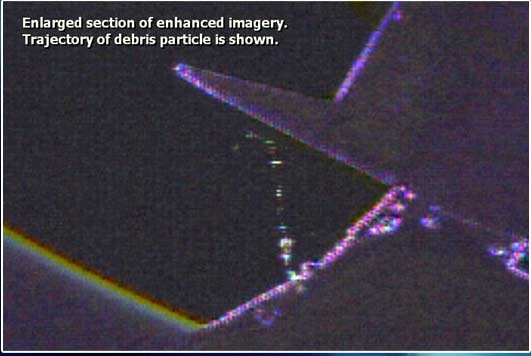
HOUSTON - Oneof several small pieces of foam that popped free from Discovery's external tankduring launch may have struck the orbiter, but likely caused no significant damage,shuttle managers said Thursday.
"We thinkthat little piece of foam at that altitude did not cause damage of concern,"said Wayne Hale, NASA's deputy shuttle program manager, during a press briefinghere at Johnson Space Center (JSC), adding that he fully expects the orbiterwill be free of any debris concerns as data is processed. "I expect that onFlight Day 6, we're going to get the go ahead to fly as is."
Earliertoday, NASA officials said they were confidentthat Discovery's heat shield is intact and the orbiter fit for an Earth return,but are awaiting additional analysis.
After twodays of image analysis, analysts have tracked several small pieces of foam insulationas they popped free from the tank very near the origin of a larger, 0.9-poundchunk that missed Discovery as it fell, shuttle officials said.
Theyoriginated from an ice frost ramp, very close to another ramp that shed thelarger foam chunk, and separated from the tank about 20 seconds after thebigger piece, Hale said. There is no definitive evidence - based on surveysconducted Wednesday with a sensor-laden orbital boom and sensors inside thewing - that the foam debris made contact with Discovery's right wing leadingedge as it fell away, he added.
But even ifthe small foam piece did strike the orbiter, it would have hit with only 1/10ththe energy needed to cause damage, according to debris transport analysis, Halesaid.
Nevertheless,shuttle officials would like to know why the additional foam pieces fell awayat all and will study the incident. NASA plans to address the current foam lossissue beforelaunching another shuttle into space.
Discovery'sSTS-114 spaceflight is NASA's first shuttle flight since the 2003 Columbiadisaster.
Hale saidthat Discovery's mission management team (MMT), which he chairs, will now handoff the external tank work to others and shift their focus onto verifying theshuttle's thermal protection system comprised of heat-resistant tiles and reinforcedcarbon carbon panels (RCC) along its wings and nose cap.
Earliertoday, the STS-114 crew and space station astronauts worked together to photographDiscovery's belly, obtaining high-resolution images of the orbiter'sbelly-mounted tiles to be reviewed by specialists on Earth. The image surveycame a day after Discovery's astronaut crew deployedthe shuttle's 50-foot (15-meter) orbital boom sensor system (OBSS) toscrutinize the orbiter's wing leading edges for any hint of damage.
"We arevery satisfied with the results we are getting," Hale said of the shuttle'stile-lined belly.
Themeasures are designed to search for damage like that which crippled theColumbia orbiter in 2003. The orbiter broke apart during reentry on Feb. 1,2003, after suffering wing damage from external tank foam at launch.
StevePoulos, NASA's orbiter projects office manager, said Discovery is a "very cleanorbiter" that sustained about 80 percent fewer impacts than past shuttleflights.
The OBSS detectedvery slight scuffs to some of Discovery's RCC panels - one such incidentleaving a mark smaller than the dot atop the letter 'i' - but additional passesare needed to catch every view flight controllers want, Poulos added.
In thehistory of the space shuttle program, most orbiter averaged about 150 nicks,dings or other damage to its heat-resistant tiles per flight, Hale said, addingthat some of that damage admittedly occurred during descent as the landing geardeployed. Of that average 150 incidents, about 31 are typically larger than aninch in size, he added.
Shuttletile specialists have picked out about 26 specific points where Discovery'sbelly tiles appear to have been dinged during flight. All but one of those - anapparently chipped tile noticed during video captured during launch - are smallerthan 1/2 inch in size, and they are all expected to be cleared of concern by July31, the sixth day of Discovery's STS-114 mission, NASA officials said.
Some ofthose tile dings may be chosen for follow-up looks with the OBSS on Friday,though tile specialists were still discussing that issue late Thursday, NASA officialssaid.
Meanwhile, Halesaid he has sent e-mails to Discovery's crew expressing his concern for thefoam shedding seen on launch day.
"I toldthem, frankly, that I was mortified of the external tank's foam loss, and thatwe're going to fix it before we fly again," Hale said.
- Fixing NASA: Complete Coverage of Space Shuttle Return to Flight
