





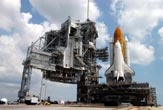
NASA'sDiscovery orbiter will fly next month, with concerns it could suffer damagefrom launch debris akin to that which doomed the Columbia mission all butsettled, shuttle officials said Friday.
Modificationsmade to Discovery's external tank since April have lowered the risk frompotentially harmful ice debris, which shuttle officials feared could shake offduring launch and strike the orbiter, to within acceptable parameters, mission managers said. But more work is still needed to better understandthe risk of ice debris striking an orbiter's protective thermal tiles, they added.
"This isgoing to require constant vigilance, but as far as [STS] 114 is concerned, Ibelieve our concerns are put to bed," said John Muratore, NASA's manager forshuttle systems engineering and integration, during a teleconference withreporters. "We're ready to fly."
Muratore'scomments came after shuttle managers concluded a debris verification meeting atNASA's Kennedy Space Center in Florida.
Discovery'sSTS-114 mission is slated to launch no earlier that July 13 and is expected tomark NASA's return to shuttle flight. NASA grounded Discovery and its twosister shuttles after the loss of the Columbia orbiter, which broke apartduring reentry on Feb. 1, 2003, killing its seven-astronaut crew. The STS-114mission is designed to test new shuttle flight safety methods and hardware, aswell as resupply the International Space Station.
Shuttleofficials will hold a flight readiness review meeting for the mission betweenJune 29-30 before deciding on a final launch target.
"I would gothe flight readiness review with the mindset that we could make the opening ofthe launch window," NASA space shuttle program manager Bill Parsons toldreporters. "Where we are today, we have every opportunity to make the opening ofthe launch window."
Discovery'slaunch window stretches from July 13 to July 31. A second window, currentlyallocated to the second return-to-flight mission STS-121, opens on Sept. 9.
Launchdebris work
Externaltank debris has been a major concern for shuttle managers and engineerspreparing the Discovery orbiter for flight.
Investigatorsattributed the Columbia accident to a suitcase-sized chunk of insulating foamthat separated from the Columbia's external tank at launch and struck theorbiter's left wing. That damage, investigators concluded, fatally woundedColumbia and allowed hot atmospheric gases to enter the wing during reentry,which led to its destruction.
Engineersspent two yearsredesigning portions of shuttle external tanks to cut down the amount offoam debris shaken loose during launch.
In lateApril, mission managers pushedback their initial May flight target to July after realizing that ice debrisposed a larger hazard to the shuttle than previously thought, especially from asection known as the liquid oxygen feed bellows. That unit expands andcontracts due to the supercold propellant that runs through it, allowing ice toform and potentially break loose at launch.
Discovery swappedexternal tanks earlier this month and is now attached to a tank equippedwith a bellows heaterto keep ice from forming on the bellows unit.
Meanwhile,an independent safety panel - the Stafford-Covey Return to Flight Task Group -is expected to hold its final public meeting on June 27. The group hasmonitored NASA's return to flight progress and passed the space agency on all butthree of the 15 items which Columbia investigators recommended should becompleted before the another shuttle launch is attempted. Those items includedtwo debris mitigation recommendations and a third pertaining to orbiter repair.
"I believethat at least two of the remaining three will be closed," Parson said. "I'mfairly optimistic."
- Busy Months Ahead for NASA's STS-121 Astronauts
- With Shuttle and Cargo at Pad, NASA Steps Closer Toward Launch
- Space Shuttle Discovery Returns to Launch Pad
- Fixing NASA: Complete Coverage of Space Shuttle Return to Flight
