


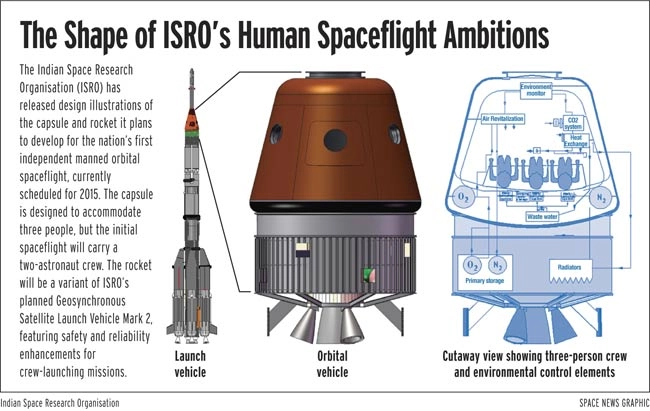
BANGALORE,India -The Indian Space Research Organisation (ISRO), with help from Russia,hopes to join the ranks of nations capable of independently launchingastronauts into space around 2015 and has revealed the designs for its firstorbiting crew capsule.
In itsmaiden manned mission, ISRO?s largelyautonomous 3-ton capsule will orbit the Earth at 248 miles (400 km) inaltitude for up to seven days with a two-person crew on board, ISRO chairman G.Madhavan Nair announced Jan. 3 at the Indian Science Congress held in Shillong.The capsule will be designed to carry three people, and a planned upgradedversion will be equipped with a rendezvous and docking capability, hesaid.
ISROspokesman S. Satish told Space News Jan. 10 that the program isestimated to cost about 100 billion rupees ($2 billion) over aneight-year period dating back to 2007. The manned mission was formallyproposed to the government in 2006.
Althoughfull-mission funding has yet to be approved, Satish said preliminary work hasalready begun using 950 million rupees ($19.4 million) allocated for the effortin ISRO?s 40.7 billion rupee ($834 million) budget for 2007-2008.
Thenecessary mission infrastructure includes a new launch pad at ISRO?s SatishDhawan Space Centre in Sriharikota, Satish said. Another key facility is anastronaut training center to be located in Bangalore.
As aprecursor to manned spaceflights, ISRO launched and recovered intact a 1,212-pound(550-kg) space capsule in January 2007, demonstrating its capability todevelop heat-resistant materials necessary for atmospheric re-entry. India alsolaunched a landmark moon probe, Chandrayaan-1, into lunar orbit last year.
But severalkey capabilities have yet to be developed, including a man-rated launcherfeaturing safety and reliability enhancements, life support systems, rescue andrecovery systems, a robotic manipulator, and new mission-management and controlsystems, Satish said.
Satish saidthe astronaut capsule would launch atop a modified version of ISRO?s GeosynchronousSatellite Launch Vehicle (GSLV) Mark 2, currently under development. TheGSLV Mark 2 features an indigenously developed cryogenic upper-stage engine;the Mark 1 variant currently in use has a Russian-supplied upper stage engine.The first test launch of the standard GSLV Mark 2 launcher is scheduled forthis year.
Satish saidISRO?s human spaceflight program will benefit from assistance provided by theRussian Federal Space Agency, Roskosmos. Thecooperative arrangement was sealed in an accord signed Dec. 5 by Nair andRoskosmos Director-General Anatoly Perminov during a state visit to Indiaby Russian President Dimitri Medvedev.
Under theaccord, an Indian cosmonaut will fly aboard a Russian Soyuz spacecraft in 2013ahead of ISRO?s planned 2015 mission, Satish said.
Roskosmoswill also help in crew selection and training and in construction of ISRO?sorbiter vehicle.
Russia andIndia have a long history of space-related collaboration. In 1984, RakeshSharma became the first Indian in space, flying to the then-Soviet Union?s Salyut-7space station aboard a Soyuz capsule.
Today onlyRussia, the United States and China are capable of independently launchingastronauts. China joined the exclusive club in 2003 using a capsule that wasdeveloped with Russian assistance.
- Video - Chandrayaan-1: India's First Moonshot
- India Slams Probe into the Moon
- Vote Now - The Best Manned Spacecraft