





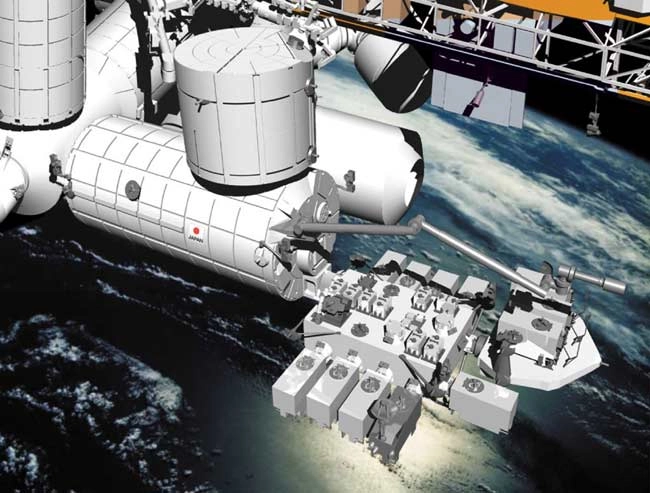
Pieces ofthe largest laboratory to launch towards the International Space Station (ISS)are coming together and Japancouldn’t be happier.
More thantwo-thirds of the Japan Aerospace Exploration Agency’s (JAXA) Kibo laboratory awaits NASA shuttle rides to the spacestation early next year at the U.S. agency’s Cape Canaveral, Florida spaceport. Altogether, engineers areporing over two JAXA pressurized modules and a robotic arm as theyawait next year’s delivery of external experiment platform to complete Kibo,also known as the station’s Japanese Experiment Module (JEM).
“JEM is thefirst Japanese human [spaceflight] facility,” Kichiro Imagawa, JAXA’s JEMdevelopment project manager, told SPACE.comin an interview. “I think it’s very important for Japan to develop them and launchthem successfully.”
JAXA hasspent about $3 billion developing Kibo, whose name means ‘Hope,’ Imagawa said.The laboratory’s total cost, however, is about twice that when including themodule’s planned orbital operations and ground mission control center in the SpaceStation Operations Facility at Tsukuba Space Center, which sits just north of Tokyo in Ibaraki Prefecture, Japan, he added.
The firstpiece of JAXA’s laboratory was slated to launch towards the ISS in December ofthis year, though NASA pushedthe flight to February 2007 following delays with its next shuttle mission,STS-117 aboard Atlantis.
“We at JAXAhave been waiting for JEM’s launch for more than 10 years, so two more monthsof delay is not a big problem,” Imagawa said.
AssemblingKibo
It will takesome three space shuttle flights and a series of spacewalks between 2008 and2009 to completely install Kibo at the ISS once NASA’s Harmonyconnector node and Europe’s Columbus laboratory are delivered later thisyear.
Thatorbital train begins with NASA’s STS-123 mission slated to haul the laboratory’spressurized experiment logistics module to orbit aboard Endeavour on Feb. 14next year.
“In thecoming year, we will work very hard in order to have a successful mission,”JAXA astronaut Takao Doi, who will serve as an STS-123 mission specialistduring the upcoming flight, said in a statement after his assignment to theflight earlier this year. “With Kibo being assembled in space, wein Japanwill be entering into an exciting new era of Japanese space development.”
Among the biggesthurdles for Kibo’s development was ensuring it was safe for human occupants,JAXA officials said.
“The humanfacility is very much directed by the safety issues,” Koki Oikawa, JAXA’s JEMdevelopment project function manager, told SPACE.com. “JAXA didn’t [originally] havethat kind of understanding for crew safety…I think that was one of the mostchallenging requirements.”
Piece by piece
The heartof JAXA’sKibo laboratory is its cylindrical Pressurized Module.
About thesize of a large tour bus, the module runs 36.7 feet (11.2 meters) long, 14.4feet (4.4 meters) wide and includes enough interior room for 23 racks -- 10 ofthem dedicated to orbital experiments -- according to a NASA description.
Kibo’s smallerpressurized storage pod, known as the Experiment Logistics Module, is the samewidth as its larger counterpart but only 12.8 feet (3.9 meters) long, enoughroom for about eight experiment racks. It is slated launch towards the ISS during theSTS-123 mission.
ThePressurized Module is due to follow during NASA’s STS-124 mission on April 24,2008 with Kibo’s 33-foot (10-meter) main robotic arm and will be followed by a smaller, 6.2-foot(1.9-meter) appendage.
JAXA’sexternal platform, the Exposed Facility, will round out the laboratory in 2009.At 13.1 feet (four meters) long and around 17 feet (or about five meters) wideand tall, the facility is large enough to hold 10 experiments at a time forspace materials and exposure tests.
Japaneseastronauts gear up
FollowingDoi to the ISS will be JAXA astronaut Akihiko Hoshide, who will help install the massive 35,000-pound(15,900-kilogram) Pressurized Module during NASA’s STS-124 mission.
VeteranJAXA astronaut Koichi Wakata will then become Japan’s first long-durationspaceflyer when he join’s the space station’s Expedition 18 crew in mid-2008,NASA has said. JAXA spaceflyer Soichi Noguchi, who flew aboard the Discoveryorbiter during NASA’s STS-114 mission in July 2005, is Wakata’s backup.
Theastronauts have been trainingalongside Russian cosmonaut and Expedition 18 flight engineer Salizhan Sharipov and other crewmembers for the upcoming spaceflight, which will be commanded byNASA spaceflyer Mike Fincke.
“It’s importantfor us to assembly our modules to ISS and have it done by our own astronauts,” Imagawasaid of Kibo’s construction. “It’s very important for the Japanese people. It’sa symbol, our JEM.”
- NASA Spaceport Welcomes Japanese Space Station Component
- SPACE.com Video Interplayer: ISS Ready for Orbital Expansion
- Complete Space Station Mission Coverage
