


Space canbe an unforgiving environment for elderly satellites, with temperatureextremes, tiny rocks and other hazards threatening to breach spacecraft hulls.
But futurespacecraft may be able to extend their mission lifetimes by borrowing a humantrait to heal minor nicks and scratches.
"Theanalogy is the human body," said Ian Bond, of England's University of Bristol, in an interview with SPACE.com. "Think about cutting yourself. There, capillary action will drawblood out to block the cut."
Bond andhis colleague developed a similar system, but replacing blood with resin andveins with tiny glass tubes, to fill in cracks or small holes in satellite"skin" as part of a European Space Agency (ESA) program to study technology forself-healing spacecraft. By closing small cracks or micrometeorite puncturesthemselves, satellites could stave off more serious structural problems theinitial damage may lead to, researchers said.
"We weresurprised at how well it worked," said Bond, a senior lecturer in of theyear-long study. "We're trying to develop an autonomous system...so you don'thave to initiate the healing process for a spacecraft."
Crackingdown on cracks
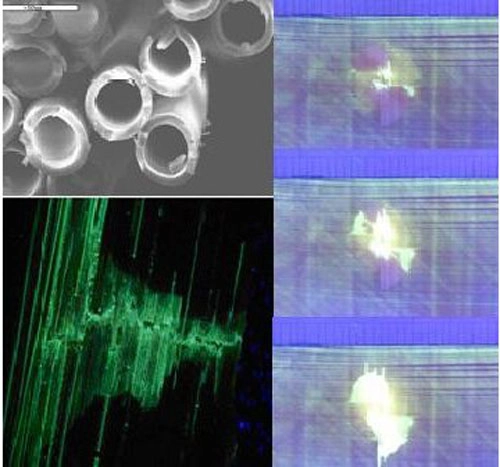
In theirexperiment, Bond and his colleagues packed a gooey, resinous adhesive and ahardening agent inside tiny, hollow tubes embedded in a composite materialcommonly used in spacecraft hardware.
"We havehollow fibers in structure which are then breached, and the resin bleeds outinto the damage," Bond said. "It's quite viscous."
The adhesiveresin flows through a 40-micron wide space inside the glass fibers, Bond said,adding that other fibers filled with hardening agent are intermixed among theirresin-full counterparts to cure and close a crack or hole. One micron isone-millionth of a meter. For comparison, a human hair is about 100 micronsthick.
The methodsuccessfully sealed breaches in material across a wide range of temperatures,from -148 degrees to 212 degrees Fahrenheit (-100 degrees to 100 degreesCelsius), in a vacuum chamber, Bond said. It also sealed cracks within about 90minutes, about the time it takes a spacecraft to complete one full orbit aroundthe Earth, he added.
"It'sreally useful for cracks of small holes, that sort of thing," Bond said. "Ifthere's like a big hole there, we wouldn't be able to repair it."
Fibersor microcapsules
Lining aspacecraft's skin with a wound-sealing resin is not the only way to ward offstress maintain hull integrity.
Researchersat the University of Illinois Urbana-Champaign are seeding composite materialswith tiny capsules of healing agent and hardening catalyst to test theirself-repairing properties.
"There arecertainly applications in microelectronics, as well as with materials thatsuffer from thermal or mechanical fatigue," said Scott White, who heads theAutonomic Healing Research project at the university. "One of the problems withcomposites is that, if there's internal damage, it's hard for us to see it."
Adhesive-ladenmicrocapsules or fibers could fill in microcracks or gaps between layers of acomposite material that separate over time due to age or delamination, headded.
White's labcan fabricate microcapsules ranging in diameters from 100 microns down to thesub-micron level.
Vascularmimicry
Bothmicrocapsules and hollow fibers suffer from a limited supply of healing agent.Once the microcapsules or resin fibers near a damage site are exhausted, thehealing process stops regardless of whether it's complete, the researcherssaid.
"What wehave now, it's a one-shot system," Bond said.
Both teamsare working to develop transport systems that would shift healing agentsthrough a material. The next step for the fiber-based method is the developmentof a pumping setup akin to the human body's vascular system that couldcirculate healing agent throughout a spacecraft to ensure a constant supply,Bond said.
Meanwhile,White and his colleagues - a group that includes Bond - are studying thepotential of building channels directly into a material, where microcapsulescould flow from a central reservoir.
"We're onthe first rung of the ladder," Bond said, adding that the system could one dayevolve beyond unmanned satellites to help astronauts safeguard their vesselsagainst small hull breaches. "For manned spacecraft...it could mitigate thingslike [extra] spacewalks."
- Air Force Satellite Shows Off Rendezvous Skills
- Fender Bender: NASA's DART Spacecraft Bumped Into Target Satellite
- Orbital Assistance: ConeXpress Spacecraft Could Extend Satellite
