You are now subscribed
Your newsletter sign-up was successful
Want to add more newsletters?
Delivered daily
Daily Newsletter
Breaking space news, the latest updates on rocket launches, skywatching events and more!
Once a month
Watch This Space
Sign up to our monthly entertainment newsletter to keep up with all our coverage of the latest sci-fi and space movies, tv shows, games and books.

Once a week
Night Sky This Week
Discover this week's must-see night sky events, moon phases, and stunning astrophotos. Sign up for our skywatching newsletter and explore the universe with us!

Twice a month
Strange New Words
Space.com's Sci-Fi Reader's Club. Read a sci-fi short story every month and join a virtual community of fellow science fiction fans!
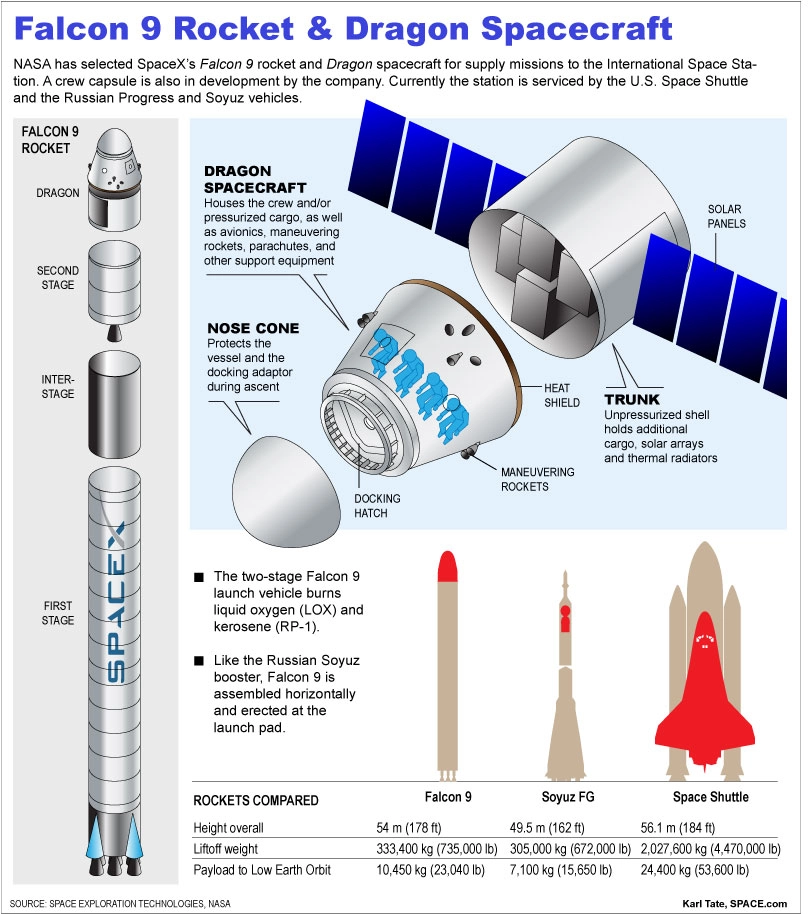
NASA's spaceshuttles are flying their final missions this year, but one commercialspaceflight company in California has a new, privately-built rocket standingready to replace the aging workhorse.
SpaceExploration Technologies? (SpaceX) new Falcon 9 rocket is already assembled inCape Canaveral, Fla. for a debut in the first half of 2010. A following flight,sometime between May and November, would launch the cargo-carrying Dragonspacecraft to resupply the International Space Station.
Dragon couldalso eventually loft NASA astronauts into space by as early as 2014. Just don'tcall it a taxi service, said Gwynne Shotwell, president of SpaceX. The company,founded by PayPal entrepreneur Elon Musk, has already launched satellites toorbit on its smaller, unmanned Falcon 1 rockets.
"Elonstarted this company with the hopes of making space more accessible forprofessional crews ? not necessarily joy-riders or tourists ? and really tofacilitate the manned exploration of space," Shotwell told SPACE.com.
NASA'sproposed 2011 budget request would scrap its new spacecraft plans and, instead,set aside about $6 billion over the next five years to support commercialspaceflight. That marks a major shift toward using private companies suchas SpaceX to launch both cargo and humans into low Earth orbit.
A fifthcommercial launch in July 2009 marked two clean launches in a row, or whatShotwell deemed a "critical milestone" for the company. She addedthat the people at SpaceX remain "stubborn" and "tenacious"even as they acknowledge the challenges that lay ahead.
"Historyshows that the first two flights of any vehicle is a struggle," Shotwellsaid. "We're certainly not rushing to the flight line."
But all thecomputer simulations and firing tests on the ground can only go so far,Shotwell explained. Only launch day will show just how well a rocket's guidanceand control perform under actual flight conditions.
"We'renot talking about putting crew on the first Falcon 9 flight," Shotwellsaid. She added that the idea of commercial spaceflight being inherentlydangerous was "ludicrous," and pointed to commercial airlines asexamples of reliable private enterprises.
Anindependent advisory panel also issued a January report that said privatecompanies do not meet NASA's crew-rating standards.
Elon Musk,founder and CEO of SpaceX, countered by calling the Aerospace Safety AdvisoryPanel's findings"bizarre." He and Shotwell questioned how the panel came to itsconclusion after barely spending any time reviewing SpaceX's vehicles or data.
"Commercialcompanies rely on the quality of their products and services to stay inbusiness, and quality for ISS missions clearly means safety andreliability," Shotwell noted. "We stay alive based on our trackrecord."
NASA has notyet officially established safety standards to rate commercial vehicles thatwould carry astronauts into space, but it has shared some of its existingguidelines, NASA officials have said. SpaceX has adopted temporary guidelinesbased on those existing crew ratings in anticipation of the U.S. space agency'sdesires.
"Wedon't anticipate that they'll make it any easier on us, and we don't want to betreated in a special way," Shotwell said. "We're designing the safestvehicle that we possibly can."
Fiveastronauts have already undergone preliminary training with SpaceX's Dragonspacecraft, so that they know how to receive the unmanned Dragon during dockingoperations with the space station. But SpaceX has also prepared for the daywhen astronauts themselves will ride Dragon into space.
"We'reconfident of being able to do it at $20 million per seat," Musk said. Bycontrast, a ride into orbit aboard the Russian Soyuz costs NASA approximately$51 million per person.
NASA's newbudget also includes extending the space station's life until 2020 ? a prospectwelcomed by SpaceX.
"Itcertainly provides a longer-lasting market for resupply activities,"Shotwell said. "On the other hand, I think that we've invested anincredible amount of money in the ISS, and we've forged important politicalrelationships in that process."
"For a$278 million investment on NASA's side, they're getting access to a brand newrocket and a Dragon spacecraft that can shuttle cargo," Shotwell said."I can't imagine a better value for the dollar."
- SPACE.com Video Show - NewSpace: The Orbital Industrial Revolution
- NASA Awards $50 Million to Commercial Spaceship Builders
- Video ? SpaceX's Vision for Manned Dragon Spaceship
