





In photos: NASA's Mars Perseverance rover mission to the Red Planet
NASA's Mars 2020 mission, including the Perseverance rover and the Ingenuity Mars Helicopter, launched to space on July 30, 2020 from Cape Canaveral, Florida. After traveling nearly 300 million miles, Perseverance landed inside Mars' 28-mile-wide (45 kilometers) Jezero Crater on Feb. 18, 2021. It will spend roughly the next two years searching for signs of past microbial life and possible habitable environments, while also collecting samples that can be returned to Earth by a future mission campaign.
See images of NASA's Perseverance Mars rover mission, including the spacecraft's components, assembly, and historic landing sequence, in this Space.com gallery.
NASA's Mars 2020 Perseverance rover mission: Live updates

Perseverance on Mars
NASA's Perseverance Mars rover landed inside Mars' Jezero Crater on Feb. 18, 2021, shortly before 4 p.m. EST (2100 GMT). The 28-mile-wide (45 kilometers) Jezero Crater lies about 19 degrees north of the Red Planet's equator. The rover will study the crater's geology, hunt for subsurface water ice, and test out its scientific instruments.

Mars 2020 mission launch
The Mars 2020 mission successfully launched toward the Red Planet on July 30, 2020, at 7:50 a.m. EDT (1150 GMT), riding an Atlas V rocket into space from Cape Canaveral Air Force Station in Florida. The rocket launched from Space Launch Complex-41, carrying NASA's next Mars rover, named Perseverance.
Shortly after liftoff, Perseverance experienced minor communications and temperature glitches that left the spacecraft in a protective "safe mode" for a brief period of time. The unexpected temperature difference occurred when the spacecraft zoomed through Earth's shadow. However, this did not harm the mission, as the spacecraft was taken out of "safe mode" and returned to normal operations the next day (July 31, 2020).

Epic sky crane descent
Cameras on Perseverance's sky crane descent stage captured this stunning aerial view of the rover being lowered to the surface of the Red Planet. In this photo, Perseverance is shown dangling about 6.5 feet (2 meters) above the ground inside Jezero Crater. Perseverance's landing on Mars was documented in greater detail than any other previous mission. Since its successful landing on Feb. 18, NASA has released high-definition photos, video and audio captured by multiple cameras during Perseverance's entry, descent and landing (EDL).

HiRISE spots Perverance's descent
The High Resolution Imaging Experiment (HiRISE) camera aboard the Mars Reconnaissance Orbiter captured this view of NASA's Perseverance rover falling through the Martian atmosphere with its parachute trailing behind during the rover's historic landing on Feb. 18.
The Mars 2020 spacecraft deployed its supersonic parachute about four minutes after entering the Martian atmosphere. HiRISE captured this photo approximately 435 miles (700 kilometers) from Perseverance, at which time the orbiter was traveling at about 6750 mile per hour (3 kilometers per second).

First color view of Mars
Perseverance sent back the first images of its new home in Jezero Crater just minutes after landing on Mars. Perseverance is equipped with six Hazard Detection Cameras, called HazCams, located on the front and rear of the rover. The rover's HazCams captured this high-resolution, color image on Feb. 18, showing the rocky surface of Mars and the rover's own shadow cast on the Martian surface. As Perseverance continues to explore Jezero Crater, the HazCams will help the rover navigate the hazardous Martian terrain by detecting large rocks, trenches or sand dunes in its path.

JPL waiting for confirmation
The entry, descent and landing (EDL) phase of Perseverance's mission was referred to as "seven minutes of terror" because the sequence happens faster than radio signals can reach Earth from Mars. This photo captures members of NASA's Perseverance Mars rover team anxiously awaiting confirmation that the rover landed on the Red Planet safely. The photo was taken inside mission control at NASA's Jet Propulsion Laboratory (JPL) in Pasadena, California. The team is reflected in a monitor, which showed real-time data of Perseverance's position and configuration, including altitude, velocity, speed, acceleration and fuel.

JPL goes wild!
Mission control burst with excitement after receiving confirmation that Perseverance landed safely on Mars. Members of NASA's Mars 2020 Perseverance rover mission cheered and congratulated each other for a successful landing on Feb. 18 in Mission Control at NASA's Jet Propulsion Laboratory (JPL) in Southern California.

Fist bump!
Members of the Attitude Control team for NASA’s Mars 2020 Perseverance rover mission give each other an enthusiastic fist bump to celebrate the rover's successful landing in Jezero Crater. Celebrating Perseverance's historic landing looked a little different inside mission control this year, as team members followed COVID-19 precautions by wearing face masks and having clear plastic dividers between stations.
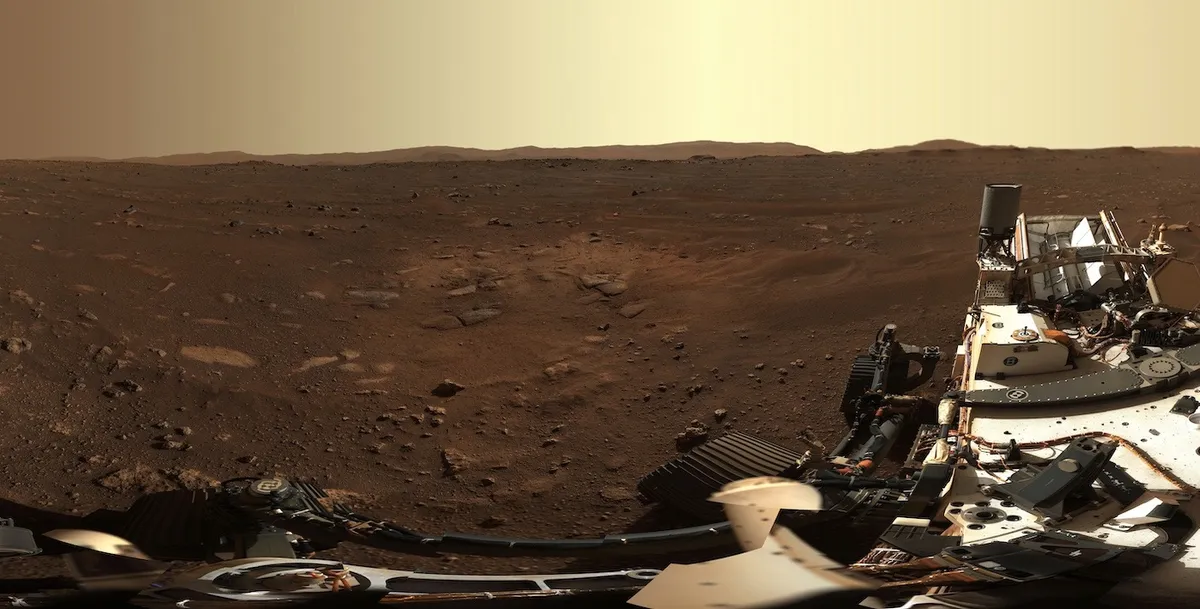
Percy's 1st panorama
NASA's Perseverance rover captured its first panoramic image of the Martian surface on Feb. 20, just two days after landing in Jezero Crater. (See the full version here.)
The panorama was created using six individual images taken by the rover's onboard Navigation Cameras (or Navcams). The panorama shows a wide field view of the rocky red terrain inside the ancient lake bed, where Perseverance will search for signs of past microbial life.

Panorama view of Perseverance's deck
NASA's Perseverance Mars rover is equipped with two color stereo Navigation Cameras (Navcams), which are located up high on the rover's mast. The Navcams captured this panoramic view of the rover's deck on Feb. 20, showing the Planetary Instrument for X-ray Lithochemistry (PIXL) instrument, which is on the rover's stowed arm. The PIXL instrument is used to rapidly examine the chemical makeup of Martian rocks by focusing an X-ray beam.

Mastcam-Z calibration
Perseverance’s Mastcam-Z photographed its calibration target for the first time on Feb. 20. Mastcam-Z consists of a pair of cameras mounted on the rover’s mast, which take color images and video, three-dimensional stereo images and have a powerful zoom lens. This natural-color composite image shows the Mastcam-Z primary-color and grayscale calibration targets, which the cameras use to calibrate images of the Martian terrain to adjust for changes in brightness and dust in the atmosphere.

HiRISE snaps first photo of Percy on the surface
The High Resolution Imaging Experiment (HiRISE) camera aboard the Mars Reconnaissance Orbiter captured the first image of NASA’s Perseverance Rover on the surface of the Red Planet. Taken on Feb. 19, this aerial view shows where the many parts of the Mars 2020 spacecraft landed after separating from Perseverance during entry, descent and landing. The parachute, back shell and descent stage are seen to the left of the rover, while the heat shield landed off to the right. Each component of the Mars 2020 spacecraft served a vital function in landing the rover safely on Mars.

Perseverance up close
This closeup view of Perseverance shows the rover poised on its landing target in Jezero Crater. Perseverance sits at the center of a blast pattern created by the descent stage rockets that lowered the rover to the ground along with the sky crane tethers. This photo is a zoomed in version of a larger aerial photo captured by the High Resolution Imaging Experiment (HiRISE) camera aboard the Mars Reconnaissance Orbiter, which showed where different parts of the Mars 2020 spacecraft landed after separating from Perseverance.

Closeup of Perseverance's parachute
Perseverance deployed a supersonic parachute from its aeroshell about four minutes after entering the Martian atmosphere. The parachute helped slow the rover down during its descent to the surface before it separated from the spacecraft. This image, captured on Feb. 19 by the High Resolution Imaging Experiment (HiRISE) camera aboard the Mars Reconnaissance Orbiter, shows where the parachute landed on the Red Planet's surface. This photo is actually a zoomed in version of a larger aerial photo captured by HiRISE showing where the different parts of the Mars 2020 spacecraft landed.

Hidden message
Perseverance’s parachute, which helped the rover land safely on Mars, contained a hidden message written in binary computer code. The rover was equipped with cameras that recorded its entry, descent and landing, including when the parachute unfurled above the rover. Images of the parachute revealed red and white patterns that spell out “Dare Mighty Things,” which is a motto used by the Perseverance team at NASA's Jet Propulsion Laboratory (JPL) in Pasadena, California. The pattern of colors in the parachute’s outer ring also translates to the geographic coordinates for JPL: 34°11'58" N 118°10'31" W. Adam Steltzner, Perseverance’s chief engineer, confirmed the message on Twitter.

HiRISE closeup of the descent stage
Perseverance's descent stage had eight throttleable retrorockets, or Mars landing engines, which helped slow the spacecraft in preparation for touchdown on the surface of Mars. Once the rover made contact with the ground, the descent stage detached and flew off to crash-land safely away from Perseverance. This image, taken on Feb. 19 by the High Resolution Imaging Experiment (HiRISE) camera aboard the Mars Reconnaissance Orbiter, captures an up-close view of the descent stage's final landing spot.

Where Perseverance's heat shield landed
During entry and descent through the Martian atmosphere, Perseverance was protected by a heat shield, which endured peak heating of 2,370 degrees Fahrenheit (about 1,300 degrees Celsius). Soon after Perseverance deployed its parachute, the heat shield separated and dropped away from the spacecraft, exposing the rover to Mars' atmosphere for the first time. This image, taken on Feb. 19 by the High Resolution Imaging Experiment (HiRISE) camera aboard the Mars Reconnaissance Orbiter, captures an up-close view of the heat shield's final landing spot, safely away from the Perseverance rover.

Perseverance's wheel
One of Perseverance's Hazard Detection Cameras (HazCams) snapped an up-close view of one of the rover's aluminum wheels. The rover has six wheels, each with its own individual motor. The six HazCams are located on the front and rear of the rover. This HazCam photo captures a detailed view of the rocky Martian soil beneath the rover's wheel.

A presidential congratulations
Acting NASA Administrator Steve Jurczyk received a call from US President Joe Biden following Perseverance’s successful landing on Mars on Feb. 18. President Biden called Jurczyk about an hour after the rover touched down in Jezero Crater. Not only did the president congratulate Jurczky and the Mars 2020 mission team, he also sent his regards to the mighty Mars rover. Vice President Kamala Harris also congratulated NASA and the Perseverance rover team in a message on Twitter.

Empire State Building glows red
In celebration of the Mars 2020 mission, the Empire State Building in New York City beamed bright red lights beginning at sunset on Feb. 16 through the early morning of Feb. 17. The bright red glow honored the Perseverance rover and its long awaited landing on the Red Planet.

RIP, contingency plan
Following Perseverance's successful Mars landing, Thomas Zurbuchen — associate administrator of NASA's science mission directorate — tore apart the contingency plan for the Mars 2020 mission during a post-landing update on Feb. 18 at NASA's Jet Propulsion Laboratory in Pasadena, California.

Mars doughnut
Krispy Kreme celebrated Perseverance’s landing with a special doughnut designed to look just like the Red Planet. The doughnut was filled with chocolate creme, dipped in caramel icing with a red swirl and had chocolate cookie crumbs on top to mimic the rocky terrain of Mars.The doughnut was available only on Feb. 18. Krispy Kreme gave away free Mars doughnuts to people who sent their names on the Perseverance rover and showed their NASA-issued Mars 2020 Perseverance boarding pass. This Mars doughnut was photographed in New York City .

Mars marbles
Members of the Perseverance mission team used marbles to countdown the days before the rover landed on Mars. Beginning when the rover launched to space on July 30, 2020, the team moved one marble a day from the jar with an Earth sticker to a jar with a Mars sticker. Perseverance flight director Magdy Bareh moved the final marble from the Earth launch jar to the Mars landing jar on Feb. 18 at NASA's Jet Propulsion Laboratory in Pasadena, California.

Mars landing sites
This map of Mars shows the location of the Jezero Crater, as well as the locations of where NASA's other successful Mars missions landed. Jezero Crater is believed to have contained a lake and a river delta in the ancient past. Thus, the rover will begin its mission on Mars searching the area for signs of long-dead life.

Jezero Crater
NASA's Mars Reconnaissance Orbiter (MRO) captured this view of the Jezero Crater, the landing site for the Perseverance Mars rover. This Martian crater offers an optimal landing site, as it has geologically rich terrain dating as far back as 3.6 billion years old.
"On ancient Mars, water carved channels and transported sediments to form fans and deltas within lake basins," NASA officials said in a statement. "Examination of spectral data acquired from orbit show that some of these sediments have minerals that indicate chemical alteration by water. Here in Jezero Crater delta, sediments contain clays and carbonates."
The rover aims to collect samples from the area to be brought back to Earth during a future mission. In turn, these samples could help answer important questions in planetary evolution and Mars' ability to harbor life.

Perseverance's path
This image captures one of the possible routes charted for Perseverance. This path takes the rover across Jezero Crater as it investigates various ancient environments that may have once been habitable. In this photo — taken by Mars Reconnaissance Orbiter — the rover's route begins at the cliffs defining the base of a delta, where a river once flowed into a lake that filled the crater billions of years ago.
The rover will then travel up and across the delta toward possible ancient shoreline deposits, before climbing to the top of the crater rim, which rises 2,000 feet (610 meters) high. Perseverance will then explore the plains surrounding the crater rim. The rover's mission will last approximately one Mars year, or about 687 Earth days.
During its time on the Red Planet, Perseverance will hunt for signs of ancient Mars life, while also collecting at least 20 samples of Martian rock and soil for future return to Earth. The Mars 2020 mission marks humanity's first interplanetary sample-return campaign.

Step-by-step landing guide
This illustration captures a step-by-step view of the seven-minute entry, descent and landing (EDL) plan for NASA's Mars 2020 spacecraft. The sequence begins when the Mars 2020 spacecraft reaches the top of the Martian atmosphere and ends with the Perseverance rover stationary on the Martian surface, ready to start its roughly two-year mission exploring Jezero Crater.

Perseverance's science instruments
NASA's Perseverance Mars rover is equipped with seven science and exploration instruments. This includes two cameras — Mastcam-Z and SuperCam — located at the head of the rover, giving the cameras a wide field of view. The rover also has two additional imaging instruments to study the composition and mineralogy of Martian surface materials: the Planetary Instrument for X-ray Lithochemistry (PIXL) and the Scanning Habitable Environments with Raman & Luminescence for Organics and Chemicals (SHERLOC).
The Perseverance rover also has an instrument called the Mars Oxygen ISRU Experiment (MOXIE). Located on the front right side of the rover, MOXIE will produce oxygen from Martian atmospheric carbon dioxide. Thus, this exploration technology will help determine the feasibility of future oxygen generators to support human missions on Mars.
In addition, the rover is outfitted with a set of five sensors — called the Mars Environmental Dynamics Analyzer (MEDA) — that will measure the weather and dust in the atmosphere on Mars, as well as a ground-penetrating radar, called the Radar Imager for Mars' Subsurface Experiment (RIMFAX), which will study geologic features under the Martian surface.

Detecting Martian rock chemistry
The Planetary Instrument for X-ray Lithochemistry (PIXL) is an X-ray fluorescence spectrometer and high-resolution imager that can determine the composition of Martian surface materials as small as a grain of sand. Located on the rover's robotic arm, PIXL will use a focused X-ray beam that causes the rocks to glow. In turn, the glow produced will vary according to the rock's elemental chemistry.

Dynamic duo: SHERLOC and WATSON
The Scanning Habitable Environments with Raman & Luminescence for Organics and Chemicals (SHERLOC) will use an ultraviolet laser to identify mineralogy and detect organic compounds on the surface of the Red Planet. Located on the end of the rover's robotic arm, SHERLOC features an auto-focusing camera called WATSON (Wide Angle Topographic Sensor for Operations and eNgineering).
Using the images captured by WATSON, SHERLOC's ultraviolet laser is able to focus on the center of rock surfaces and detect microscopic minerals. This data will help the rover determine which rocks to drill and collect samples of to be returned to Earth with a future mission.

Perseverance's cameras
This is a close-up view of the head of NASA's Perseverance Mars rover remote sensing mast. The mast head contains two cameras, known as Mastcam-Z and SuperCam. The Mastcam-Z is an advanced camera system with panoramic and stereoscopic imaging capability and the ability to zoom. In addition to imaging, the SuperCam will be able to detect the presence of organic compounds in rocks and regolith from a distance.
The SuperCam instrument is the large lens on the front of the mast head, while the two Mastcam-Z imagers are housed in the gray boxes beneath mast head. The rover also has two navigation cameras on the exterior sides of the two Mastcam-Z imagers.

Protecting Perseverance
Built by Lockheed Martin, the Perseverance rover's heat shield and cone-shaped back shell will protect the spacecraft during its passage to the Red Planet. As the spacecraft descends through the Martian atmosphere, it will experience extreme amounts of friction. The heat shield will protect the spacecraft from the high temperatures created by this friction.
In addition, the back shell contains several elements critical to landing the rover, including the parachute and antennas for communication. In this image, the back shell sits on a support structure. A portion of the descent stage and rover can also be seen directly below the lower edge of the back shell.

Parachute for Perseverance
Perseverance is equipped with a supersonic parachute that measures 70.5 feet (21.5 meters) in diameter. The rover's parachute is imperative for ensuring the spacecraft lands safely on the Red Planet. It is similar to the parachute successfully flown by NASA's Mars Curiosity rover in 2012, but designed to be a little stronger, given Perseverance is heavier than Curiosity.
In this photo from June 2017, the parachute was tested in a wind tunnel at NASA's Ames Research Center in California's Silicon Valley. During this test, engineers verified the parachute would hold up under the strain of slowing the fast-moving spacecraft down in the Martian atmosphere. Subsequent tests of the parachute and its deployment mortar were conducted throughout 2018 and 2019. On March 26, 2020, technicians finished installing the rover's parachute system.

The Mars helicopter
On April 6, the Mars Helicopter, also known as Ingenuity, and its delivery system were attached to the belly of NASA's Perseverance rover at Kennedy Space Center in Florida.
The Mars Helicopter is a small robotic helicopter that is designed to scout targets on Mars and help plan the best driving route for Mars rovers. The helicopter will be deployed to the Martian surface about two-and-a-half months after Perseverance lands, and will test powered flight on another world for the first time.

Ensuring safe travels for Ingenuity
The Mars helicopter Ingenuity stands 19 inches (0.5 m) tall and weighs just 4 lbs.pounds (1.8 kg). It is equipped with two sets of rotor blades that span some 4 feet (1.2 m) each.
The small drone helicopter must safely detach from the Perseverance rover to start its mission. A shield will cover the helicopter and its delivery system to protect it during landing. After the rover touches down on the Red Planet, the shield will fall away and a latch will release the helicopter from the belly of the rover, initiating a sequence of events to bring the helicopter down to the Martian surface. Engineers at NASA's Jet Propulsion Laboratory and Lockheed Martin Space tested the helicopters delivery system.

Perseverance nameplate
A titanium nameplate was installed on the rover's robotic arm. The titanium plate will help protect power and data cables that extend from the rover's body to actuators in its robotic arm and other instruments. The plate will shield rock and debris from impacting the cables as Perseverance moves around the Red Planet.
Measuring 17 inches long by 3.25 inches wide (43 cm long by 8.26 cm wide), and weighing 104 grams (3.7 ounces), the name plate is made of titanium and coated with black thermal paint. The plate was cut using a water jet and engraved with the rover's name using a computer-guided laser.

Tribute to healthcare workers
A commemorative plate was also installed on the left side of the rover chassis. The plate pays tribute to the impact of the COVID-19 pandemic and the perseverance of healthcare workers around the world.
Measuring 3-by-5-inches (8-by-13-centimeters), the plate is made of aluminum and was attached to the rover in May 2020 during final assembly at Kennedy Space Center in Florida.

JPL signatures
To commemorate the Mars 2020 mission, members of the Perseverance Mars rover team signed a gold serving tray at NASA's Jet Propulsion Laboratory in Pasadena, California. The team members signed the tray on Feb. 18, following Perservance’s successful landing on the Red Planet.

First driving test
The Perseverance rover took its first test drive on Dec. 17, 2019, at NASA's Jet Propulsion Laboratory (JPL). During the test, the rover successfully rolled forward and backward, and turned around in a circle for the very first time. The short-distance drive test took place in a clean room at JPL, where the rover was built. NASA engineers tested the rover's driving capabilities for more than ten hours, according to the space agency.
The rover has six wheels that are designed for added durability. During the drive test, the rover conquered small inclines. The next drive the Mars 2020 will take will be on the rugged Martian surface.

Preparing launch configuration
NASA engineers working on Perseverance began placing the rover and its components into configuration for launch in April 2020. This process started with the integration of the rover and its rocket-powered descent stage, according to a statement from NASA.
On April 29, the rover and descent stage were attached to the cone-shaped back shell, captured in the picture above. The assembly took place inside the Payload Hazardous Servicing Facility at NASA's Kennedy Space Center in Florida. The back shell contains the parachute and, along with the mission's heat shield, provides protection for the rover and descent stage as the spacecraft descends through the Martian atmosphere.

Rover assembly
The rover's disk-shaped cruise stage sits atop the cone-shaped back shell. The brass-colored heat shield below is about to be attached to the back shell in this image taken on May 28, at Kennedy Space Center in Florida.
During the rover's descent to the Martian surface, the back shell and cruise stage will separate at about 6 miles (9 kilometers) above Mars' Jezero Crater.

Arrival of Atlas V rocket
The first stage of the Atlas V rocket arrived at Kennedy Space Center in Florida on May 11. It travelled to the space center on an Antonov cargo plane. NASA's Perseverance Mars rover flew on top of the United Launch Alliance Atlas V rocket when it launched to the Red Planet on July 30, 2020.

Move to launch pad
The United Launch Alliance Atlas V booster for NASA's Mars Perseverance rover was moved to the Vertical Integration Facility at Launch Complex 41 at Cape Canaveral Air Force Station in Florida on May 28, 2020. The mission launched from this location on July 30, 2020.

Perseverance encapsulation
On June 18, 2020, the Perseverance Mars rover was prepared for encapsulation in the United Launch Alliance Atlas V payload fairing, or nose cone.
The two halves of the cone are seen on each side of Perseverance. The spacecraft was encased prior to being placed atop the Atlas V rocket. The nose cone will protect the spacecraft during launch.
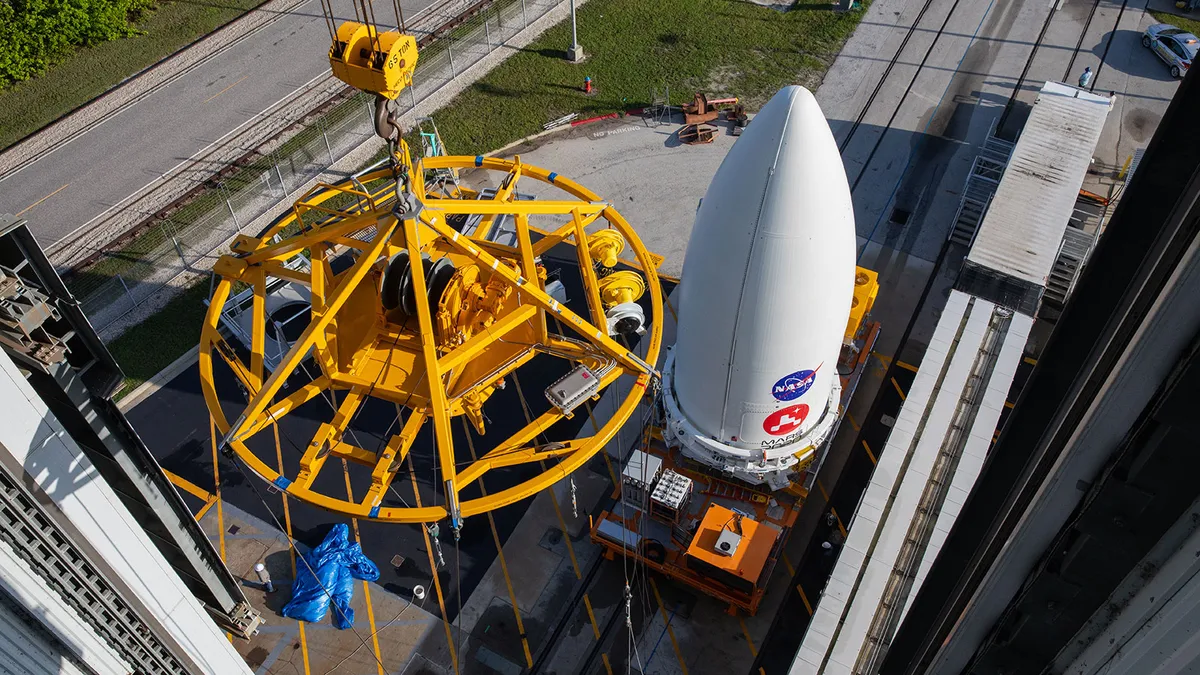
Mated to its rocket
The payload fairing containing the Perseverance rover was raised atop the launch vehicle on July 7. This photo was taken inside the Vertical Integration Facility at Cape Canaveral Air Force Station's Space Launch Complex 41 in Florida.
"I have seen my fair share of spacecraft being lifted onto rockets," John McNamee, project manager for the Mars 2020 Perseverance rover mission at NASA's Jet Propulsion Laboratory, said in a statement. "But this one is special because there are so many people who contributed to this moment. To each one of them I want to say, we got here together, and we'll make it to Mars the same way."

Mars 2020 Perseverance in flight
The Mars 2020 Perseverance mission landed inside the 28-mile-wide (45 kilometers) Jezero Crater on Feb. 18, 2021. This artist's illustration captures the spacecraft cruising through space on its nearly 300-million-mile voyage. A NASA interactive web application called Eyes on the Solar System allowed people to follow the mission in real time as it traveled to the Red Planet.
Eyes on the Solar System showed you Perseverance's location as it traveled millions of miles through deep space. The application uses the same trajectory data that the navigation team used to plot Perseverance's course to Mars, allowing users to visualize the spacecraft's journey. Leading up to the rover's landing, users could track the distance remaining until Perseverance reached Mars and view the spacecraft up close. You can still use Eyes of the Solar System to learn about the different celestial bodies and spacecraft in our cosmic neighborhood.

Mars 2020 spacecraft components
The Mars 2020 spacecraft has five major components, including the top ring-shaped cruise stage, backshell, descent stage, Perseverance rover and heat shield. Each of the various components perform a critical function throughout the spacecraft's mission.
The cruise stage provides power, telecommunications, navigation and propulsion for the roughly six-and-a-half month journey to Mars. The backshell houses the descent stage and rover, while the heat shield protects the vehicle from burning up in the extreme heat generated during the initial descent through the planet's atmosphere. Together, the backshell and the heat shield form a capsule known as the aeroshell.

Mars 2020 flight director
On Sept. 30, 2020, NASA completed the second trajectory correction maneuver (TCM-2) for the Mars 2020 mission. Matt Smith, flight director for TCM-2, is photographed donning a mask as he studies the screens at NASA's Jet Propulsion Laboratory in Southern California. TCMs are a series of planned adjustments to put the rover on the correct path to land on Mars. The agency has planned a total of five trajectory correction maneuvers for the Mars 2020 mission.

Correcting Perseverance's trajectory
The Mars 2020 navigation team celebrated Perseverance's second trajectory correction maneuver in the Mission Support Area at NASA's Jet Propulsion Laboratory in Southern California.
During this type of maneuver, engineers adjust the vehicle's path by firing eight thrusters on the cruise stage for a specific amount of time. Fine-tuning the spacecraft's flight path helps ensure that it will enter the Martian atmosphere and land inside Jezero crater as planned.

Aeroshell separation
As the spacecraft cruises toward the Red Planet, the Perseverance rover and its descent stage are protected inside a capsule known as an aeroshell, which is attached to the ring-shaped cruise stage. Measuring nearly 15 feet (4.5 meters) in diameter, the aeroshell consists of two parts: the backshell and the heat shield, which protects the spacecraft during entry, descent and landing (EDL). The aeroshell separated from the cruise stage about 10 minutes before Mars 2020 entered Mars' atmosphere. Then, the aeroshell traveled to the Martian surface on its own.

Entering the Martian atmosphere
The entry, descent and landing (EDL) phase began when Perseverance reached the top of the Martian atmosphere, at which point it was travelling nearly 12,100 mph (19,500 kph). About 90 seconds after atmospheric entry, peak deceleration occurred, as the spacecraft slowed to under 1,000 mph (1,600 kph).
The atmospheric drag helped to slow the spacecraft during its descent. The aeroshell also fired small thrusters on the backshell to reorient itself and make sure the heat shield was facing the Red Planet as it plunged into the atmosphere. This helped ensure the spacecraft was protected as it endured peak temperatures of 2,370 degrees Fahrenheit (1,300 degrees Celsius) upon entering the Martian atmosphere.
Perseverance is also equipped with a microphone that recorded the sounds of its entry, descent and landing — a sequence sometimes referred to as "seven minutes of terror." The Mars 2020 team tested the mic in flight on Oct. 19, 2020 to ensure it was functioning properly. In the process, the team captured a whirring sound made by the rover's thermal system, confirming the microphone is working well.
After the rover successfully landed in Jezero Crater on Feb. 18, its microphone recorded sounds from the surface of Mars, representing the first audio ever recorded on the surface of another planet.

Perseverance's parachute
It took approximately seven minutes for the entry, descent and landing (EDL) phase to be complete. About four minutes after entering the Martian atmosphere, the spacecraft deployed a supersonic parachute from its aeroshell. The parachute measures 70.5 feet (21.5 m) in diameter and was deployed at an altitude of about 7 miles (11 km) and a velocity of about 940 mph (1,512 km/h). The parachute helped slow the vehicle to about 200 mph (320 km/h).
The Mars 2020 spacecraft was also equipped with a new parachute deployment technology called Range Trigger. This technology helped the spacecraft narrow in on its target landing area by autonomously adjusting the timing of the parachute deployment based on the spacecraft's position and distance from its landing target.
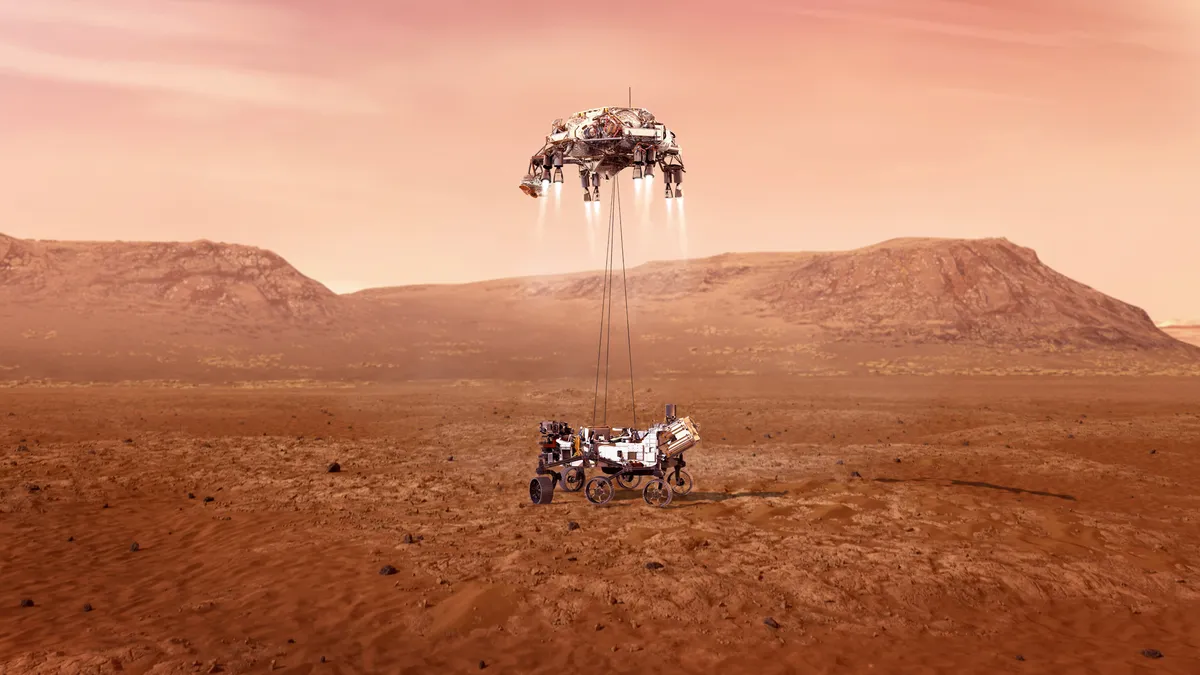
Sky crane landing
Perseverance's descent stage was equipped with eight throttleable retrorockets, or Mars landing engines, which helped slow the spacecraft in preparation for touchdown. The descent stage fired up its engines during the final minute before Perseverance landed on the Red Planet to help guide the spacecraft to its landing target.
A sky crane then lowered the rover safely to the surface using three nylon cables that extended 25 feet (7.6 m) below the descent stage. Meanwhile, the rover stretched its legs and brought its wheels into landing position. Once the rover sensed its wheels touched the ground, it cut the cables and the descent stage flew away and crash-landed safely away from Perseverance.
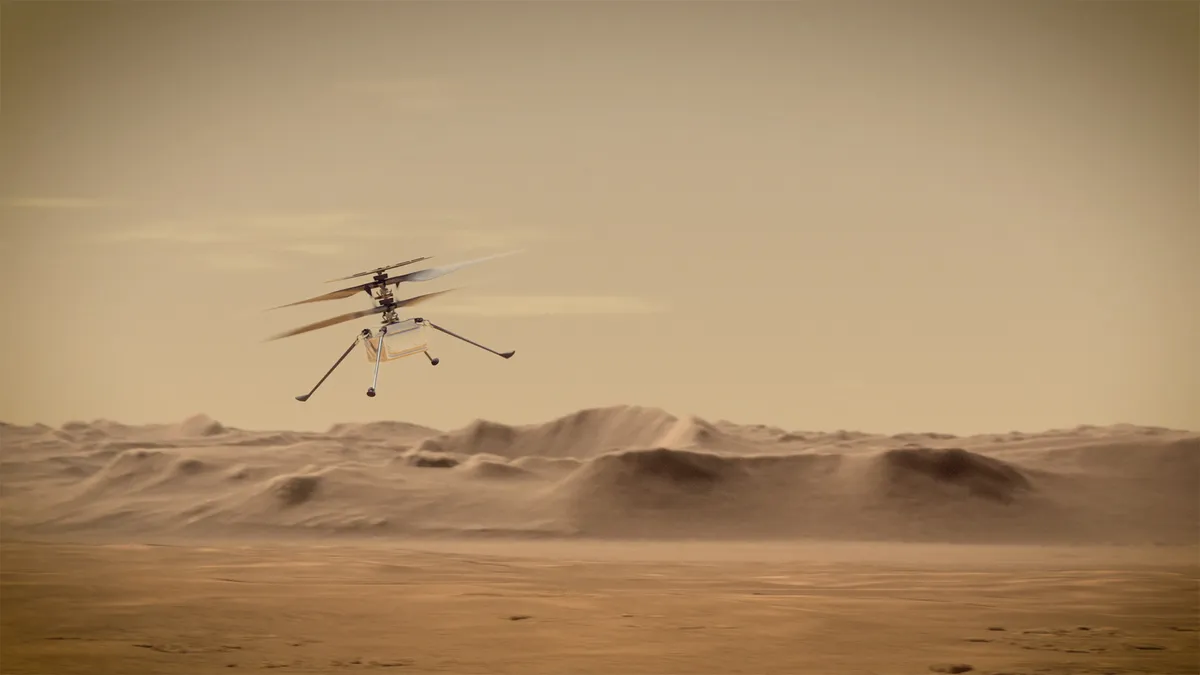
Ingenuity Mars helicopter
Perseverance launched to the Red Planet with a travel companion named Ingenuity. The Ingenuity Mars Helicopter is the first robotic helicopter designed to fly on another planet. Weighing 4-lb. (1.8 kilograms), Ingenuity was stowed beneath Perseverance's belly during its journey to Mars.
Controllers at NASA's Jet Propulsion Laboratory (JPL) received a downlink on Friday (Feb. 19) at 6:30 p.m. EST (2330 GMT) through the Mars Reconnaissance Orbiter, indicating the 4-lb. (2 kilograms) helicopter and its base station are both operating normally. The team then powered up Ingenuity on Feb. 20 to begin charging the helicopter's six lithium-ion "rotorcraft" batteries. NASA will continue to do weekly charging sessions to keep Ingenuity warm on the cold Martian surface and prepare the helicopter for its pioneering flight in a few months. If all goes according to plan, Ingenuity will prove that robotic flight is possible in the skies of another planet.
View Original

View Original

View Original

View Original

View Original

View Original

View Original

View Original

View Original

View Original

View Original

View Original

View Original
View Original
View Original

View Original
View Original
View Original

View Original

View Original

View Original

View Original

View Original

View Original

View Original

View Original

View Original

View Original

View Original

View Original

View Original

View Original

View Original

View Original

View Original

View Original

View Original

View Original

View Original

View Original

View Original

View Original

View Original

View Original

View Original

View Original

View Original

View Original

View Original

View Original

View Original

View Original

View Original

View Original

Follow Samantha Mathewson @Sam_Ashley13. Follow us on Twitter @Spacedotcom and on Facebook.

Samantha Mathewson joined Space.com as an intern in the summer of 2016. She received a B.A. in Journalism and Environmental Science at the University of New Haven, in Connecticut. Previously, her work has been published in Nature World News. When not writing or reading about science, Samantha enjoys traveling to new places and taking photos! You can follow her on Twitter @Sam_Ashley13.