




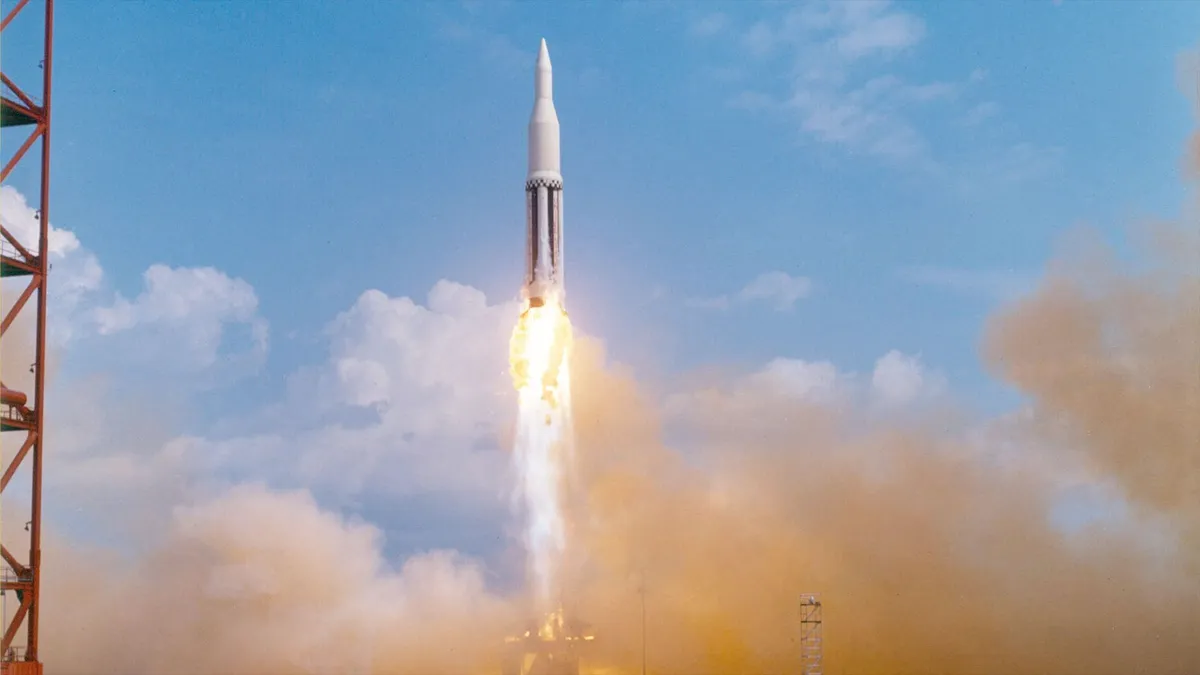
On Oct. 27, 1961, NASA launched the first test flight of its new Saturn I space launch vehicle.
The Saturn I rocket was the United States' first heavy-lift rocket designed to launch big payloads beyond low Earth orbit. This was also the first test flight of any rocket in the Saturn family of rockets, which includes the Saturn V that was used to launch astronauts to the moon during the Apollo program.
The Saturn I was enormous compared to every rocket that came before it. It was almost three times as tall as the Jupiter-C rocket, which launched the first American satellite into orbit in 1958. It also produced more than 10 times the amount of thrust that the Jupiter-C rocket could. The liquid-powered rocket launched on its maiden voyage from Cape Canaveral.
Despite a one-hour weather day, the flight was nearly perfect. It reached an altitude of 85 miles and splashed down in the Atlantic Ocean 15 minutes later. The only thing that went wrong was that its engines cut off 1.6 seconds early, but that wasn't a huge deal. Scientists figured out that this happened because there was too much liquid oxygen in the rocket and not enough propellant.
Why it mattered
NASA was only 3 years old when it launched its first Saturn rocket on Oct. 27, 1961. Human spaceflight was a mere 6 months old, after the April 12 launch of Soviet cosmonaut Yuri Gagarin earlier that year. Yet NASA had its eyes on the moon.
That's where the Saturn rocket family came in.
The Saturn I rocket, the predecessor to the Saturn V that sent Apollo astronauts to the moon, began its life in 1957 as the so-called Saturn C-1 booster, a project led by rocket scientist Wernher von Braun at the Advanced Research Project Agency. The plan called for a heavy-lift rocket capable of 1.5 million pounds of thrust (the first launch generated 1.3 million pounds of thrust, but later versions hit that 1.5 million mark). At launch, the Saturn I stood 162 feet tall and weighed 460 tons. NASA called that first test flight the Saturn SA-1 flight.
The Launch Complex 34 pad at what is now Cape Canaveral Space Force Station was specially built for the Saturn I rocket, with NASA taking charge in June 1961.
"The flight was considered essentially flawless," NASA said in a statement. "The Saturn SA-1 flight was the first of 32 successful Saturn rocket launches — 10 Saturn Is, 9 Saturn IBs, and 13 Saturn Vs — between 1961 and 1973."
NASA ultimately built three different types of Saturn rocket, the Saturn I, more powerful Saturn IB and the super-sized Saturn V rocket for Apollo moon launches.
Want more space history? Check out our full On This Day In Space Story archive and watch our On This Day In Space videos on YouTube.