





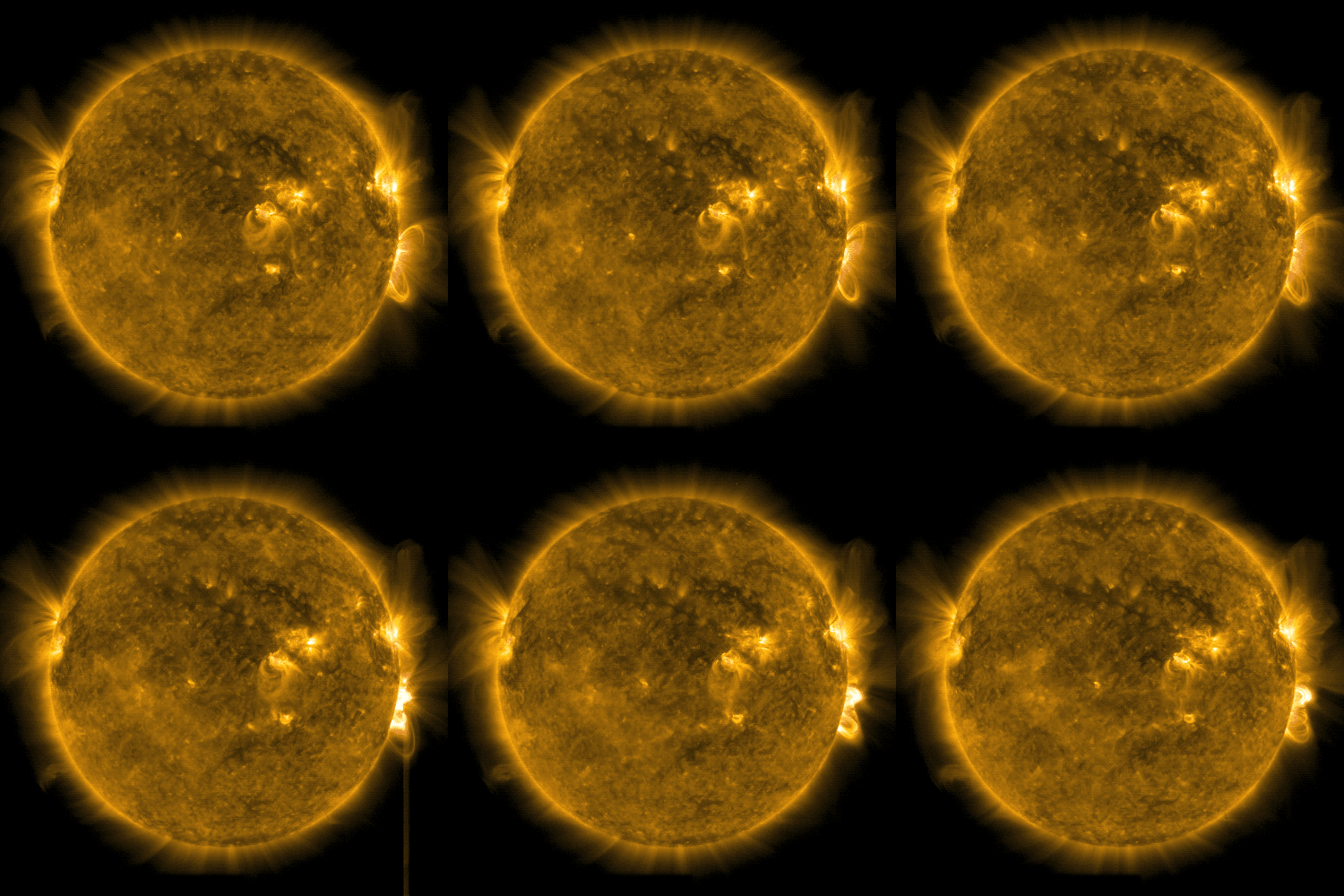
The orbits of Venus, Earth and Jupiter may explain the sun's regular 11-year cycle, a new study suggests.
A team of researchers from Helmholtz-Zentrum Dresden-Rossendorf (HZDR), a research institute in Dresden, Germany, showed that the tidal forces of those three planets influence the cycle of solar activity, resolving one of the bigger questions in solar physics.
"Everything points to a clocked process," Frank Stefani, a researcher at HZDR and lead author of the new study, said in a statement. "What we see is complete parallelism with the planets over the course of 90 cycles."
Related: Stunning Photos of Solar Flares & Sun Storms
The researchers compared observations of solar activity — like sunspots, solar flares and coronal mass ejections — from the last thousand years with planetary alignments in order to show that there was in fact a correlation, according to the statement.
While other stars like the sun go through similar cycles, marked by a change in levels of radiation or number and size of sunspots, previous models have been unable to explain what causes the very regular, 11-year cycle of Earth's sun.
However, this new study shows a connection between the tidal forces of Venus, Earth and Jupiter — whose gravitational pull tugs on the sun's plasma — and the steady rhythm of the sun's magnetic activity. "There is an astonishingly high level of concordance," said Stefani.
The researchers said they hope to use the same model of the sun's magnetic field to more effectively quantify and predict space weather events, or solar storms that spew potentially harmful radiation.
The study was published May 22 in the journal Solar Physics.
- Surprise! Sun's Magnetic Field Is Stronger Than We Thought
- Could We Move the Entire Planet Earth to a New Orbit?
- What's the Closest Planet to Earth? Not Venus, Scientists Say
Follow Passant Rabie @passantrabie. Follow us on Twitter @Spacedotcom and on Facebook.
