





Billions of years ago, something happened in our solar system that gave rise to one of the most peculiar planetary mysteries: what caused Uranus to spin on its side?
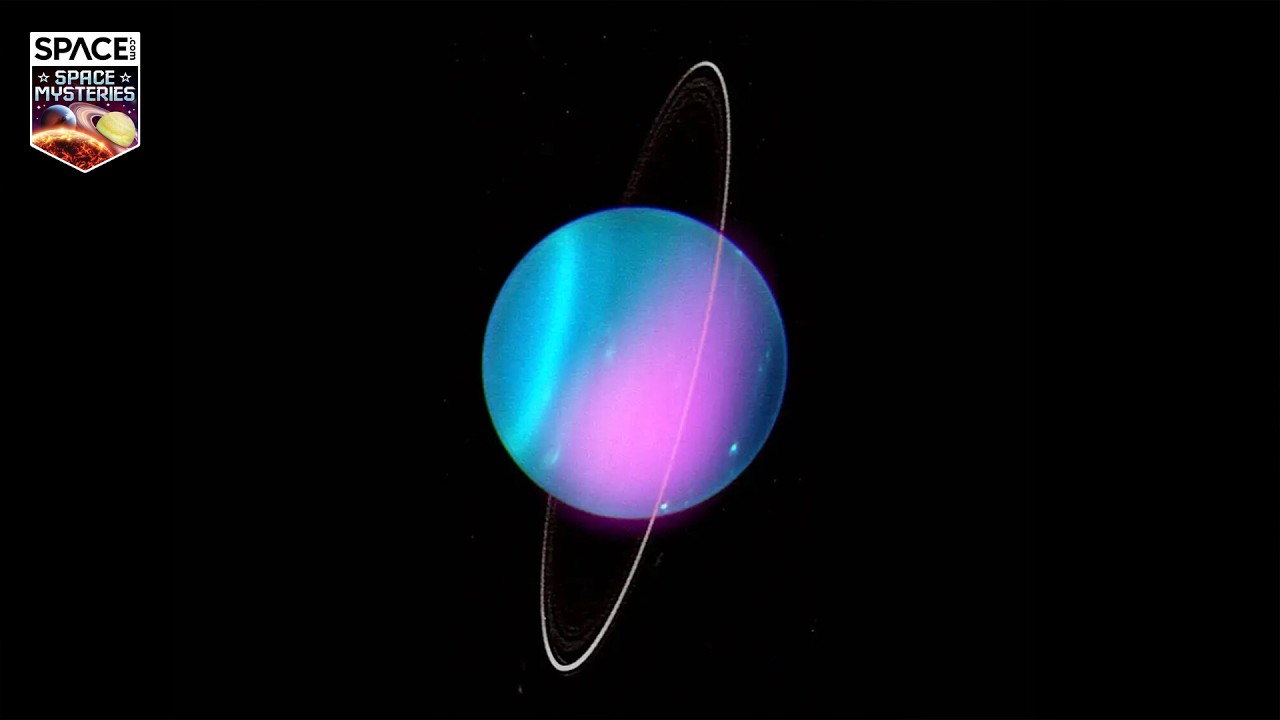
Although most planets spin with their rotational axes generally upright with respect to their orbital plane, Uranus exhibits an extreme axial tilt, causing its spin to resemble something more akin to a steady roll.
The exact reason for the planet's unusual tilt has long perplexed astronomers, and debate continues over what might have led to its present-day appearance. However, recent research suggests that at some point in the distant past, interactions between Uranus and a hypothetical "lost" moon could hold the key to what instigated this modern planetary mystery.
What do we know?
An atypical ice giant
Compared with its neighboring planets, Uranus is quite the outlier. Not only is it the coldest planet in our solar system, but Uranus is accompanied by at least 27 moons that share its unusual tilt, and some evidence suggests there could be even more Uranian satellites that presently remain hidden.
The earliest recorded observations of Uranus date back to the late 1600s, at which time it was initially thought to be a star. By 1781, British astronomer William Herschel concluded, based on initial observations he made with a home-built telescope, that the object was most likely a comet. Ongoing monitoring would eventually lead to its confirmation as the seventh planet from the sun.
Herschel's early observations of Uranus led to him noticing the odd paths of its moons, which had been one of the earliest indications that the planet possessed an extreme orientation. However, it wasn't until the early 20th century that the first serious attempts to measure the ice giant's rotation occurred, leading to the eventual confirmation of its unusual, tilted appearance.
Compared to Earth's rotational axis of around 23.5 degrees, Uranus's roughly 98-degree tilt causes several notable effects. For instance, according to NASA, because Uranus requires close to 84 Earth years to complete an orbit around the sun, each pole is exposed to direct sunlight for close to a quarter of the Uranian year, leaving the opposite side to cool over a 21-year-long winter. Equally unlike seasonal phenomena on Earth, sunlight falls almost directly onto Uranus's equatorial region during the planet's equinoxes.

What remains unknown?
Uranus's extreme spin
While such seasonal effects are well characterized, the mystery of what caused Uranus to end up on its side remains a matter of debate among astronomers.
One popular explanation suggests that at some point early in our solar system's violent history, Uranus may have collided with a large planetary body, while other theories suggest that no single impact would be necessary, and instead focus on ancient gravitational interactions between the giant planets, which may have gradually altered Uranus's orientation.
In 2022, a team of researchers led by Paris Observatory astronomer Melaine Saillenfest revisited the idea that Uranus may have been gradually tilted long ago by the presence of a large object. However, instead of a planet-sized object, Saillenfest and his colleagues suggested that, based on simulations, an ancient moon of significant enough size could have driven Uranus toward its extreme tilt through gravitational interactions before eventually crashing into the planet.
"The migration of a moon modifies the precession frequency of the planet's spin-axis," Saillenfest recently told Space in an email. "As this frequency increases or decreases, at some point it becomes equal to the precession frequency of the planet's orbital plane (or a harmonic of it). This creates a resonance between the two frequencies."
"Once locked into this resonance, the two frequencies remain equal, and the planet gets more and more tilted as the moon migrates farther and farther away," Saillenfest explained.

According to Saillenfest, the presence of a hypothetical moon and its gradual migration could have pulled Uranus toward a 90-degree tilt, although going beyond 90 degrees would have required an additional step. What the researchers propose in their 2022 study is that as Uranus approached the 90-degree tilt, this would have caused instability in the moon's orbit. The resulting motion would have been chaotic enough to drive the planet's tilt even further, bringing it to the roughly 98-degree tilt observed today.
"During this phase of instability, the planet's obliquity evolves chaotically and it can go beyond 90 degrees up to the observed state of Uranus," Saillenfest told Space. Although the final act in this planetary drama would have been the hypothetical moon's collision into Uranus, Saillenfest says he doesn't think this cataclysmic event is likely to have contributed significantly to the tilting process.
"The satellite is too small to noticeably alter Uranus's spin axis through the collision in itself," Saillenfest said, although noting that the eventual collision of this suspected "lost" moon into the planet is nonetheless a requirement for the team's scenario to work.
"This is because today Uranus has no moon with the mass range needed for this mechanism to work," Saillenfest adds, emphasizing that the planet's existing moons are too small to account for the effects he and his colleagues have modeled.

The mystery continues
Ultimately, the team found that in simulations where the unstable moon exhibits forces against Uranus over time and eventually crashes into it, the planet becomes tilted at about 98 degrees — the same tilt observed today, which Saillenfest calls "quite interesting."
"In order for Uranus to be tilted all the way to beyond 90 degrees, the previous moon of Uranus must have migrated across quite a long range," Saillenfest adds. "This means that internal processes inside Uranus must be able to dissipate a lot of energy through heat."
Saillenfest and his colleagues suggest there are two primary ways their ancient-moon hypothesis can be tested. First, if observations of Uranus's moons revealed them to be moving outward by as much as several centimeters each year, this would provide evidence of such energy dissipation occurring within Uranus — meaning that an ancient moon could potentially have also migrated far enough that it played a role in tipping the planet over. Rapid migration could also suggest that the present-day Uranian moons may even be debris produced during an earlier disruption of Uranus's satellite system.
"This would give support to the idea that [they] could have formed as a second generation of moons, potentially from the debris of the previous moon," Saillenfest says, adding that afterward "they would [have] migrated away from Uranus up to their current locations."
Second, the ages of the planet's current moons could also provide clues. Current estimates indicate that they could be almost as old as the solar system itself, although such values remain uncertain. However, if the present-day Uranian moons were proven to be younger, this could lend support to the idea that they may be debris left over from an earlier collision with a larger singular moon.
Additional observations will be required to confirm the suspected role of this hypothetical ancient impact, but Saillenfest and his colleagues remain optimistic about what future data could reveal.
"If these age estimates are revised in the future, in a way that the current moons of Uranus are estimated to be substantially younger than the solar system, then this would be another hint
