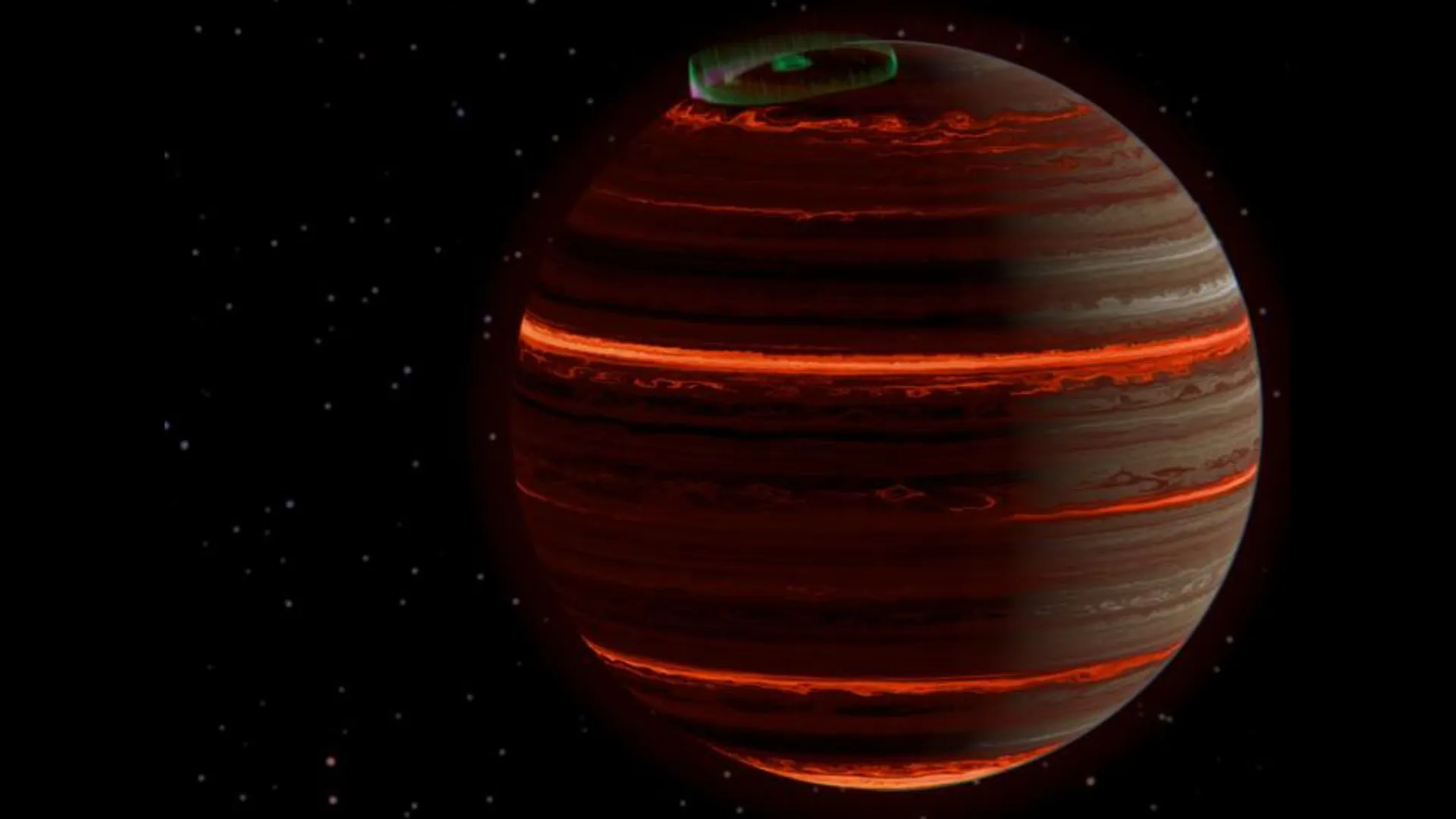
With a new analysis of James Webb Space Telescope observations, we're one step closer to interstellar weather forecasting — a baby step, at least.
Before astronomers can issue weather forecasts for worlds beyond our solar system, they need to know what drives the atmospheres of those planets and whether their weather follows recognizable patterns. And in a new study based on James Webb Space Telescope (JWST) data, researchers studied SIMP 0136, a world about 20 light-years away, and traced much of its atmospheric variability to two factors: temperature differences and changes in the vertical structure of its clouds.
SIMP 0136 isn't exactly an exoplanet but rather a brown dwarf. Brown dwarfs occupy the murky territory between planets and stars. They are generally more massive than planets but cannot sustain the hydrogen fusion that powers stars. But because astronomers can observe them directly, brown dwarfs offer laboratories for studying the atmospheres of giant, exoplanet-like worlds.
Using a technique called principal component analysis, the team examined subtle brightness changes taking place as SIMP 0136 rotated, distilling down a complicated dataset into a few patterns responsible for most of the variation. The analysis revealed three recurring weather states rotating in and out of view. Some regions were hotter and covered by thinner clouds, while cooler regions had thicker clouds extending higher through the atmosphere.
However, identifying recurring weather states is only part of the story. To make actual forecasts, astronomers also need to know whether an atmosphere plays by the same rules over and over again — and in this case, it did. "We also discovered that these drivers of the weather patterns on SIMP-0136 persist over time, even as the detailed appearance of the atmosphere evolves over more than a dozen rotations," study lead author Merle Schrader, a doctoral candidate at Trinity College Dublin, said in a statement.
The method does not yet let astronomers predict tomorrow's conditions on a distant world, but it offers a relatively quick way to identify the forces shaping an atmosphere before scientists run more computationally demanding models.
"Applying this technique to a wide range of brown dwarfs and giant exoplanets will help us better understand the diverse weather systems that shape worlds far beyond our solar system," study co-author Johanna Vos, an associate professor at Trinity College Dublin, said in the statement.
The research was published in the journal Astronomy & Astrophysics on Sept. 16.