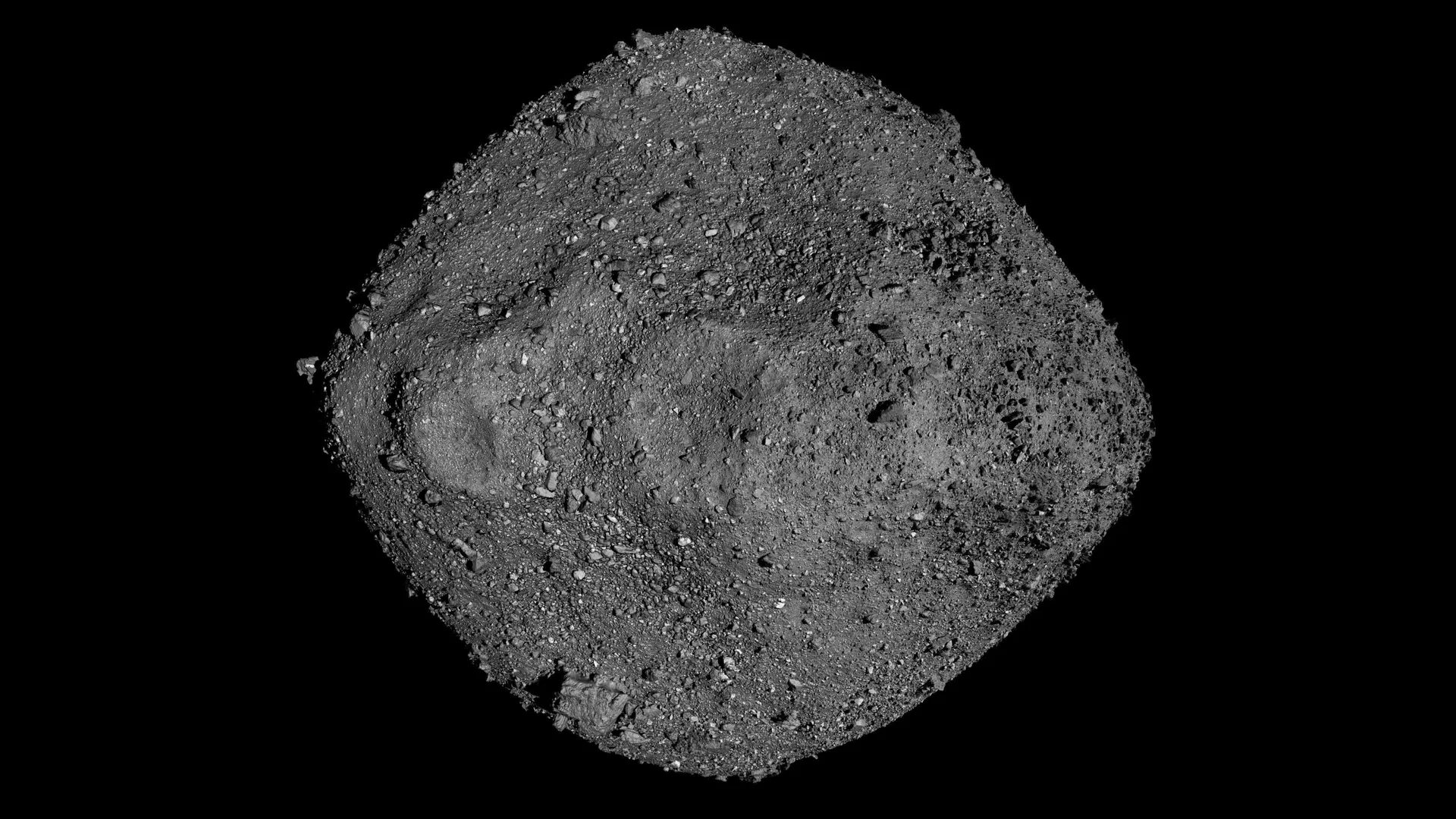
The asteroid Bennu was shaped on the boundary between hot and cold in the dusty disk that formed the planets 4.5 billion years ago, meaning the samples brought back from this space rock by NASA's OSIRIS-REx mission give us our best look at the primordial material from which the planets assembled.
"Bennu may offer our best glimpse of the original mix of chemical elements from which the terrestrial planets were ultimately built," said Maria Schönbächler, a professor of isotope geochemistry at ETH Zurich in Switzerland, in a statement.
Bennu is a near-Earth asteroid that NASA visited with its OSIRIS-REx (Origins, Spectral Interpretation, Resource Identification, Security, Regolith Explorer) mission between 2018 and 2021. Then, on Sept. 23, 2023, the OSIRIS-REx spacecraft which parachuted down to Earth a sample of 0.26 pounds (120 grams) of regolith from Bennu.
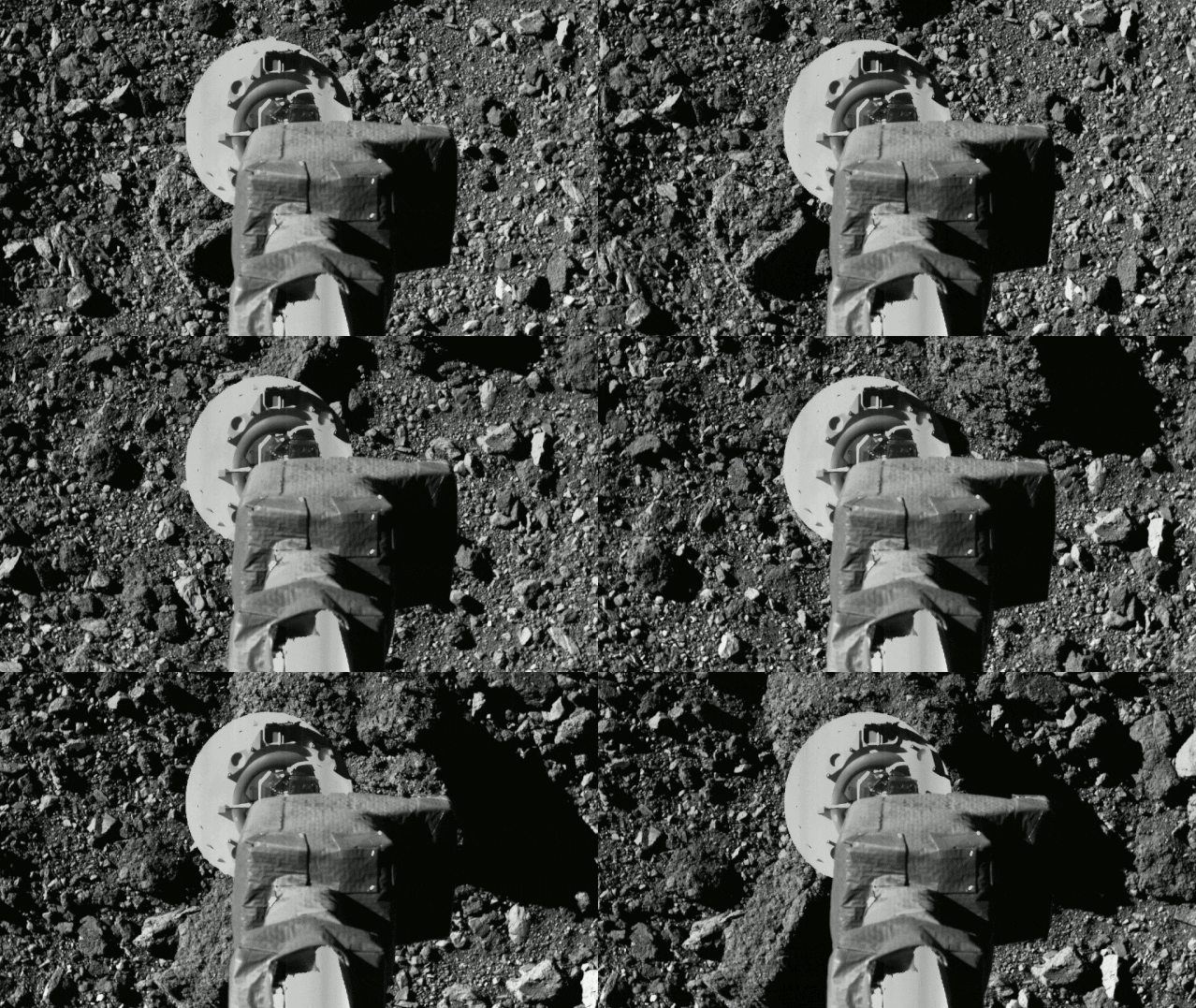
The material in that sample was subsequently shared out among researchers around the globe, including half a gram being received by Schönbächler's lab. The findings of Schönbächler and her team had subsequently changed what we thought we knew about the birth of Bennu.
They analyzed isotopes — variations of elements with greater or lesser numbers of neutrons — of iron, titanium and chromium in the sample, finding iron and titanium in particular to be well mixed throughout. Bennu's composition is also remarkably similar to another asteroid, Ryugu, from which Japan's Hayabusa2 mission has also obtained a sample. A rare breed of meteorite, called CI chondrites, also share a similar isotopic composition with Bennu and Ryugu, suggesting a common birthplace.
And that's where things get really interesting. Both Bennu and Ryugu are pieces of larger bodies that at some point were smashed apart. Some scientists have suggested that those parent bodies probably formed far from the sun in the outer solar system, maybe even alongside comets, and that they formed later than the planets since processes that far out are relatively slow.
However, the isotopic analysis of the Bennu sample by Schönbächler's team begs to differ. The even mixing of the isotopes suggests that it was formed from fine dust grains rather than clumpy, coarser material. The presence of water molecules also implies it formed closer to the sun than had been thought.
Schönbächler's team posit the following scenario: that Bennu formed close to the snow line, which was the dividing line in the planet forming disk beyond which temperatures were too cold for water vapour, the water instead froze as ice. Inside the snow line the temperatures were hotter, causing ice to sublimate into a gas or melt into a liquid. This snow line between fire and ice existed roughly where Jupiter does today. Material from both sides of this line flowed together to assemble the parent objects of Bennu, Ryugu and CI chondrites, with ice acting like glue to bond the fine dust particles together.
And Jupiter had a role to play in this process too. The giant planet formed fairly soon after the sun (within a million years). As it grew and came to dominate its orbit, it acted as an obstacle to heavier, coarser clumps of dust while finer grained dust was able to flow around it and feed into the zone where Bennu formed. This explains why the isotopes are so well mixed rather than clumped, and also tells us that Bennu's parent probably formed not long after Jupiter did. The prevalence of water-bearing minerals in the Bennu sample also suggests that water-ice that sublimated into vapor just inside the snow line was also part of the material that was transported into the region where Bennu and its cousins were built.

"Bennu is a hybrid," said Schönbächler. "The material does not clearly match either the inner or the outer solar system." Instead, Bennu has characteristics derived from both regions.
What's more, the well-mixed fine-grained material more closely matches the composition of the pre-solar nebula and hence the sun itself. This means that Bennu is stuffed full of primordial material that was the foundation for the formation of the solar system, and can help us better understand the material out of which the planets, including our Earth, came to be.
What's intriguing is that both near-Earth asteroids, Bennu and Ryugu, which have been destinations for successful sample-return missions should both have very similar origins. Is that pure coincidence, or is it telling us something about where the population of near-Earth asteroids came from?
"We are now wondering whether other asteroids have the same isotopic signature as Bennu and Ryugu," said Schönbächler.
The only way that can be answered is by going and obtaining more samples. A Chinese mission called Tianwen-2 arrived this summer at the near-Earth asteroid Kamo'oalewa, to bring back a sample next year, while Japan's Martian Moons eXploration mission, set to launch this August, plans to bring back a sample from Phobos in 2031. While designated a moon of Mars, Phobos is thought to possibly be a captured asteroid. If so, its isotopic composition might have more in common with Bennu than with Mars.
The latest findings from Bennu were published on Sept. 23 in the journal Science Advances.