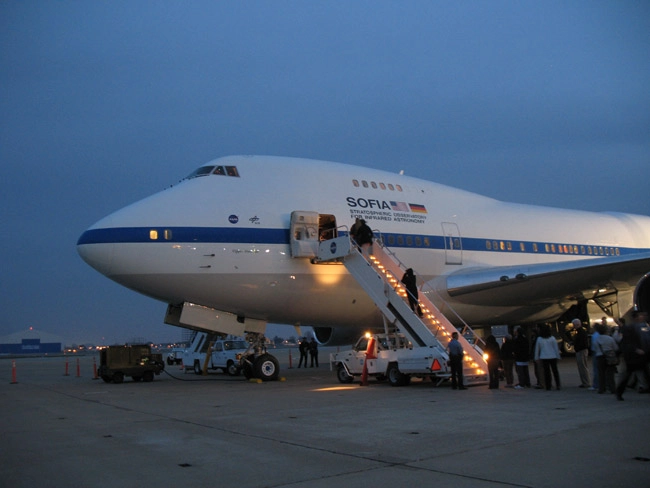
NASA's Stratospheric Observatory for InfraredAstronomy (SOFIA) touched down at NASA Ames Research Center to an emotionalwelcome. Dr. Eric Becklin, SOFIA's Observatory Director and Chief Scientist,said, "It brought tears to my eyes to see this beautiful observatoryarrive." Scientists, engineers, technologists and educators who haveworked long and hard on this observatory surrounded Becklin. They weredelighted to witness SOFIA make two fly-bys over Moffett Federal Airfield, andtouch down to cheers.
SOFIA has beenunder development since 1996; it's a long-awaited infrared observatory thatwill take astronomers and educators on research flights to observe the infrareduniverse. SOFIA carries a 2.5 meter-diameter telescope to the stratosphere torise above the water vapor and carbon dioxide in Earth's atmosphere thatabsorbs infrared energy. SOFIA will open new eyes on the universe.
On Monday,January 14, SOFIA was flown from NASA's Dryden Research Center to NASA's Ames Research Center for a 1-day visit. This allowed NASA employees, contractors, and theirfamily and friends the opportunity to walk through the new airborneobservatory. SOFIA's predecessor, the KuiperAirborne Observatory (KAO), was also on display. A modified C-141 cargoaircraft, the KAO carried a 0.9 meter-diameter telescope to the stratosphere toconduct infrared research during a mission spanning more than two decades,including numerous deployments around the world. Carrying a much more powerfultelescope and new instrumentation, SOFIA will resume these research missionsonce the engineering testing and other final finishing details are completed.

Together,SOFIA and the KAO made a dramatic pair as dusk fell upon the apron where theywere parked.
More than3500 people had the opportunity to see the observatories, and I saw smileseverywhere. I've been involved with airborne astronomy since 1991. Inpartnership with many people at NASA's Ames Research Center, I managed theFOSTER — Flight Opportunities for Science Teacher Enrichment — program for theKAO. In just over 3 years, we trained and flew teams of pre-college teachers on50 research missions onboard the KAO. Their students thought that they hadbecome astronauts, and that became a teachable moment for these educators.Recently, one of these educators told me that her students ask her each year ifshe's the NASA teacher. They're still proud and excited about learning sciencefrom her. It's a decade later, and still these educators' experiences ofworking with KAO scientists, NASA and the SETI Institute continue to haveimpact in their classrooms. SOFIA will be able to bring educators from all partsof the US and Germany to participate in research missions. It's a wonderfulprospect.
I was soexcited to be able to walk up the steps and enter the observatory with myfriend, Carl Gillespie, who had first envisioned building an infrared telescopein a Boeing 747SP in the 1970s. Carl was a flight director on the KAO, and losttrack of how many flights he directed over his 21-year career on the KAO. He'snow retired, but was delighted to see his dream come to fruition. I was too. I'mlooking forward to seeing scientists, undergraduate and graduate students, andeducators work together onboard the observatory when SOFIA begins to do scienceroutinely in a few years. There's great science and inspiring education andoutreach in store for people across the world.
SOFIA is a joint program of NASA and theGerman Aerospace Center (DLR). Overall SOFIA program management is based atNASA's Dryden Flight Research Center in southern California, while thescientific mission and operations are planned and run from NASA's Ames ResearchCenter in northern California. Universities Space Research Association(USRA) and the Deutsches SOFIA Institut at Universitaet Stuttgart managescience operations for NASA and the DLR, respectively. SOFIA's home hangar willbe at the Palmdale (California) Airport near Dryden. The SETI Institute and theAstronomical Society of the Pacific are partners in administering SOFIA's education and public outreach programs.
- VIDEO: Figure the Odds of E.T.!
- All About SETI
- SOFIA Flies to California
