Space weather refers to variations in the space environment that are a consequence of charged particles and electromagnetic radiation emitted from the sun.
On Earth, water, temperature and air give rise to weather, whereas the key contributors to space weather are particles, electromagnetic energy and magnetic fields, according to the UK's national weather service The Meteorological Office (Met Office).
Fortunately for life on Earth, the amount of heat and light the sun radiates is remarkably constant. However, the star can also blast matter out into space, though for most of human history these ejections have gone unnoticed.
Today, these phenomena, known as space weather, can have drastic effects on satellites in space and electronic technology on which we rely on Earth.
Related: The sun's atmosphere: Photosphere, chromosphere and corona
The origins of space weather can be traced to contortions in the sun's magnetic field, leading to dark blotches, or sunspots, on its surface, according to an article by the NASA Earth Observatory.
It's from these spots that space weather-causing phenomena such as solar flares and coronal mass ejections can emerge sunspot activity rises and falls on an 11-year cycle, known as the solar cycle, and we're currently approaching the next solar maximum in 2025.
Solar storms
While space weather ultimately originates on the sun, the term solar storm refers to occurrences on, or near, our own planet, when material tossed out by the sun reaches us. There are two distinct types of solar storm: Geomagnetic storms and solar radiation storms.

The first of these refers to strong disturbances to Earth's magnetic field caused by ejected solar material called a coronal mass ejection (CME). The second. refers to a stream of much faster moving particles ejected by the sun. According to NOAA's National Weather Service, solar radiation storms involve large quantities of protons and electrons which bathe the near-Earth satellite environment, these storms can last from a few hours to days, depending on the magnitude of the eruption.
As dangerous as the latter sounds, we're largely protected from its effects by Earth's geomagnetic field, as are the majority of satellites in orbit around the planet. As a consequence, solar radiation storms are only a really serious problem for deep space missions.
Solar storm rankings
NOAA ranks geomagnetic storms on a scale running from G1, which could cause an increase in auroral activity around the poles and minor fluctuations in power supplies, up to G5, which includes extreme cases like the Carrington Event — a colossal solar storm that occurred September 1859, a few months before the solar maximum of 1860, and which disrupted telegraph services all over the world and triggered auroras so bright and powerful that they were visible as far south as the Bahamas
Predicting space weather
We all know how unpredictable weather is on Earth, but it gets even more complicated in space.
Understanding the sunspot activity and the solar cycle is a key component of space weather forecasting and scientists hope to one day be able to forecast space weather as accurately as meteorologists forecast weather on Earth.
Related: Space weather is difficult to predict — with only an hour to prevent disasters on Earth
Scientists at NOAA's Space Weather Prediction Center analyze sunspot regions daily to assess the threats. They monitor and record changes in sunspot size, number and position to evaluate the likelihood of an Earth-directed solar flare and/or CME from an active region.
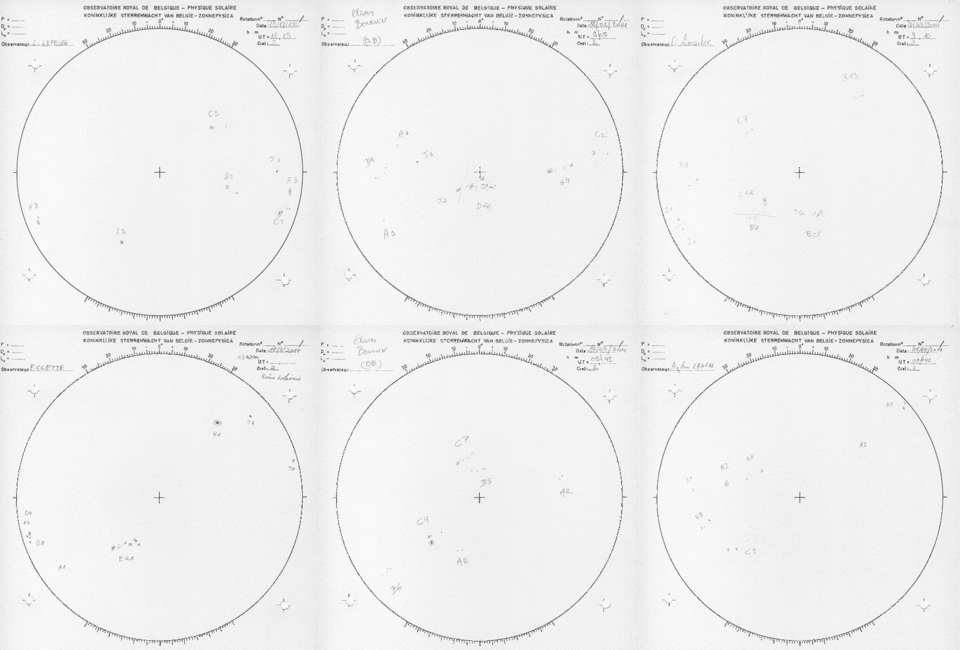
The World Data Center for the Sunspot Index and Long-term Solar Observations at the Royal Observatory of Belgium also tracks sunspots and records the highs and lows of the solar cycle to evaluate solar activity and improve space weather forecasting.
NASA also has a fleet of spacecraft — known collectively as the Heliophysics Systems Observatory (HSO) — designed to study the sun and its influence on the solar system, including the effects of space weather.
The HSO is made up of several solar, heliospheric, geospace and planetary spacecraft, which watch the sun and measure its activity at different distances and angles. These satellites include the Parker Solar Probe on a daring mission to "touch" the sun, the Solar and Heliospheric Observatory (SOHO) — a joint effort between NASA and the European Space Agency (ESA), the Solar Terrestrial Relations Observatory (STEREO) consisting of two near-identical observatories one located ahead of Earth's orbit and the other trailing behind and ESA's Solar Orbiter that is taking a first time look at the sun's uncharted polar regions.

ESA's Vigil mission, due to launch mid-2020s, is a dedicated solar weather forecasting mission. Vigil will monitor the sun from Lagrange 5, approximately 93 million miles (150 million kilometers) from Earth. The spacecraft will be positioned so it can keep an eye on the "side" of the sun. It will monitor solar conditions before they rotate around to face Earth in a bid to give us advanced warning of possibly hazardous solar activity.
Understanding the solar environment is no mean feat hence why there is a whole fleet of space missions dedicated to understanding our sun and its behavior.
"There is no bad weather, just bad preparation," Jake Bleacher, chief scientist for NASA's Human Exploration and Operations Mission Directorate at NASA said in a NASA statement. "Space weather is what it is — our job is to prepare."
Additional resources
For official space weather forecasts for the U.S. check out NOAA's Space Weather Prediction Center (SWPC). If you'd like to learn more about the impacts of space weather, NOAA's SWPCC has got you covered. Explore how scientists around the world help to track the solar cycle in this NASA article.
Bibliography
NOAA / NWS space weather prediction center. Homepage | NOAA / NWS Space Weather Prediction Center. Retrieved June 22, 2022, from https://www.swpc.noaa.gov/
NASA. World of change: Solar activity. NASA. Retrieved June 22, 2022, from https://earthobservatory.nasa.gov/world-of-change/Solar
NOAA Space Weather Scales. NOAA Space Weather Scales | NOAA / NWS Space Weather Prediction Center. Retrieved June 22, 2022, from https://www.swpc.noaa.gov/noaa-scales-explanation
Silso: World Data Center for the production, preservation and dissemination of the international sunspot number. SILSO | World Data Center for the production, preservation and dissemination of the international sunspot number. Retrieved June 22, 2022, from https://www.sidc.be/silso/
What is space weather? Met Office. Retrieved June 22, 2022, from https://www.metoffice.gov.uk/weather/learn-about/space-weather/what-is-space-weather