


Solar activity is ramping up as we experience solar cycle 25 and with it comes an increased likelihood of solar storms — a large release of energy in form of solar flares or coronal mass ejections.
Solar storms can seriously impact technology on Earth as well as satellites and spacewalking astronauts due to increased radiation exposure. Earth is no stranger to the sun's wrath as large geomagnetic storms can interfere with high-frequency radio communications and Global Positioning Systems (GPS), according to NASA.
Here we take a look at some of the worst solar storms in history.
1859: The Carrington Event

The Carrington Event of 1859 was the first documented event of a solar flare impacting Earth. The event occurred at 11:18 a.m. EDT on Sept. 1 and is named after Richard Carrington, the solar astronomer who witnessed the event through his private observatory telescope and sketched the sun's sunspots at the time. The flare was the largest documented solar storm in the last 500 years, NASA scientists have said.
According to NOAA, the Carrington solar storm event sparked major aurora displays that were visible as far south as the Caribbean. It also caused severe interruptions in global telegraph communications, even shocking some telegraph operators and sparking fires when discharges from the lines ignited telegraph paper, according to a NASA description.
1972: Solar flare vs. AT&T

The major solar flare that erupted on Aug. 4, 1972 knocked out long-distance phone communication across some states, including Illinois, according to a NASA account.
"That event, in fact, caused AT&T to redesign its power system for transatlantic cables," NASA wrote in the account.
1989: Major power failures from geomagnetic storm

In March 1989, a powerful solar flare provoked a geomagnetic storm which subsequently set off a major March 13 power blackout in Canada that left six million people without electricity for nine hours.
According to NASA, the flare disrupted electric power transmission from the Hydro Québec generating station and even melted some power transformers in New Jersey. This solar flare was nowhere near the same scale as the Carrington event, NASA scientists said.
2000: The Bastille Day Event

The Bastille Day event takes its name from the French national holiday since it occurred on the same day — July 14, 2000. This was a major solar eruption that registered an X5 on the scale of solar flares.
The Bastille Day event caused some satellites to short-circuit and led to some radio blackouts. It remains one of the most highly observed solar storm events and was the most powerful flare since 1989.
2003: The haunting Halloween storms
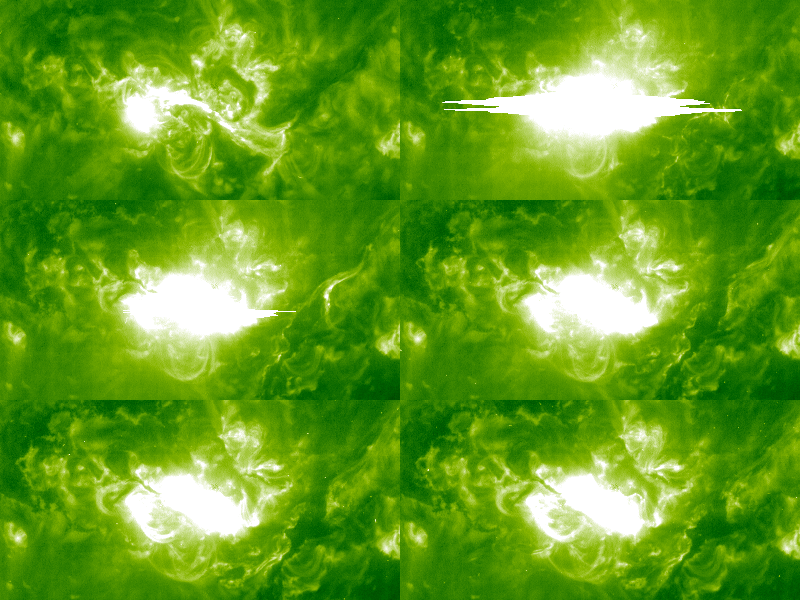
From October through November 2003, the sun unleashed a barrage of powerful solar flares and coronal mass ejections that slammed into Earth's atmosphere.
Dubbed the "Halloween Storms of 2003" by NASA these solar storms caused aircraft to be re-routed, affected satellite systems and caused power outages in Sweden. The Solar and Heliospheric Observatory (SOHO) temporarily failed during the solar onslaught.
On Oct. 28, 2003, the sun unleashed a whopper of a solar flare. The flare was so intense it overwhelmed the spacecraft sensor measuring it. The sensor topped out at X28, already a massive flare), but later analysis found that the flare reached a peak strength of about X45, NASA has said.
The Halloween storms were particularly scary as they occurred during a time in the solar cycle when solar activity should be relatively quiet — about two to three years after the solar maximum. According to NASA, 17 major flares erupted from the sun during this time.
2006: X-Ray sun flare for Xmas

When a major X-class solar flare erupted on the sun on Dec. 5, 2006, it registered a powerful X9 on the space weather scale.
This storm from the sun "disrupted satellite-to-ground communications and Global Positioning System (GPS) navigation signals for about 10 minutes," according to a NASA description.
The sun storm was so powerful it actually damaged the solar X-ray imager instrument on the GOES 13 satellite that snapped its picture, NOAA officials said.
2022: A very expensive storm

In February 2022, SpaceX witnessed the destructive power of the sun when a geomagnetic storm destroyed up to 40 Starlink satellites worth over $50 million shortly after deployment.
Starlink satellites (and other low-Earth orbit satellites) are particularly vulnerable to geomagnetic storms because they are released into very low-altitude orbits (between 60 and 120 miles (100 to 200 km), and they rely on onboard engines to overcome the force of drag, raising themselves to a final altitude of about 350 miles (550 km).
During a geomagnetic storm, Earth's atmosphere absorbs energy from the storms, heats up and expands upwards, leading to a significantly denser thermosphere that extends from about 50 miles (80 km) to approximately 600 miles (1,000 km) above the Earth's surface. A denser thermosphere means more drag which can be an issue for satellites.
This is what happened in February when the batch of recently released Starlink satellites failed to overcome the increased drag caused by the geomagnetic storm and began to fall back to Earth, eventually burning up in the atmosphere.
