Rolling, rolling, rolling. Keep those Mars rovers rolling. You can almost hear the crack of a Martian whip.
Since January, NASA's Spirit and Opportunity robots have been wheeling and dealing with the red planet. Last week they had their driving licenses renewed for an additional six months. The science results already have changed how researchers view Mars, and the mission could be far from over.
The rovers steadily worked through a primary three-month mission that ended in April. Then the Mars twosome added another five months of "bonus exploration" during the first extension of their respective duties.
The overall health of the robotic explorers points to more travel, more science and more discovery, mission officials say. All the better to piece together a more solid story about the history and present state of the red planet - and whether or not it has been, or is today, a home for life.
Cold conditions
Spirit at the Gusev Crater site is partway up the west spur of highlands tagged the Columbia Hills, a drive of more than 2 miles (3 kilometers) from its landing spot.
On the other side of the planet, at Meridiani Planum, Opportunity is inside the stadium-size Endurance Crater, wheeling itself toward the base of a stack of exposed rock layers labeled Burns Cliff - a location that is a potential exit route on the crater's south side.
If power were the only limiting factor, the solar-energized rovers could chalk up multiple years of service. "But chances are that something else will get us before then," said Mark Adler, Mars Exploration Rover Mission Manager at the Jet Propulsion Laboratory (JPL) in Pasadena, California.
Both rovers face ever-colder conditions as winter sets in on Mars. "Anybody that has a machine knows. Things break sooner or later," Adler said. "But life is good...and we're going to keep driving them as long as they last."
Heat shield inspection
Next on Opportunity's agenda is to wheel itself up and out of Endurance Crater.
The plan is to steer the robot by a nearby hunk of discarded hardware - a heat shield that protected the rover and airbag landing system as they plunged through the martian atmosphere last January.
"If the heat shield broke, we may be able to see a cross-section of the heat-shield material and observe the char depth to compare that with what we predicted," Adler told SPACE.com. "For science, we expect that the heat shield dug a pretty good trench on impact."
Opportunity could use its Microscopic Imager to inspect in detail the heat shield, Adler said. Once done at that site, the rover is to bolt out across the "big Meridiani parking lot," he added.
Spirit's mission is being geared to explore rock outcrops in the Columbia Hills - a far different place than months of driving across the plains of Gusev Crater.
"And that's sort of the bottom line," Adler said. "In my opinion, it's worthwhile to keep funding the rovers because the discoveries keep coming as long as they can go explore new terrain. I hope our sponsors will agree with that. It'll be very hard to stop operating these rovers as long as they can continue to roll."
Emerging picture
In looking back on the months of Mars exploration, what is the most striking, surprising new view of Mars obtained by the rovers?
"That's hard to say this early in the game. I think it's going to take a long time for the science community to fully digest our results," said Steve Squyres of Cornell University in Ithaca, New York and principal investigator for the Mars Exploration Rover project.
But Squyres added: "What's emerging to me is a picture of Mars as a planet that's made of basaltic rock, and with groundwater that's dilute sulfuric acid. The acid interacts with the rock, dissolving things out of it, and then can evaporate away and leave interesting sulfate salts behind. When you have a little interaction and a little evaporation, you get the kind of deposits -- like a little bit of magnesium sulfate salt in the soil -- that we see at Gusev. When you have a lot of interaction and a lot of evaporation, you get the kind of sulfate-rich evaporate beds we see at Meridiani."
Taking this into consideration, the life on Mars issue, Squyres said, means grappling with a key notion. "I think that we've got to start considering how easy it might or might not be for life to take hold in this kind of sulfur-rich, low-pH [measure of acidity] environment."
Supporting suspicion
And given the data amassed to date by the twin robots, is the prospect now more likely that Mars was, or is now, an abode for life?
"I think so," Squyres responded. "We've always suspected that there were places on Mars where liquid water has been present at the surface for significant periods of time, but now we have some actual in-situ evidence to support that suspicion," he told SPACE.com.
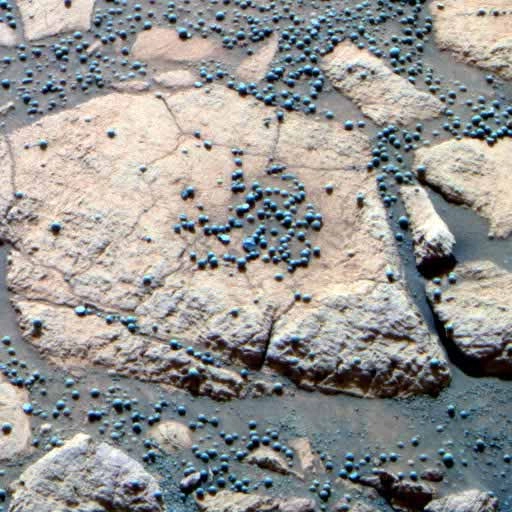
Squyres underscored the significance of the kinds of mineral deposits that the Opportunity rover has found at Meridiani, including evaporites and concretions - the kinds of materials that can be good at long-term preservation of evidence for life.
"So our results don't just provide evidence that there were habitable environments, they also suggest a possible search strategy for evidence that there might once have been
life," Squyres said.
Martian time scale
Thanks to rover science data relayed so far, the outlook for life on Mars is a resounding yes, but with a caveat, explained Ronald Greeley, a leading planetary scientist at the Department of Geological Sciences at Arizona State University in Tempe. "This is still a long way from saying that the 'spark' of life ever took place."
Consider the exploration of Mars by spacecraft, beginning with the NASA Mariner 4 flyby of Mars in 1965. Greeley recounted that every new mission provides increasing information to support the idea of a "wet" Mars.
From polar processes, channels and valley networks, to the recent observations of small young gullies and measurements of water - the water history of the red planet is being revealed in step-by-step fashion.
Now the twin Mars rovers show that the rocks at both sites have been formed and altered by extensive water, Greeley said. "While water is certainly at or near the surface in many areas today, what we do not know is the time scale for the formation and alteration of the rocks seen at the rover sites."
Greeley said that, in his mind, placing constraints on the martian time scale is the biggest need facing Mars researchers now. "The next level of understanding of the features seen on the surface -- and the related environments -- is dependent on this time scale. The only way to get at this issue is to have suites of samples returned to Earth from key places on Mars," he said.
Saga of water
So far, the most striking aspect of Mars rover work is the saga of water on the planet.
Not necessarily 'floods' of water, but sufficient amounts to alter the rocks. This is true even at the Gusev site, Greeley added, where the basaltic rocks show several lines of evidence of modification by water. This could be from water in the atmosphere, interactions by ground water - that is to say, subsurface water that percolates through the rocks and soils -- or surface water, he said.
"For the most part, the Mars Exploration Rover results confirm the pre-mission interpretations of remote sensing data for Gusev crater and Sinus Meridiani. This gives confidence that the Mars community can exploit the great wealth of present and future remote sensing data as the exploration program moves forward," Greeley concluded.
Life on Mars, past or present, remains an open question. That's the view of Joy Crisp, JPL project scientist for the Mars Exploration Rover effort,
"We already knew that there was liquid water around in the past, so I'm not sure that the rover mission has really changed the prospects for past life," Crisp noted. "The mission has not changed the prospects for current life. Today, Mars is still the harsh place we thought it was."
Fossils?
Through Mars rover science, research teams have found a specific rock deposit that preserves a record of a past environment that could have been favorable for life.
"And that could have preserved evidence of fossil life, if life was around when the rocks were deposited or later soaked in liquid water," Crisp said.
To the extent that water and life go together -- which they do -- the rovers have enhanced the case that "Mars had the right stuff in the past in terms of liquid water," said Ray Arvidson, Mars Exploration Rover Deputy Principal Investigator from Washington University in St. Louis, Missouri.
"Certainly, all the ingredients to make the biogeochemical compounds would have been there," Arvidson stated.
"It bodes well for all the right stuff, in terms of a Mars environment and materials for life to get started and to evolve. And whether it happened or not, I think we need to go down and explore with the right tools," Arvidson concluded.
- Mars Rovers: Full Coverage