


Scientistsoften have a reputation for working in stuffy laboratories, cut off from theworld around them. But this certainly isn't the case at the Centre forGeobiology, University of Bergen, Norway.
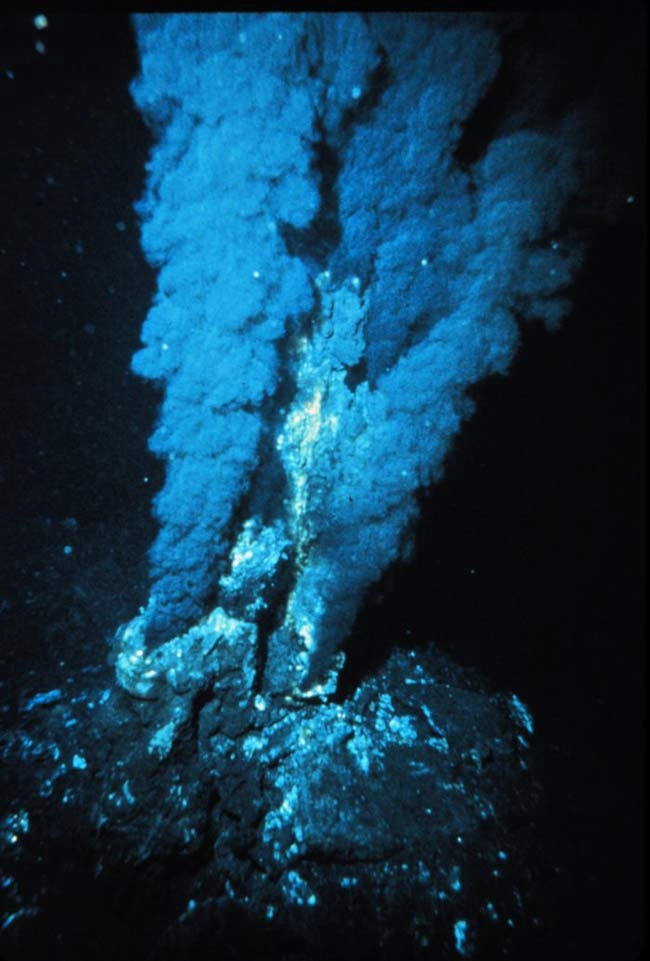
Thecenter has operated two summer cruises thus far in which researchers embarkedon voyages to study conditions on the ocean floor. Using state-of-the-arttechnology, including a remotely operated vehicle, the scientists havediscovered a new field of deep-sea vents, one of the most northerly in theworld. [This discovery was reportedby LiveScience in July.]
Creaturesliving around these "black smokers" show just how tough life on Earthcan be, and hint that organisms on other worlds may be able to thrive in veryhostile environments.
Life on the ocean floor
Scientistsused to think that life on Earth was always based on ecosystems withphotosynthesis — making food and energy from sunlight — as the foundation. Divedeeper than 656 feet (200 meters) and you'll be lucky to see any light at all — below 3281 feet (1000 meters), there is none. Amazingly, researchers have foundorganisms there, generally referred to as "extremophiles" (as theyexist in extreme environments), often thriving despite the harsh conditions.
Justhow unforgiving are environments deep in the ocean?
Creaturesliving 1968 feet (600 meters) deep endure crushing pressures around 60 times morepowerful than at sea level. But that is only one of the problems they face. Thetemperature on the sea floor is very low, averaging about 39 F (4 C). Thischanges abruptly around hydrothermal vents, where temperatures can suddenlysoar up to 752 F (400 C).
Thesevents, like the ones discovered during the research cruise, actually createhavens for life despite the scorching heat. Creatures that live in hotenvironments are called thermophiles, which means "heat loving."They're perfectly happy on the outskirts of vents, where the temperature isaround 122 F (50 C). Another group of organisms are known as hyperthermophiles.They live up to this impressive name by thriving at temperatures up to 248 F(120 C). Many chemicals spewed out at the vents are toxic to more common formsof life, but some exteremophiles are so hardy that they actually can use thesechemicals for food and energy!
Scientists take to the seas
ElinorBartle is the Centre for Geobiology's Information Officer. She was part of theCentre's team aboard the newest, largest and most advanced research ship in theNorwegian fleet. After sailing for two days, they reached the first study siteoff the west coast of Norway. Says Bartle, "Each leg [of the trip]involved a group of around 25 researchers, technicians and public outreachpersonnel in addition to the ship's crew. The group was international withrepresentatives from a number of international partner institutions."
Theirmain mission was mapping the sea floor, hunting for areas of interest likeelusive vents. They also collected rock samples that could provide clues aboutthe local geology.
Theresearchers found the black smokers on mineral deposits that may be among thelargest ever discovered, having been built up over the course of 100,000 years.An entire ecosystem surrounds these newly-discovered vents, usingchemosynthesis for energy. Instead of light being the basis for energy,chemicals from the vents supply the foundations for life. Samples of thecreatures were collected to be studied, and the hope is that they will help usgain better understanding of extremophile life.
Alien parallels?
Studyingthese organisms is very important for astrobiologists. Says Bartle, "Weare finding microbial organisms in unusual and extreme environments, and thisis providing extremely relevant information for the search for life onother planets."
Theremay be similar hydrothermal vents on the ocean floors of other worlds, such asJupiter's icy moon Europa.Scientists also think that conditions around the vents could match what it waslike when lifefirst formed on the Earth four billion years ago. The deep ocean would haveprovided protection from deadly solar radiation before the ozone layer hadformed.
Thesummer cruise's results are certainly good news when thinking about life onother worlds. The fact that there are many hydrothermal vents on the ocean floorhint that they could be common on geologically active planets and moons. Andthe existence of life in these areas indicates there could be havens forbiological communities spread throughout the solar system and beyond.
Havingbeen spurred on by these discoveries, Bartle says, "We are going to followup the cruise with intensive work to isolate, characterize and describe some ofthe unusual microbes we have found in three different types of extreme settingsthis summer. It is critical that we continue to build on the information wehave gathered this year."
