





Updated 8:30 a.m. ET Jan. 29
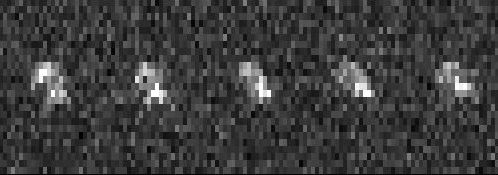
Astronomers have obtained the first images of an asteroid on course to make its closestapproach to Earth Tuesday, showing the space rock is lopsided.
The newimages, taken with the Goldstone Solar System Radar Telescope in California's Mojave Desert, refine estimates of the asteroid's size. Named 2007 TU24, theasteroid was estimated to span up to 2,000 feet (610 meters), but is nowthought to have a diameter of about 800 feet (250 meters).
Scientistsat NASA's Near-Earth Object Program Office at the Jet Propulsion Laboratory in Pasadena, Calif., have determined that there is no possibility of an impact with Earth inthe foreseeable future.
As theasteroid moved nearer to Earth, on Jan. 28, the Arecibo Observatory in PuertoRico working with the Robert C. Byrd Green Bank Telescope in W. Va. producedanother image of the asteroid. Astronomers used the Arecibo telescope, which is operated by Cornell University on behalf of the National Science Foundation, to bounceradar signals off the asteroid. The Green Bank Telescope received the echosignal and transmitted the data back to Arecibo to be transformed into animage.
Other radartelescopes were expected to point toward theasteroid as it made its closest approach to Earth, 334,000 miles (537,500kilometers), at 3:33 a.m. Eastern time Jan. 29. For comparison, the moon is anaverage of 239,228 miles (385,000 kilometers) away.
At itsnearest, the asteroid will reach an approximate apparent magnitude 10.3, orabout 50 times fainter than an object visible to the naked eye in a clear, darksky. Then, it will quickly get fainter as it moves away.
Thecombination of these telescopes will provide higher resolution images of theasteroid. Measurements from Arecibo's radar telescope will gauge the object'ssize more precisely, its speed and spin.
Like other asteroids,this one orbits the sun. Most do so in the asteroid belt between Mars andJupiter. NASA pays particular attention to those whose orbits bring them soclose to Earth.
TU24,discovered by NASA's Catalina Sky Survey on Oct. 11, 2007, is one of anestimated 7,000 near-Earth objects identified to date (another 7,000 areestimated to exist but are yet to be discovered).
"Wehave good images of a couple dozen objects like this, and for about one in 10,we see something we've never seen before," said Mike Nolan, head of radarastronomy at the Arecibo Observatory. "We really haven't sampled thepopulation enough to know what's out there."
- Video: Asteroid Hunting
- The Enduring Mysteries of Asteroids
- Image Gallery: Asteroids
