


Wobbles in the rotation of Mars swung the planet into about 40 extreme ice ages in the past 5 million years and allowed thick ice layers to remain far away from the poles, an astronomer says.
Various spacecraft have revealed evidence for ice ages on Mars. Around 4 million to 5 million years ago, precipitation events sent piles of snow and ice that accumulated around the ice caps. Nowadays, the only visible ice on Mars is the pair of polar caps. But in recent years, orbiting probes have found solid evidence for vast sheets of underground ice near the red planet's equator, at what scientists call mid-latitudes.
How ice ended up so far from the poles has remained a mystery.
The answer could be in the wobble of Mars, concludes Norbert Schörghofer of the University of Hawaii's Astrobiology Institute.
Moon mechanics
Earth's rotation axis is tilted by about 23.5 degrees, a slant that is pretty much fixed due to the gravitational influence of our moon. Mostly due to Mars' lack of a stabilizing moon, its tilt can wobble as much as 10 degrees from the current 25-degree angle.
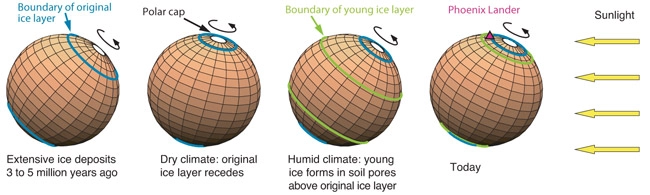
Using computer simulations, Schörghofer found that while not topsy-turvy, the wobbles change the amount of sunlight reaching Mars' surface and can cause vast amounts of ice to shift between the poles and the rest of the planet every 120,000 years.
Here's how it works: When the planet's axis swayed one way, sun rays vanished from some areas and beamed down on others. Regions beneath sunlight became dry with warmer temperatures, causing the ice to recede or disappear entirely except at the highest latitudes.
The receding ice, lost to evaporation, provided plentiful water vapor for new ice to form once the sun retracted and humidity soared. In the humid climate, Schörghofer said, the water vapor diffused into the Martian soil and froze to form"pore-ice," which is mainly soil with bits of ice that plug pore spaces.
Dual processes
The wobble would leave two types of ice on or near the surface of Mars: the very old massive ice sheet and the recent pore-ice, less than half a million years old. Dry soil covers both types of ice.
"Today, this gives rise to pore-ice at mid-latitudes and a three-layered depth distribution in the high latitudes," Schörghofer writes in the Sept. 13issue of the journal Nature. At high latitudes, the original ice sheet is covered by a layer of pore-ice, which is veiled by a layer of dry sediment.
When the Phoenix Lander spacecraft arrives at Mars, which is expected in 2008 and will land in the Martian north polar region, Schörghofer expects it will "see"the abundant and layered ice forms.
