A new exhibit aimed at promoting the importance of safety toNASA employees is using debris recovered from the loss of space shuttleColumbia to underscore its message.
Developed by the agency's space shuttle program office, the"Columbia Safety Exhibit" incorporates recognizable remnants of thefallen orbiter's hardware, including one of the flight deck window frames,control panels and hand controllers from the crew cockpit, heatshield tiles andone of the thrusters used to maneuver the spacecraft in orbit.
The concept of building a safety exhibit was spearheaded byoutgoing shuttle program manager Wayne Hale, whosenew appointment as deputy associate administrator for strategic partnershipswas announced by NASA Feb. 22. Hale described the reason behind the exhibit inan e-mail sent to employees at Johnson Space Center in Houston.
"The only bulwarkbetween an accident and a safe, successful space mission is the competence andattention of highly focused individuals. If we are to truly honor the sacrificeof these crews, we must teach that lesson to every new person that comes towork here and live each day with the utmost commitment to safety in all itsdetails," said Hale.
"To this end, we have constructed a traveling memorialthat will spend this year visiting every NASA center," he continued."We hope this memorial will provide the thoughtful contemplation of ourduty, similar to a visit to the Vietnam War memorial or Arlington,"concluded Hale.
The glass-encased, self-standing safety exhibit featuresnine components from Columbia, including four pieces recovered from thecompartment where the STS-107 crew rode. Nearby panels put each artifact intothe context of position and use within the shuttle, including a controller usedby Commander Rick Husband, a window that once overlooked the payload bay and apyro initiator T-handle from the crew's access hatch.
Heatshield tiles and wing leading edge material are alsodisplayed, as is one of the thrusters recovered from the nose of the orbiter.
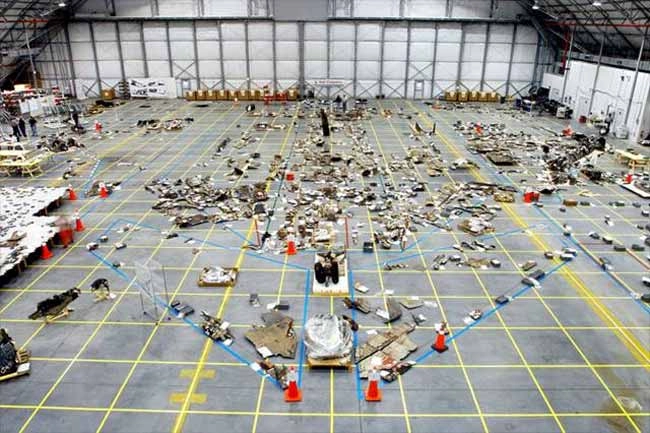
The sides and back of the exhibit show photographs of therecovery and reconstruction of Columbia as a cause for the accident was soughtand found, along with the inscription, "Everyone that touches a mission onevery level, is responsible for what it represents and the lives that areinvolved." The word "Everyone" appears in several places alone,stressing the roll of all employees.
The Columbia Safety Exhibit first went on display at theKennedy Space Center in Florida, in the lobby of one of its operation supportbuildings. Since Feb. 26, it has been on display in the lobby of Johnson SpaceCenter's headquarters building. It will remain in Houston for a few weeks,before continuing to 11 other NASA locations.
Additional stops planned for the exhibit include centers inMississippi, Alabama, Ohio, Virginia, Washington, D.C., Maryland, New Mexicoand California. Intended only for the space agency's employees, the displayareas are not accessible by the general public.
The exhibit, which pays tribute to Columbia, the crew ofSTS-107, and the recovery effort following their loss, will ultimately returnto Kennedy Space Center. There, the Columbia hardware will be added back tothe controlled storage facility on the 16th floor ofthe Vehicle Assembly Building, where all 84,000 recovered parts are catalogedand preserved for posterity and research.
Space shuttle Columbia and its STS-107 flight crew of seven astronautswere lost on Feb. 1, 2003 as they returned from space after a 16-day sciencemission. By studying the orbiter's debris, investigators concluded that a holein Columbia's left wing was caused by its own fuel tank's insulation fallingoff and striking the vehicle during launch, leading to its later break-upduring reentry.
The Columbia Safety Exhibit is not the first time NASAemployees have had an opportunity to see the debris. In addition to access tothe reconstruction hangar during the 2003 accident investigation, at least onecomponent from the orbiter, a flight data recorder, has been on displayat the Johnson Space Center since August 2007.
NASA hasloaned pieces from the debris to researchers for study but to date, thehardware has not been lent to museums, though it was reported that severalsubmitted requests for their displays. The Smithsonian's National Air and SpaceMuseum in Washington, D.C. exhibits an embroidered STS-107 mission patch thatflew on-board Columbia and was found along with the shuttle's remains.
- VIDEO: Columbia's Crew: In Their Own Words
- GALLERY: Columbia's STS-107 Shuttle Crew
- SPACE.com Special Report: The Columbia Tragedy