


PARIS — Start-up broadband satellite operator Avanti Communications Group of London has raised some $68 million in cash from institutional investors and the British government to pay the additional costs it will incur in shifting the launch of its first satellite to an Ariane 5 or Soyuz rocket instead of a Falcon 9 vehicle operated by Space Exploration Technologies Corp. (SpaceX), Avanti said.
The new financing, totaling 42.2 million British pounds ($68.9 million), includes 10.7 million pounds from the European Space Agency (ESA) that came from British ESA contributions.
The decision to switch launchers, which had long been expected, will permit Avanti to remove doubts about its viability among customers and prospective investors, Avanti said in a July 1 statement to shareholders and the London Stock Exchange.
Avanti's Hylas Ka- and Ku-band broadband and high-definition television satellite, now under construction at Astrium Satellites of Europe and the Indian Space Research Organisation/Antrix of India, is scheduled to be ready for launch in mid-2010, according to its prime contractor, Astrium.
Industry officials said Evry, France-based Arianespace agreed to reserve a slot for the 2,500-kilogram Hylas satellite in mid-2010 as either a co-passenger on a heavy-lift Ariane 5 rocket or as the main customer for a launch of the European version of Russia's Soyuz rocket. A formal launch services contract announcement is expected by late July.
Arianespace officials have said the manifest for the European Soyuz, whose inaugural flight from Europe's Guiana Space Center in French Guiana has slipped to February 2010, is crowded for the rest of that year — no more than four Soyuz launches in total are expected, including the inaugural flight — making it more likely that Hylas will fly aboard an Ariane 5.
Avanti's Hylas had been scheduled for launch in late 2009. The yearlong delay has been caused by unexpected difficulties Astrium has encountered in completing the flexible Ka-band payload, whose development has been funded in part by ESA through British government's ESA investment.
It remains unclear when the satellite will be ready for launch. Astrium Satellites Chief Executive Evert Dudok on June 16 said the Ka-band payload's development should be completed in time to ship it to India in August for integration with the platform.
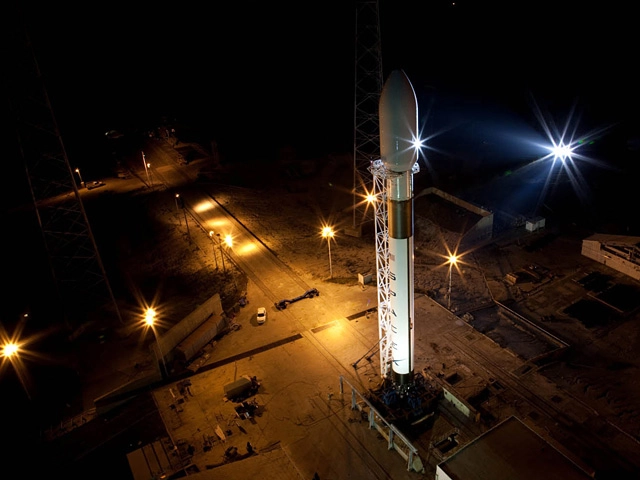
Hawthorne, Calif.-based SpaceX is also behind schedule with its new Falcon 9 launch vehicle, which previously had been slated to make its debut in 2007. Company spokeswoman Cassie Kloberdanz said in a July 9 statement that the company is on track for an inaugural launch this year. Kloberdanz said the company would have no comment on the Avanti situation.
Avanti has been leasing capacity on other commercial satellites as it awaits the Hylas launch, but Hylas remains central to the company's broadband service offer.
Avanti had criticized Arianespace as overly expensive and insufficiently entrepreneurial when it selected SpaceX in mid-2007, but industry officials have long said the company eventually would be forced to reconsider the European launch provider given the risks and delays usually associated with the development of new rockets like Falcon 9.
Avanti announced in February 2008 that it had secured a Falcon 9 insurance policy valued at 89 million British pounds covering the satellite's launch and its first year in orbit. SpaceX said at the time that the Avanti contract was valued at $150 million including the Hylas flight and three additional Avanti launches for satellites Avanti has yet to order.
In the company's July 1 statement to the London Stock Exchange, Avanti Chief Executive David Williams said the launch risk concerns of prospective customers forced Avanti to cancel Hylas' Falcon 9 launch.
"Our success in pre-sales [of Hylas capacity] has been pleasing but there are some significant potential government and commercial customers whose commitment can only be secured early by reducing the perception of launch risks," Williams said.
Williams said the company continues to negotiate with "our government sponsor" for financing a second satellite. "[W]e hope to conclude a transaction which would be highly accretive to shareholders before the end of the year. Therefore for several reasons the upgrade of our launcher increases the quality of our project strongly."
Avanti said it had already signed agreements with 47 distributors in 11 nations who "have already committed to 13 percent of Hylas capacity at launch."
Avanti spokesman Paul Dulieu said Williams would not be available to comment on Hylas' development.
A spokeswoman for the British Department for Business, Innovation and Skills on July 8 confirmed that the department's Technology Strategy Board, a partner in the British National Space Center, agreed to invest an additional 10.7 million pounds into Avanti's Hylas project through ESA's Artes telecommunications development program.
ESA and Avanti signed their initial Hylas contract in mid-2006. ESA said its financing, mainly through the British government, was in the amount of 34 million euros ($47.5 million). ESA said at the time that the entire project was expected to cost 120 million euros, with a launch then planned for late 2008.