


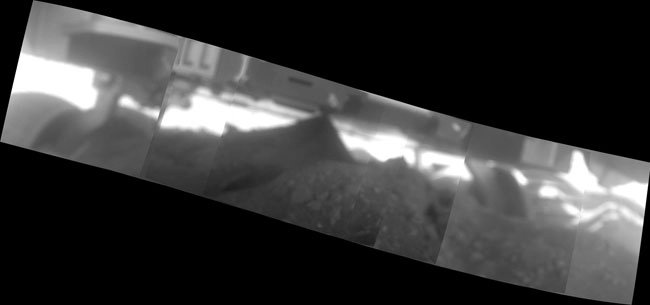
NASA?sSpirit rover, stuck in the Martian sand since May 6, has taken a picture of itsunderbelly to help mission engineers get a handle on the rover?s predicament.
Early lastmonth, Spirit was continuingits journey around a low plateau called "Home Plate," when it hitwhat one rover team member called an "insidiousinvisible rover trap."
Since then,Spirit has been mired in the sandy soil up to its hubcaps, and rover engineershave been working to try to free the rover so that it can continue its now morethan 5-year stint on the Martian surface.
Engineershad Spirit use its microscopic imager, located on the end of the rover'srobotic arm, to peek underneath itself to get a better view of its sandy trap.The operation was testedout first with Spirit's twin rover Opportunity, which is currently stilltrundling along on the opposite side of Mars, and which just reached its10-mile mark.
Thepanoramic mosaic of multiple images, taken on June 2, shows the region of softsoil now called "Troy."
Asked whythe feature was given that name, Steve Squyres, lead scientist for the MarsExploration Rover Project, said, "Well, we had to call it something."
"Thestory of Troy is a rich one, with lots of characters and events, providing agood source of related names for other things in the area. For example, some ofthe soil we're working on right now we've named Ulysses," he added in anemail to SPACE.com.
The imageappears blurred because the microscopic camera was designed to focus on targetsjust a few centimeters in front of its optics.
Scientistsare currently debating whether a small mound that appears in images to betouching Spirit's belly actually is, and whether or not it is a rock or soil,Squyres said. A rock touching the rover's belly plate would pose a greater riskto any attempt to move Spirit.
Thepanorama will help scientists with analyses and ground-based testing torecreate the rover's conditions before testing various options for extractingit from its current location.
Engineersare using a test rover back on Earth at NASA's Jet Propulsion Laboratory in Pasadena, Calif., to test out strategies for extracting the rover. The test rover isidentical to Spirit and Opportunity.
Adding tothe difficulty of that task is Spirit's hobbled right front wheel, which hasbeen dead for three years.
Some goodnews for Spirit has been the state of its energy supplies: Dust storms inrecent weeks have cleaned off the rover's solar panels, boosting Spirit'senergy supplies. While that won't give the rover more "oomph" forextracting itself, it does buy the rover team more time to try out all theiroptions for freeing the stuck rover.
- Video Show ? Rover Tracks
- Video ? Spirit: The Little Rover That Could
- Spirit Stuck in 'Insidious Invisible Rover Trap' on Mars
