





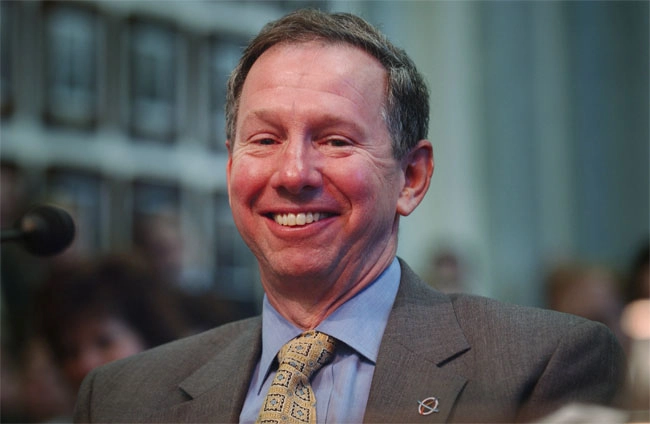
WASHINGTON - MikeGriffin gave his last speech as NASA administrator to his staff beforedeparting Washington on a ski vacation on Jan. 16, leaving AssociateAdministrator Chris Scolese to run the agency until U.S. President Barack Obamasettles on a successor.
Griffin'sdeparture and the resignation of his deputy, Shana Dale, left Scolese asthe top ranking official at NASA. Outgoing President George W. Bush issuedan executive order Jan. 16 making the 22-year NASA veteran's position as actingadministrator official.
Griffin'sparting words were marked by personal thanks to managers and staff he had ledduring nearly four years as NASA chief. He said he was heartened that staffmembers continued to work with him even as it became increasingly clear duringthe past two months that Obama would not ask him to stay on the job despite Griffin'sdesire to do so.
"I'mwell aware that as a political appointee it's very, very easy for the careerstaff to adopt what I call the belief in the hereafter - I'll be here afterhe's gone. And when that happens the agency can't get anything done becauseyou're at odds. And that by and large didn't happen in my four years here andI'm grateful to you," Griffin said.
Likethousands of other Bush appointees, Griffin submitted his resignation effectiveJan. 20, when Bush officially left office.
While Obamahad not named a successor before Griffin's last official day on the job,sources said the leading candidate was retired U.S. Air Force Maj. Gen. Jonathan ScottGration, a decorated fighter pilot and close adviser to Obama during thecampaign. Gration helped write the seven-page space policy paper the Obamacampaign released in August supporting Bush's goal of sending humans tothe Moon by 2020 and calling for narrowing the time gap between the planned2010 retirement of the space shuttle and the first flight of its successorsystem, now scheduled for 2015, sources said. The paper stood out as the mostcomprehensive NASA policy statement released by a major presidentialcandidate in recent history.
Grationheld senior policy positions in the military prior to his 2006 retirement fromthe Air Force but lacks space-related experience aside from a one-year stint in1982 as a White House Fellow working for NASA's deputy administrator at thetime, Hans Mark.
Sources hadsaid an announcement of Gration's nomination could come as soon as Jan. 14.However, a potential roadblock emerged on Capitol Hill that day when U.S. Sen.Bill Nelson (D-Fla.) warned against placing someone withoutNASA experience in the job. Nelson, who chairs a key NASA oversight panel,had previously endorsed retired U.S. Marine Corps Maj. Gen. Charlie Bolden, aformer astronaut who co-piloted Nelson's 1986 space shuttle mission, for thepost.
Bolden saidJan. 16 he had not been contacted by anyone representing Obama to discussthe administrator post.
"I'mhonored just to have my name out there," Bolden said. "I haveresisted the temptation to respond to questions about what I would or wouldn'tdo because that would be presumptuous."
Nelson,asked to comment on the prospect of Gration leading the space agency, referredto the tenure of former NASA Administrator Sean O'Keefe, who had no directspace experience before moving to NASA from the White House Office ofManagement and Budget in late 2001.
"Ithink President Bush made a mistake when he appointed someone without NASAexperience in Sean O'Keefe to head the agency. I hope President Obama's pickwill have that kind of [NASA] background," Nelson said Jan. 14 through hisspokesman, Dan McLaughlin.
Nelsonadded in a Jan. 16 statement that he hoped Obama would select someone withexperience similar to Griffin, an engineer with three decades of experience inspace and other high-technology jobs.
"MikeGriffin is a good man and was a good administrator," Nelson said. "Iam hopeful that the administration's selection to replace him has similarexperience and knowledge of the space program as Mike does."
JohnLogsdon, a space policy expert with the Smithsonian Institution's Air and SpaceMuseum here, said Gration's lack of space experience should not disqualifyhim for the job. "There are lots of NASA administrators who have come fromother areas without a background in space," he said. "You want a guywho is a leader and can manage a large organization."
Thoseformer administrators include the second and third NASA chiefs, James Webb andTom Paine, respectively. Webb was a lawyer who served in the Marine Corpsduring World War II and held several positions in Washington, includingundersecretary of the State Department and White House budgetdirector, before becoming NASA chief. Paine, an engineer by training,replaced Webb after a career as a laboratory researcher and manager who hadserved as a U.S. Navy submarine officer in World War II.
Gration,who retired from the Air Force in 2006, flew 274 missions over Iraq during andafter the first Gulf War, according to the Air Force's Web site. He toldattendees of the Democratic National Convention in August that he met then-Sen.Obama in 2005 while serving as director of strategy, plans and policy at U.S.European Command.
"That'swhen I met a leader unlike any I had met before," he said as he led aretired generals' tribute at the convention. "He asked tough questions,and he didn't settle for easy answers. It was this same way of thinking thatled him to get it right when he opposed the [current] war in Iraq,when he warned of its consequences. That's the judgment of a leader."
Grationaccompanied Obama on a five-nation, 15-day tour of Africa in 2006. He went onto campaign for Obama alongside former Navy Secretary Richard Danzig andretired Gen. Merrill McPeak, former Air Force chief of staff, as part ofObama's national security policy working group. He also served on Obama'stransition team for the U.S. Defense Department.
The son ofmissionary parents, Gration spent part of his childhood in the Congo and speaksSwahili fluently, according to a Newsweek article published in August 2007. Hejoined the Air Force in 1974 through the Air Force Reserve Officer TrainingCorps at Rutgers University in New Brunswick, N.J., where he earned abachelor's degree in mechanical engineering. He earned a master's degree innational security studies from Georgetown University in Washington in 1988.
- Video: Back to the Moon with NASA's Constellation
- On Heels of Campaign Promises, Obama Faces Big NASA Decisions
- NASA's Most Memorable Missions