


This story was updated at 6:52 p.m. EDT.
NASA istaking a look at what might be required to postpone the retirement of its threespace shuttles until their Orion capsule replacement begins operational flightin 2015, but only as a preparatory measure for Congress and the incoming president,agency officials said Friday.
The study, calledfor by NASA Administrator Michael Griffin, is aimed at preparing for inquiries onhow the agency intends to fill the gap between the shuttle fleet?s retirement in2010 and the firstflights of Orion, said John Yembrick, a spokesperson for spaceflightoperations at NASA headquarters in Washington, D.C.
?The Administratorasked the program managers to evaluate this potential of flying through 2015,? Yembricktold SPACE.com, stressing that the agency currently is not planning tofly shuttles beyond 2010. ?We?re doing the analysis so we can gather the data,and so when we?re asked we can give some smart, timely answers.?
Yembricksaid NASA officials hope to complete the study by the end of September. It wasspurred in part by a recent letter by presidential candidateJohn McCain (R- Ariz.) and other senators that beseeched President GeorgeW. Bush to avoid actions that would prevent NASA from being able to continueflying space shuttles beyond 2010. Presidential candidate Barack Obama (D-Ill.)has also pledged support for NASA?s Constellation program, which includes Oriondevelopment, and said in the past that adding additional shuttleflights to close the gap between Orion and shuttle retirement was a possibility.
NASAcurrently has a deal with Russia to fly astronauts to the International SpaceStation aboard Russian-built Soyuz spacecraft through 2011, but would have toseek new approvals from Congress to extend the agreement beyond that deadline.
An internale-mail discussing the new study was posted to the Web site of the Florida newspaperthe Orlando Sentinel on Friday.
NASA plansto launch 10 more shuttle missions by 2010 to complete construction of theInternational Space Station and overhaul the Hubble Space Telescope. Theshuttle?s successor, the Orion Crew Launch Vehicle and its Ares I rocket, arenot expected to begin crewed flights until 2015 at the latest, though NASA isworking toward an internal 2014 target for the first operational missions.
Falllaunch date under review
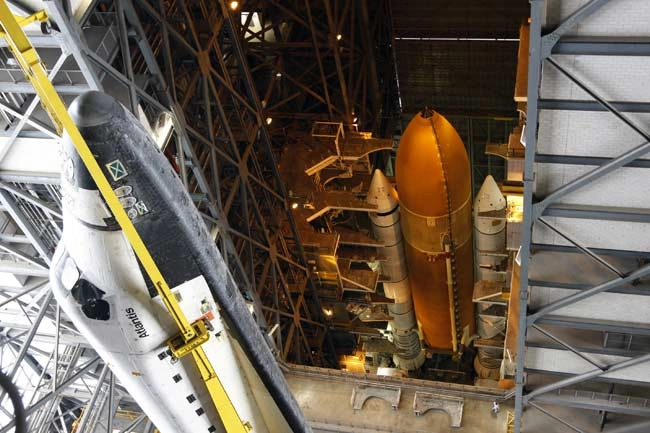
Meanwhile, NASAmission managers are discussing whether to push back the plannedOct. 8 launch of the shuttle Atlantis on the final flight overhaul the HubbleSpace Telescope due processing delays spawned the recent Tropical Storm Fay.
Fay passed overNASA?s Kennedy Space Center spaceport in Cape Canaveral, Fla., last week, forcingthe center to close for several days until the weather cleared. Challengesreadying the new instruments and replacement parts to launch toward Hubbleaboard Atlantis could delay the mission by two days or so, but NASA willcontinue to work toward an Oct. 8 liftoff as long as possible, Yembrick said.
?Because ofFay, the payload is going to be delayed getting out on the launch pad,? headded. ?If that happens, we?ll have to reassess launch dates accordingly.?
Atlantis?seven-astronaut crew will haul new science instruments and spare parts toHubble for the fifthand final service mission to the iconic orbital observatory. That equipmentwas slated to be delivered to the launch pad by Sept. 17, but may now arrivetwo days late due to Fay-related delays, Yembrick said.
NASA isalso tracking two more storms, Hurricane Gustav in the Caribbean and TropicalStorm Hannah in the Atlantic Ocean and their possible impact to space centeractivities.
As of 5:00p.m. EDT (2100 GMT), Gustav was nearing hurricane strength as it moved west-northwesttoward the Cayman Islands. The storm was about 100 miles (160 km) to theeast of Grand Cayman and moving northwest at about 12 mph (19 kph) withmaximum sustained winds reaching speeds of nearly 75 mph (120 kph), accordingto the National Hurricane Center.
The center?sthree-day projections predict Gustav will pass over Cuba and reach the coast ofLouisiana early next week. NASA?s Michoud Assembly Facility, which builds theexternal fuel tanks used for space shuttle launches, is based in New Orleans,while the agency?s Stennis Space Center that tests shuttle main engines isbased in Bay St. Louis, Miss.
Yembricksaid both the Michoud and Stennis centers will be closed after the Labor Day holidayon Monday, though employees should call in on Tuesday to be sure.
TropicalStorm Hannah, meanwhile, was passing about 215 miles (345 km) north of the LeewardIslands and moving about 12 mph (19 kph) with maximum sustained winds of about 50mph (85 kph). Current forecasts for Hannah predict the storm will turn west toward the Bahamas over the nextseveral days, according to a National Hurricane Center chart.
- Video - Hubble Service Mission 4 Countdown
- Video - Flame Trench Repair
- Video - Mock Orion Capsule Crashes to Earth
