


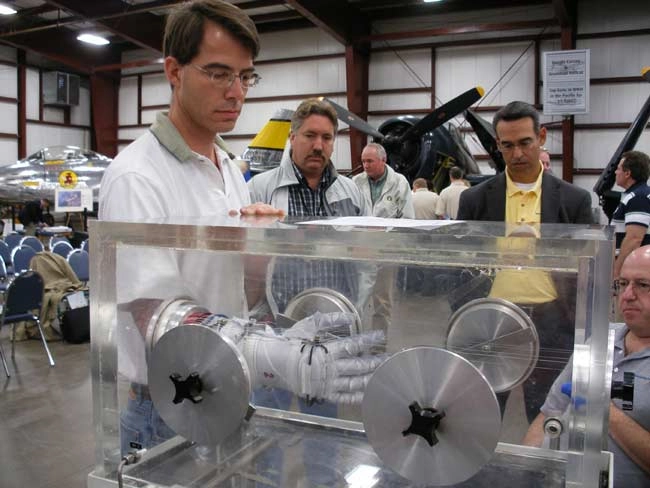
WASHINGTON – Peter Homer, an out-of-workaerospace engineer and one-time sailmaker from Maine who won $200,000 from NASA this May for an astronaut glovestitched together on his dining room table, has been hired by a start-up hopingto outfit private space explorers.
LosAngeles-based Orbital Outfitters intends to put Homer?s engineering and sewingskills to work on a pressurized space suit for suborbital space flyers. Aprototype of that suit, dubbed the IndustrialSuborbital Space Suit-Crew, was unveiled at the X Prize Cup in New Mexico in late October.
?We?vebrought Peter Homer on as a consultant initially for glove design and hopefullyother parts of the suit,? said Jeff Feige, Orbital Outfitter?s chief executiveofficer. He said Homer would continue to work out of his home in Southwest Harbor, Maine. ?I think for the moment we will work where he is,? Feigesaid. ?We?re a small company and we don?t need things right away,? he said,noting that there is not exactly a pressing demand right now for the company?swares.
Homer, amechanical and aeronautical and astronautical engineer with degrees fromRensselaer Polytechnic Institute and Stanford University, took home $200,000 inNASA?s first-everAstronaut Glove Challenge by demonstrating that a glove he designed couldperform at least as well as NASA?s current space glove – built by HamiltonSundstrand and ILC Dover– in a variety of dexterity, flexibility and durability tests held over atwo-day period.
OrbitalOutfitters landed its first contract last year to design the emergencypressure suits for a piloted suborbital vehicle being developed by XCORAerospace of Mojave, Calif.
OrbitalOutfitters also is working with a sister company called Space Diver on apressure suit it hopes will enable some individual to blow past the high-divingrecord Joe Kittinger set in 1960. Kittinger, then a young militaryofficer, jumped from a helium balloon hovering above 30 kilometers in altitudeas part of a U.S. Air Force research project on high-altitude bailouts.
Feige saidbreaking that longstanding record is a step toward the companies? goal offinding the right combination of space suit and suborbital vehicle that willallow thrill-seeking individuals to sky dive from the edge of space, an altitudesome 70 kilometers above where Kittinger made his jump.
- VIDEO: The 2007 X Prize Cup Highlights
- Future of Flight: Space Tourism, Investment and Technology
- Complete Coverage of the Wirefly X Prize Cup