LAS CRUCES, New Mexico -- The dust hasn't yet settled at this year's Wirefly X Prize Cup, but both the event's founders and participantsare taking a look at next year's event and beyond.
The cup was founded by the creators the Ansari X Prize, the $10 million prize package offered to anyone who could launch a re-usable sub-orbital spacecraft, capable of carrying passengers, twice in a two week period.
The prize was won on October 4, 2004 by SpaceShipOne, a revolutionary spacecraft designed by maverick aerospace engineer Burt Rutan and financed by Microsoft co-founder and entrepreneur Paul G. Allen.
Building on the success of that competition, the WireFly X Prize Cup was launched in 2005. The two-day affair involves plenty of roaring rockets, privately-built spaceships and cash awards.
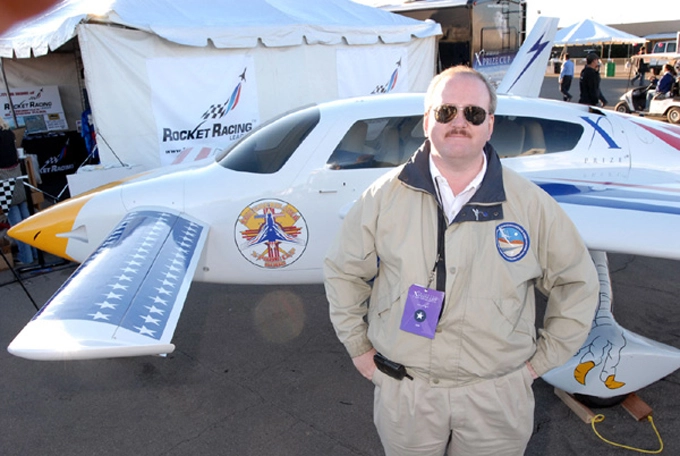
Nextyear's festivities will showcase the Rocket Racing League's X-Racer--a rocketplane powered by a powerful liquid oxygen/kerosene rocket engine. The RocketRacing League (RRL) is an aerospace entertainment organization which combinesthe competition of air racing with the excitement of rocketry.
XCORAerospace of Mojave, California is led by Jeff Greason, with his team providing theworkhorse engine for the Rocket Racing League. Their team is now busy at workon the engines, pumps and various components to assure the X-Racer vehicles areready for flight.
"We'reintegrating the whole air frame, outfitting the rocket plane with avionics andthe propulsion system. We're also doing the flight test prior to delivery tothe Rocket Racing League," Greason told SPACE.com.
Greasonsaid they'll be busy wringing out technical and production bugs in an expansiveflight test program.
XCORis also working on a suborbital vehicle--an intermediate craft--that leads to thecompany's Xerus rocket plane. "The intermediate vehicle we'll put in the airfirst," Greason added.
Space cowboys
Eachyear, the X Prize Cup here is bringing the public and space technology face toface.
Accordingto John Carmack, head of Armadillo Aerospace--a band of rocketeers fromMesquite, Texas--the hobby shop look to private space endeavors is of greatbenefit.
"There'sa lot to be said for the inspiration factor here. I think the biggest benefitfor what we do is that we sort of look like this garage operation. People havecalled us the cowboy space people," Carmack said.
Peoplelook at Armadillo Aerospace hardware and see that they can work on rocketry,too, Carmack explained: "It's not like the [NASA] space shuttle and all this 'shockand awe' of national pride."
Hiscompany's suite of rocket hardware shows that non-government groups can advancethe state of available space technology. "It's now approachable and can bebrought to a level that people can think: 'Hey, this is something I want to do.'"
Growth curve
XCOR'sGreason said the evolution of the private space industry is like a lot of othertechnologies--it's on an exponential growth curve. Therefore, there is nodefining breakthrough moment to spotlight. But things are accelerating, headded.
"Youcan look around and see a lot more happening this year than last year. And Ithink a lot more is going to happen next year," Greason observed. "I thinkpeople get excited about space again when they think some day they might get togo," he said.
Nowthat more people are sensing that might be a possibility, Greason believes thatboth private space industry and the national civil space program agenda benefit.
"Explorationis a lot more interesting when you think," Greason said. "Some day, you andyour kids might get to go see those places that are being explored."
Youth repair for aging workforce
RickHomans, Spaceport Authority Chairman and New Mexico Economic DevelopmentDepartment Secretary, said that he's looking forward to next year's flights ofthe X-racers, competing with each other in a virtual sky track. "That'll be areal crowd pleaser," Homans said.
Asfor the future of the X Prize Cup, Homans said he wants to increase the numbersof kids attending the yearly event, from all states. Opening day of the WireflyX Prize Cup saw thousands of kids race through the gates.
"Thelook on the faces of the kids was just extraordinary. To me, that was sofulfilling in terms of what this is all about," Homans said. The aerospaceindustry desperately needs a new workforce, with so many now-working expertsretiring over the next 10-15 years, he said. "They need to get peopleinterested in math, science and engineering if we're going to be a leader."
Everyyear at the X Prize Cup, Homans said, there are going to be advances intechnology. "So the more we can exhibit, display and show in the latesttechnology, that's what the X Prize Cup is all about."
Homanssaid that he's looking for more flights, more launches, more testdemonstrations, as well as bring more cash-prize competitions to the X PrizeCup.
Ayear will also make a big difference at New Mexico's Spaceport America. By roughly thistime next year the facility is expecting to earn its license to operate fromthe Federal Aviation Administration's commercial space transportation office.
Bythe spring of next year, full design of Spaceport America is to beconcluded, Homans said.
"Wewill begin construction by the end of 2007. This time next year we should beright on the verge of actually breaking ground at the spaceport. That's goingto be very exciting," Homans added.
- VIDEO: Complete Coverage of the X Prize Cup
- LIVE Coverage of the X Prize Cup
- Lunar Lander Rocket Flies But Fails In Bid For Prize Dollars
- Challenges Ahead for Spaceport America
- Astronaut Advice for Future Space Tourists
- Progress Touted In Private Space Travel
- Showtime for Spaceship Builders
- Space Elevator: Hoist to the Heavens