





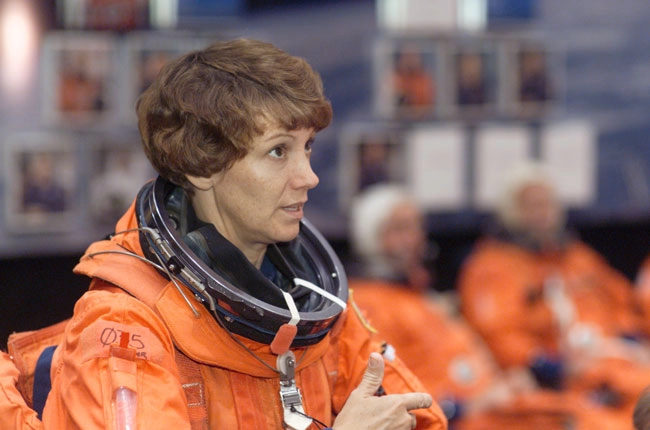
NASA astronaut veteran EileenCollins, the first woman to pilot and command a U.S. spacecraft, ishanging up her orbital wings to pursue more terrestrial exploits, the spaceflightveteran said Monday.
"It has been wonderful," Collinstold SPACE.com of her shuttle flight career. "The number one thing forme now is to spend time with my family."
Collins, 49, commanded NASA's first shuttle mission - STS-114aboard Discovery - since the 2003Columbia disaster, and is a veteran of four orbiter flights throughout anearly 16-year astronaut career.
"Eileen Collins is a living, breathingexample of the best that our nation has to offer," said NASA chief MichaelGriffin, in a statement. "She is, of course, a brave, superb pilot and amagnificent crew commander."
But the experienced shuttleastronaut will not plunge into a post-spaceflight career immediately. Collinssaid she's reserved the entire upcoming summer to spend with her husband, Pat Youngs, daughter Bridget, 10, and son Luke, 5.
"They've put up with all of mytraining schedules and then I was gone for five weeks over last summer,"Collins said of her family, citing the threeweeks of quarantine and two weeks in space during her last mission, not tomention the many national and international appearances that followed herreturn. "Now that it's been eight or nine months, I'm just going to chill outand finish the remaining work to be done from STS-114, then it's on tosomething new."
Collins said she hopes herretirement will also allow newer astronauts an opportunity to fly before the shuttlefleet itself retires in 2010. Though a native of Elmira, New York, Collinssaid she will remain in Houston, Texas - home to NASA's Johnson Space Center -for the time being.
"It's important to me that theseyoung people get a chance to fly," Collins said. "It's very important to thecountry to have more people that have flown in space because we take thatspaceflight experience with us, which is a valuablething to have when you go on to design future spacecraft and educate youngpeople."
Collins is a graduate of SyracuseUniversity, where she studied mathematics and economics, and received twomaster degrees from Stanford University and Webster University, respectively. Shecompleted her U.S. Air Force Undergraduate Pilot Training at Oklahoma's VanceAir Force Base in 1979 and was teaching serving as a mathematics and flightinstructor at Edwards Air Force Base when selected as an astronaut.
Female firsts
NASA selected Collins to join theastronaut corps in 1990 and she completed her initial training one year later.But her interest in spaceflight took root much earlier.
"When I was in fourth grade, I readthis article on the Gemini program," Collins said, adding that it was a JuniorScholastic story on whether the country should invest in space or not. "I'mnine years old and I'm thinking, 'Why would anybody say no?' Of course we needto go out in space."
Collins became NASA's first femaleshuttle pilot in 1995 during the space agency's STS-63 mission aboard Discovery,the first to the Russian space station Mir. She also served as pilot duringNASA's STS-84 Atlantis flight to the Mir station in 1997, before becomingNASA's first female shuttle commander in 1999 when she led the Columbiaorbiter's STS-93 mission that launched the Chandra X-ray Observatory.
The shuttle veteran retired from theU.S. Air Force with the rank of colonel in 2005 and has logged more than 872hours in space during her four flights.
Collins said she's felt theimportance of her shuttle firsts when speaking with young women outside of NASAwho are eager to learn how they can become astronauts as well.
"So there has been an impact and Ihope that it's been a positive one," Collins said. "I hope that if I'm going tobe a role model that I can be a good role model."
At the astronaut level, however, thedifferences between male and female astronauts stem only from their workcapabilities, she added.
"Within the job itself, themale-female commander, the male-female astronaut, it's really the same,"Collins said. "What really matters is how the person does their job."
Returning to flight
As commander of the Discoveryorbiter during the July-August 2005 flight of STS-114, Collins led her sixfellow crewmates on NASA's first shuttle flight since the 2003 loss of theColumbia orbiter and its crew.
"My crew trained for four years forthat mission," Collins said, adding that initial delays and then the Columbiaaccident pushed her mission to its July 26, 2005 launch.
The risk-filled mission tested aseries of shuttlesafety improvements, inspectiontools and fueltank modifications, as well as restocked the International Space Stationwith vital supplies. Collins has said in the past that she was surprised of thefueltank foam loss seen during the launch of her last flight, especially sinceNASA had spent more than two years working to prevent such debris after asimilar problem led to the Columbia accident.
The space agency has since takensteps to further reduce foam launch debris for its second return to flightmission, STS-121aboard Discovery to launch in July.
"I'm expecting a very successfulmission on STS-121," Collins said.
Collins' STS-114 spaceflight alsomarked the beginning of the end for NASA's shuttle program, which is now set toretire in 2010 after up to 17 more flights to finish ISS constructionand service the HubbleSpace Telescope.
"That's the right thing to do,"Collins said of the shuttle program's retirement. "The shuttle is getting old,but we still have a capability to use it to finish building the space station.And we've got a good plan to gradually phase out the shuttle and bring in the Crew ExplorationVehicle."
Collins said the CEV is particularlyexciting, because NASA hopes to use the spacecraft not only to returnastronauts to the Moon, but also push towards Mars in the future.
"I am very excited to gettingsomeday some people to walk on Mars," Collins said, adding that she hopes theU.S. takes the lead in that exploration effort. "Maybe I have a gene for this,but it's the right thing to do."
- STS-114 Astronauts Share Spaceflight Experience with Students
- STS-114 Commander Brings Letterman Up to Speed
- Flying in the Front Seats: A Look at STS-114's Commander and Pilot
- Special Report: NASA's STS-114 Return to Flight Mission
