





HOUSTON - While NASA officials hope for a smooth flight of the Space Shuttle Discovery launches later this year, mission managers are still planning for the worst-case scenario.
A contingency plan that uses the International Space Station (ISS) as a second home for Discovery's seven crewmembers is in place in the remote chance that the orbiter suffers critical damage and can't return to Earth.
"We are still going to fly with some risk," said Wayne Hale, deputy director for NASA's shuttle program, here at Johnson Space Center. "To characterize it otherwise would be inappropriate."
NASA has trained the crew of the follow-up to Discovery's flight, the STS-121 mission aboard Atlantis, to be prepared to launch within 35 days of the start of a contingency plan. That rescue mission - which would then be called STS-300 instead - would fly a reduced number of astronauts up to pick up Discovery's seven-person crew.
Risks remain
Hale said there is still a chance that foam insulation or other debris might strike the shuttle during future launches, though NASA officials have said they don't expect chunks larger than marshmallows to fall off during liftoff.
A suitcase-sized chuck of external tank foam insulation doomed the Columbia mission and seven-astronaut crew in 2003. The foam fell from Columbia's external fuel tank at launch and damaged the orbiter's left wing severely enough that the shuttle broke up during reentry.
First things first: Discovery is currently set to launch no earlier than May 15, though delays in the shuttle's delivery to its launch pad may push the date forward into a flight window that extends through June 3.
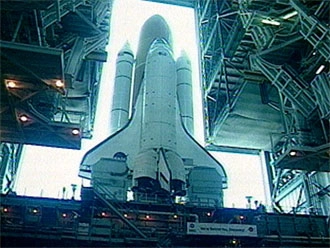
Discovery reached its launch pad early today at the Kennedy Space Center in Cape Canaveral, Florida after a slow crawl from the Vehicle Assembly Building that involved two minor delays. One of the delays was caused when a crack was discovered in the foam insulation of the external fuel tank. NASA officials said the crack was minor and would not prevent the planned liftoff.
This first shuttle to fly since Columbia, Discovery will carry the STS-114 mission crew on an ISS-bound spaceflight.
NASA redesigned the shuttle external tank for Discovery's mission though there were some concerns with the insulation this week.
Before the shuttle rolled out to its launch pad Wednesday, engineers found a small crack in the foam covering Discovery's external tank. While no larger than a strand of hair, the crack did put a hold on Discovery's roll out activities to allow time to photograph the area and relay the images to tank designers at NASA's Michoud Processing Facility in Louisiana.
Michoud officials, however, said the crack was not a concern for launch and the shuttle later rolled out to the launch pad.
Living on station time
The shuttle-ISS contingency plan was designed to give astronauts an alternative to returning home with a damaged ship. The plan calls on shuttle crews to take safe haven aboard the space station until a rescue boat could be launched to ferry them back to Earth.
The addition of seven astronauts to the two-person crew of the ISS would make for close quarters, but station managers said it is oxygen that could be the concern for such a contingency plan.
"Our system today is designed for a maximum of three to six crew, and for six just temporarily," said ISS program manager Bill Gerstenmaier.
With nine astronauts on station, ISS managers would have to make the most of supplies aboard the orbital outpost by running the primary source - a finicky Russian oxygen generator called Elektron - as well as use oxygen stored in onboard tanks and solid candles.
Currently the ISS has plenty of food and water to support an extended stay by a shuttle crew, and STS-114 commander Eileen Collins has said her orbiter will likely carry added supplies of both as a safety measure. Discounting the Elektron device, which has been working off and on recently, ISS managers believe the station should be able to support a nine-person crew complement for about 45 days.
"I think conditions won't be good on the station, but they'll be better than the alternative," Gerstenmaier said. "We kind of always plan for the worst, but hope for the best."
Rescue ship Atlantis
While the loss of one shuttle is certainly a catastrophe, the loss of two would be even worse.
"If we had a catastrophic failure with Discovery, we'd need to figure out how to prevent that same problem from occurring on Atlantis," Hale said.
Veteran astronaut Steven Lindsey, commander of STS-121, said that his crew would likely be cut down to four astronauts to free up space for the STS-114 crew.
After an extended time in orbit and the limited availability of exercise equipment aboard the ISS, Discovery astronauts would likely suffer at least some bone and muscle loss. New recumbent seats would be used on a rescue flight to allow returning astronauts to ease their return to the gravity by riding out a shuttle landing lying down, Hale said
NASA officials haven't ruled out the possibility that a returning rescue flight might, on its own suffer some emergency and could force both shuttle crews aboard to bail out.
Engineers have added extra rings to the shuttle's bail out pole - which astronauts use to fling themselves clear of the orbiter wing during an emergency egress - to account for an added crew complement during a rescue mission. But depending on the state of Discovery's crew, should such an action be required, the STS-300 crew may have to assist returning astronauts in the egress maneuver, NASA officials said.
"We have looked at that and it is a doable thing but the margins are small," Hale said. "It's better to have a plan, than to not have one."
- Special Report: NASA's Return to Flight
