newsarama.com
advertisement


The Astra 1K satellite is prepared for launch atop a Proton rocket.


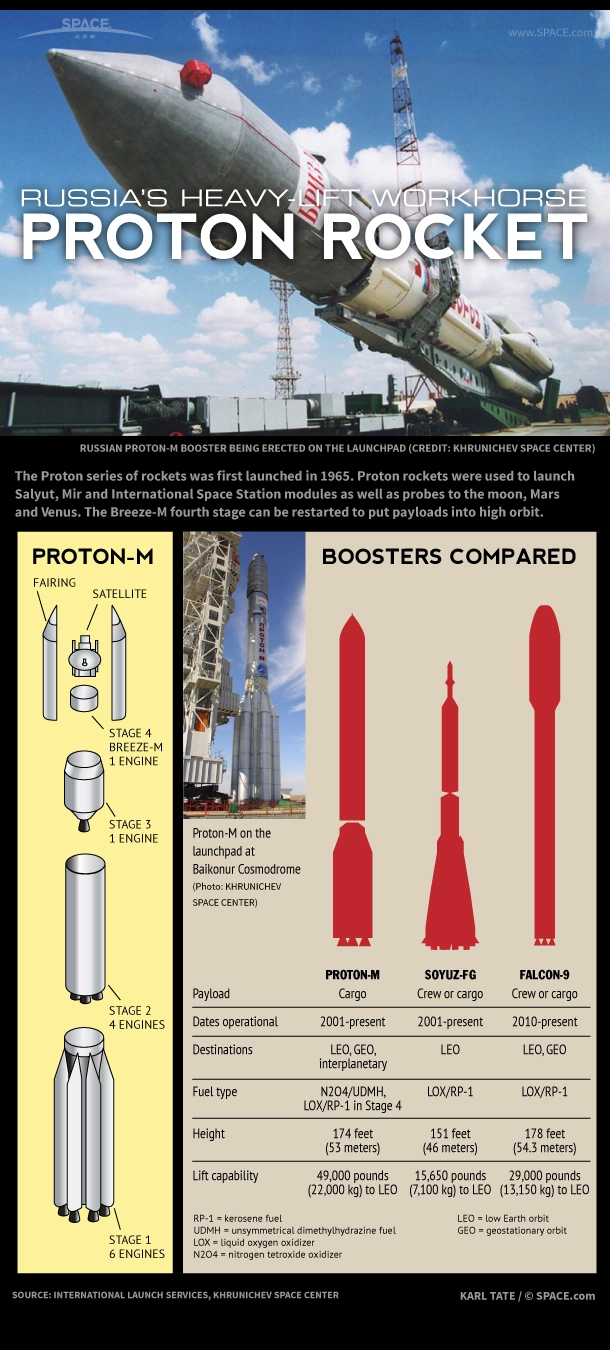
A Proton K rocket lifts off from the Baikonur Cosmodrome in Kazakhstan on Nov. 25, 2002 carrying the Astra-1K satellite.
Proton Launches Integral Spacecraft on Heels of Soyuz Disaster
Proton-K Rocket Carrying US Satellite Launched from Baikonur
Proton Delivers Military Satellite into Earth Orbit
Proton Upper Stage Fails, Leaves Astra 1K in Useless Orbit
By Jim Banke
Senior Producer,
posted: 02:00 am ET
26 November 2002


CAPE CANAVERAL, Fla. -- The upper stage of a Proton K rocket failed to work as expected Monday night, leaving a European communications satellite stranded in a low Earth orbit, International Launch Services (ILS) officials said.

Now floating uselessly in a 109-mile-high (175.5-kilometer-high) orbit inclined 51.6 degrees to the equator is the Astra-1K satellite built by Alcatel Space for SES ASTRA, which in turn is a subsidiary of SES GLOBAL.

"We extend our sincerest condolences to SES-ASTRA and SES-GLOBAL for the apparent failure of the Block DM to place the Astra-1K satellite into the proper orbit," ILS President Mark Albrecht said in a prepared statement.

"We have a long history of success with the SES-GLOBAL family of companies -- SES was the first commercial customer on Proton. We have several missions next year with SES companies, and we are committed to providing timely, reliable service," Albrecht said.

The satellite delivery mission started well with a picture perfect launch from the Baikonur Cosmodrome in Kazakhstan at 6:04 p.m. EST (2304 GMT).

The four-stage Proton K rocket worked well up to and including the first firing of the Block DM upper stage, which placed Astra-1K into its parking orbit.

Two additional firings of the Block DM were scheduled to push the satellite into a geosynchronous transfer orbit after which spacecraft separation was planned almost seven hours after liftoff.

According to ILS, "preliminary flight information indicates that the second burn of the Block DM upper stage did not occur as planned, and the Astra-1K satellite was separated into the parking orbit."

A Russian State Commission is being formed to determine the reasons for the anomaly, according to an ILS news release. The company also will form a review board to determine what happened and how to prevent it from happening again.

"We will work diligently with our partners to return the Block DM to flight as soon as possible for its few remaining missions on the ILS manifest," Albrecht said.

ILS' next Proton mission is targeted for later this month. It is to launch Telesat Canada's Nimiq-2 satellite on a Proton M rocket that features the Breeze M upper stage. The Breeze M has flown successfully eight times in various configurations, ILS said.

The Proton K rocket has flown 24 commercial missions for ILS since 1996. All of them have used the Block DM upper stage. One mission failed in December 1997 and its Block DM upper stage was to blame.

It's unclear at this point what the ultimate fate of the Alcatel Space-built satellite will be and there was no immediate word on whether or not the satellite was able to deploy its solar arrays and was healthy.

At the very low Earth orbit the spacecraft now is in it won't remain in orbit long unless it is able to use its own onboard propulsion system to raise its altitude.

The Interfax news agency quoted Russian officials as saying the satellite is expected re-enter Earth's atmosphere by this Saturday.

Industry observers contacted overnight suggest that if the satellite is able to remain healthy and in a higher, stable orbit, it's possible SES-ASTRA may still find some engineering use for it. But it's more likely to be declared a total loss for insurance purposes.

Interestingly, if Astra-1K is raised into a slightly higher orbit and can survive, it's at least theoretically possible NASA's space shuttle could be dispatched to rescue the satellite by having spacewalkers attach a new upper stage to send Astra-1K into a geosynchronous transfer orbit. This was done in May 1992 when an Intelsat spacecraft was saved with the help of shuttle Endeavour and crew.

Astra-1K is the largest satellite ever built by Alcatel Space and company officials say it also is the largest civil communications satellite in the world.

The satellite was intended to replace three ASTRA satellites now in orbit and serve as an orbital spare for four others. Alogether Astra has a constellation of 13 operational spacecraft. Astra-1K was to have been number 14 and provide direct broadcast television, radio and Internet access service to customers all over Europe.


Orion Observer 70mm Altazimuth Refractor Telescope
$129.95
Explore More


Site Map | News | SpaceFlight | Science | Technology | Entertainment | SpaceViews | NightSky | Ad Astra | SETI | Hot Topics
Image Galleries | Videos | Reader Favorites | Image of the Day | Amazing Images | Wallpapers | Games | Community
about us | FREE Email Newsletter | message boards | register at SPACE.com | contact us | advertise with us | terms & conditions | privacy statement
DMCA/Copyright
  What is This?