

NEW YORK -- Russia launched a trio of navigation satellites Saturday, aiming to replenish and improve the nation's global positioning constellation.
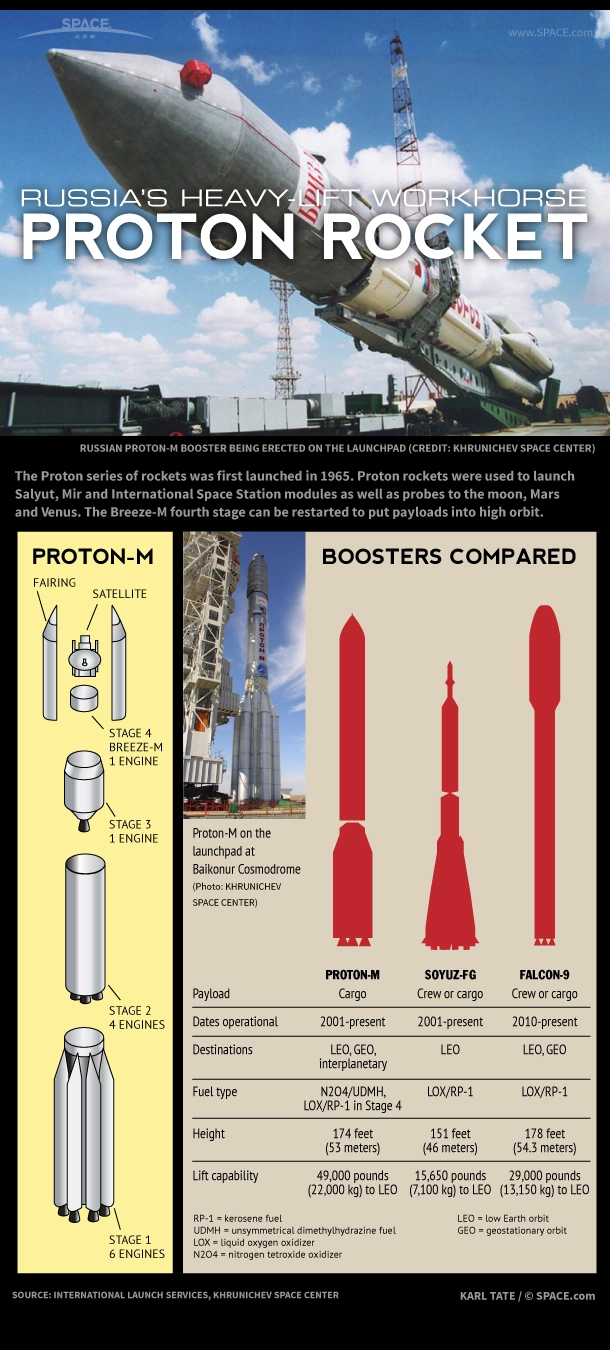
A Proton-K rocket blasted off from the Baikonur Cosmodrome in Kazakhstan at 1:04 p.m. EST (1804 GMT), carrying two standard Uragan (Hurricane) spacecraft and a brand-new Uragan-M satellite for the GLONASS network -- the Russian equivalent of the U.S. Navstar Global Positioning System (GPS).
The introduction of newer Uragan-M satellites promises to reduce operating costs of the GLONASS network thanks to the spacecraft's longer operational lifetime, officials said.
After reaching an initial low Earth orbit, the DM upper stage of the Proton rocket boosted all three satellites into an elliptical orbit with an apogee (the highest point) 19,100 kilometers above the Earth's surface, with an inclination of 64.8 degrees to the Equator.
After separation from the upper stage, each 1.5-ton satellite was expected to use its own propulsion system to circularize its orbit and move into a final orbital position within the GLONASS network.
Saturday's shot marked the 30th launch of a Proton rocket lofting a cluster of Uragan spacecraft since 1982, when the deployment of the GLONASS network began. A previous launch of Uragan spacecraft took place in October of last year.
The NPO PM development center in the Siberian town of Zheleznogorsk conducts overall development of the GLONASS system, while PO Polyot in the city of Omsk builds the Uragan spacecraft. GLONASS system
Proposed in 1976, the GLONASS network was designed to provide highly accurate navigational and time reference data for the Soviet Air Force, Navy and Strategic Missile Forces.
Originally, the constellation was expected to include as many as 24 Uragan spacecraft spread over three different orbital planes. The radio-signals from the satellites would allow determining the position of the aircraft, ships and ground installations with an accuracy of up to 10 to 15 meters anywhere in the world.
Following in the footsteps of its American counterpart, the GLONASS network became available to civilian users at the beginning of the 1990s. Russia and the U.S. also cooperated on integrating GPS and GLONASS systems, so the users could take advantage of both networks.
However, as seen with the rest of Russia's space infrastructure, the GLONASS fell victim to the nation's economic woes.
The capabilities of the network diminished during the 1990s as Russia failed to replace aging Uragan satellites, which have a nominal lifespan of only three years. As of November 27, only six Uragan satellites -- launched last year and in 1998 -- were functioning in orbit.
To solve the problem, the NPO PM has developed the Uragan-M spacecraft and designed it to survive in space twice as long compared to its predecessors.
To slash the cost of the GLONASS system even further, Russian space officials hope to conduct further launches of the Uragan spacecraft on board smaller Soyuz-Fregat rockets launched from Russia's northern Plesetsk Cosmodrome. According to unofficial estimates, the Soyuz-Fregat could cost twice as less, compared to the more than $100 million price tag on the Proton booster.