





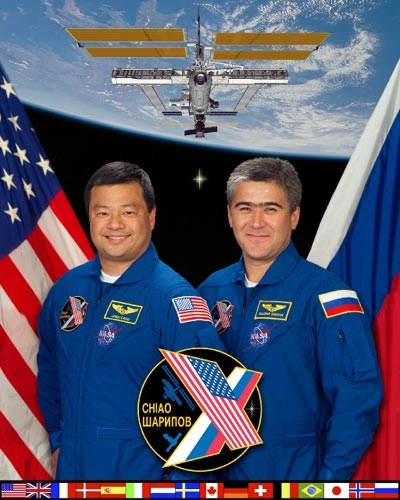
HOUSTON - Asthe two-man crew of the International Space Station (ISS) prepares to returnhome after six months in orbit, a fresh trio of astronauts is counting down toan April launch to the orbital laboratory.
ISSExpedition 10 commander Leroy Chiao and flightengineer Salizhan Sharipov areset to drop back down to Earth aboard their Soyuz 9 spacecraft on April 24 atabout 6:00 p.m. EDT (2000 GMT), effectively ending the first long-durationspaceflight for both astronauts.
"It's beenquite an impact...watching the Earth go by there knowing how much life isthere," Chiao said to reporters here at Johnson Space Centerduring a video link. "It's beautiful, even the parts where I know there isstrife and war, it looks so peaceful from here."
Meanwhile,the astronauts of ISS Expedition 11 - led by Russian cosmonaut Sergei Krikalev with NASAastronaut John Phillips serving as flight engineer - are spending their finalweeks on Earth conducting fit checks inside their Russian-built Soyuzspacecraft. European Space Agency (ESA) astronaut Roberto Vittori, an ISSvisitor, will join the Expedition 11 crew during the launch.
For better and worse
Chiao andSharipov are in the homestretch of a mission that hashad its share of surprises.
In recentweeks, the space station has suffered a few glitches - by now familiar to boththe crew and ground controllers - including a lost gyroscopestabilizer due to a power glitch and an Elektron oxygengeneratorthat won't quite stay on. The crew also overcame a potentially serious food shortageearly in their mission that forced them to modify their caloric intake until afresh Russian cargo ship arrivedon December 25, 2004. The arrival of a secondProgress cargo ship on March 2, 2005 boosted onboard food supplies.
"In termsof consumables, [the station] is in better shape than at the mission's start,"ISS Expedition 10 increment manager Susan Brand told SPACE.com.
The spacestation's U.S-built gyroscope attitude control system, however, is a bit worsefor wear, Brand said.
The ISS iscurrently relying on two functional gyroscopes - the minimum required withoutresorting to Russian thrusters - after circuit breaker failed last month.Meanwhile, the station's finicky Elektron oxygengenerator, which was working for about 30 hours over the weekend beforeshutting down, has had to be repeatedly nursed by the Expedition 10 crew.
"It justswitches off every now and then," said Sharipov ofthe Elektron, which he has been working withthroughout the mission. "The situation is such that we have plenty of oxygen onboard."
A long run for space veterans
Chiao andSharipov have been living aboard the ISS sinceOctober, when they took overstation operations from Expedition 9'sGennady Padalka and Michael Fincke.Since then, they have conducted two spacewalksto install science hardware to the station's exterior and prepare the outpostto receive an unmanned European cargo ship due to dock sometime next year.
Though both Chiao and Sharipov are spaceflight veterans,Expedition 10 marks the first long-duration spaceflight for both men.
Sean Roden, flight surgeon forExpedition 10, said the station crew is in great shape and has completelyrecovered from their earlier dietary constraintsduring the food shortage.
"They've adapted perfectly," Rodensaid of Chiao and Sharipov'sacclimation to long-duration spaceflight. "The amount of weight they lost[during their adjusted diet] was insignificant."
Roden said the Expedition 10 astronautshave exercised rigorously to maintain muscle strength and bone density despitethe lack of gravity aboard the ISS. An added bonus, he said, has been theavailability of a resistance exercise device resembling a set of football shoulderpads connected to the station floor with thick elastic bands.
"This is the first mission that we've been able to use thisdevice during the entire mission," Roden said of theresistance exercise device. "The equipment has performed flawlessly."
The second scientific paper based on research by groundscientists and an ISS crew will be published this month in the April issue ofthe Journal of Trauma, which theExpedition 10 astronauts contributed to. The first scientific paper featuringresearch collected by ISS astronauts appeared in the online edition of Radiology in November 2004. Data fromthat study was conducted by Expedition 9 astronauts.
The next ISS crew await
The Expedition11 crew and Vittori are currently set to launchspaceward aboard their Soyuz TMA-6 spacecraft at about 8:45 p.m. EDT on April14 (0045 April 15 GMT) from Baikonur Cosmodrome in Kazakhstan and arrive at the spacestation two days later.
Krikalev,Phillips, Vittori and their backup crew havecompleted flight training at Baikonur and were set toreturn to Russia's Star Citytoday, the Russian news service Interfax reportedtoday.
Krikalevtold reporters that he and his crew are "ready for the flight," Interfax reported.
Expedition11 is expected to host at least one - if not two - space shuttle crews as partof NASA's return to flight efforts. The space shuttle Discovery is currentlyslated to launch toward the ISS no earlier than May 15, with its follow-up mission- STS-121 aboard Atlantis - is scheduled to launch in mid-July. Both missionswill test new safety tools and techniques for shuttle flight.
Krikalevand Phillips are also expected to conduct two spacewalks during their mission,the first in U.S.spacesuits and the second in Russian-built Orlansuits, for station assembly and science activities.
More science aboard ISS
Don Thomas,ISS program scientist, told reporters today that Expedition 11 will mark asubstantial rise in space station science. Not only do flight controllers planto loft new science racks to the ISS during the upcoming shuttle flights, butthe added launch capability of the two shuttle flights also allows researchersa chance to resume studies that have been limited in the past due to launchrestraints.
"Over thelast few years, we have only sent about 100 pounds (45 kilograms) or so ofscience equipment to the station," Thomas said, adding that the lack of shuttleflights - which were grounded after the Columbiaaccident - accounts for the low number. "During Expedition 11 we will belaunching 4,000 pounds (1,814 kilograms) of scientific equipment to the spacestation."
Two Russiancargo ships are also set to dock at the ISS during Expedition 11, with thefirst - Progress 18 - set to dock on June 10 while its successor slated toarrive on August 26.
NASA flightcontrollers said today that Chiao and Sharipov will spend the next two weeks preparing forExpedition 11's arrival. After about eight days of handover activities, the Expedition10 crew and Vittori will board their Soyuz TMA-5spacecraft and make the plunge Earthward.
By the endof their mission, the Expedition 10 crew will have spent 192 days in space.After landing on the steppes of Kazakhstan,they will be taken to Russia'sStar City for three weeks of physicalrehabilitation to reacclimatize themselves to gravity's pull.
