





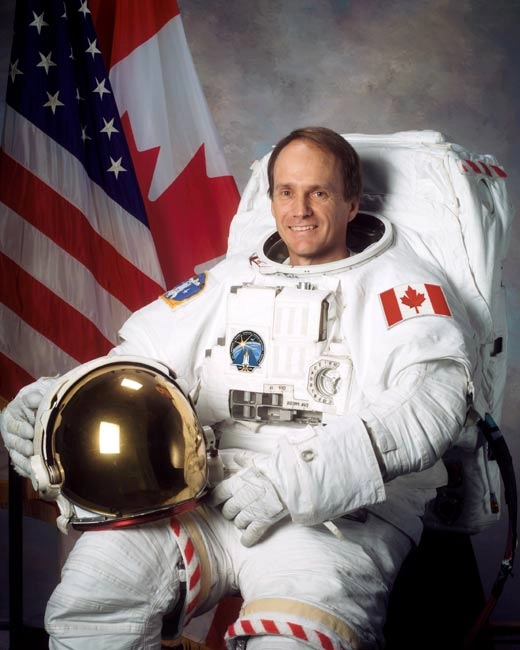
NAME: Steven "Steve"Glenwood MacLean (Ph.D.)
Astronaut, Canadian Space Agency
PERSONAL DATA: Born December 14, 1954, in Ottawa,Ontario, Steve MacLean is married, with children.
EDUCATION: Attended primary and secondaryschools in Ottawa. Received a Bachelor of Science (Honours) in Physics in 1977and a Doctorate in Physics in 1983 from York University in Toronto, Ontario.
SPECIAL HONORS: Recipient of the President's Award(Murray G. Ross Award) at York University (1977), a Natural Sciences andEngineering Research Council (NSERC) Postgraduate Scholarship (1980), twoOntario Graduate Scholarships (1981, 1982) and a NSERC Postdoctoral Fellowship(1983). Honorary Doctorate of Science from the Royal Military College inSaint-Jean, Quebec, another from York University, Toronto, and a third fromAcadia University, Halifax.
EXPERIENCE: From 1974 until 1976, Steve MacLeanworked in sports administration and public relations at York University, andcompeted with the Canadian National Gymnastics Team from 1976 to 1977. He taughtpart-time at York University from 1980 until 1983, and then became a visitingscholar at Stanford University under the renowned laser physicist and NobelLaureate A.L. Shawlow. As a laser physicist himself, MacLean's research hasincluded work on electro-optics, laser-induced fluorescence of particles andcrystals, and multi-photon laser spectroscopy.
Selected as one of the first six Canadian astronautsin December 1983, MacLean began astronaut training in February 1984. From 1987to 1993 MacLean was the Program Manager for the Advanced Space Vision System(ASVS), a computer-based camera system designed to provide guidance data thatenhances the control of both Canadarmand Canadarm2.In addition he was the Program Manager for the first prototype of the LaserCamera System that now flies as part of the Inspection Sensor System on theshuttle.
From 1988 to 1991 he also assumed the role ofAstronaut Advisor to the Strategic Technologies in Automation and Robotics(STEAR) Program.
From October 22 to November 1, 1992, Steve MacLeanflew onboard Space ShuttleColumbia as a Payload Specialist for Mission STS-52. During this mission, he performed a set of seven experiments knownas CANEX-2, which included the evaluation of the Space Vision System.
MacLean was the Chief Science Advisor for the International Space Stationfrom 1993 until 1994, when he was appointed Director General of the CanadianAstronaut Program for two years.
In August 1996 MacLean began mission specialisttraining at the Johnson Space Center in Houston, Texas. After successfullycompleting basic training in 1998, he continued with advanced training whilefulfilling technical duties in the NASA Astronaut Office Robotics Branch. Morerecently MacLean served as CAPCOM (Capsule Communicator) for both theInternational Space Station (ISS) Program and the Shuttle Program, at theJohnson Space Center.
In February 2002 Steve MacLean was assigned to hissecond space flight. He will visit the ISS as a crewmember of MissionSTS-115. MacLean will become the first Canadian to operate Canadarm2 whenthe crew adds trussesto the Station and deployssolar array panels. Steve MacLean will be the second Canadian to walk inspace.
Last updated: May 2006
- Complete Space Shuttle Mission Coverage
- NASA's STS-115: Shuttle Atlantis to Jump Start ISS Construction
