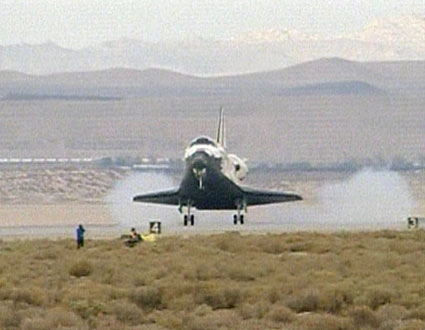
HOUSTON - Space shuttle Discovery returned safely to EarthFriday evening, landing in California after being diverted due to rain showersover Florida.
Shuttle commander Rick Sturckowbrought Discovery to a touchdown at Edwards Air Force Base in the Mojave Desertat 8:53 p.m. EDT (0153 GMT Sept. 12), after spending two days being waved offfrom the Kennedy Space Center in Florida due to rain showers and strong windsin the vicinity of the shuttle landing facility on both Thursday and Friday.
"Houston, Discovery, wheels stop," Sturckow said after landing.
"Welcome home Discovery!" Mission Control replied. "Congratulations on an extremely successful mission stepping up science to a new level on the International Space Station."
The landing concluded a 14-day mission to the InternationalSpace Station (ISS) that delivered new science equipment and the COLBERTtreadmill - named after TV comedian Stephen. The resupply mission came to anend the day after another cargo flight launched from Japan.
Back on Earth
Returning home with Sturckow wereDiscovery?s STS-128 mission pilot Kevin Ford and mission specialists PatrickForrester, Danny Olivas, Jose Hernandez and EuropeanSpace Agency (ESA) astronaut Christer Fuglesang. Rounding out the crew for the return to Earthwas flight engineer Tim Kopra, who spent 44 days as a member of the station?sExpedition 20 crew for a total of 58 days in space.
?Two months is not too long in space and it was a greatopportunity,? Kopra said from space Wednesday. ?I will miss the sunrises andsunsets, but especially my crew who I shared my two months with onboard thespace station.?
Kopra?s replacement aboard the station,astronaut Nicole Stott, launched with Discovery?s crew just secondsbefore midnight on Aug. 28. Stott, who will return on the next shuttlemission targeted for launch in November, is the last astronaut scheduled to berotated onto the station?s crew by means of the U.S. orbiter. For the immediatefuture, all ISS crew members will launch and land onRussian Soyuz spacecraft.
The day before Discovery touched down, Japan?s space agencylaunched its firstH-2 Transfer Vehicle, or HTV-1, an unmanned cargo supply ship is due toarrive at ISS Sept. 17 and be captured by the station?s robotic arm. The HTVwill compliment Russian Progress and European resupply vehicles, as well asfuture American-built commercial spacecraft, in supporting the ISS after thespace shuttle is retired in the next year or so.
?It is a very important milestone,? said Kopra, ?not justfor the International Space Station Program, but also for the Japanese portionof the program because this is a vehicle they have constructed and it is veryunique on how it will dock to the space station. It is a precursor to how wemay use commercial vehicles to bring supplies to the space station.?
Discovery landed with over 2,000 pounds of scienceexperiment results and refuse from inside the outpost. Equipment and supplieswere also returned on the orbiter?s middeck, including a 12-inch Buzz Lightyear action figure, which spent more than a yearon the ISS as part of an educational partnership between NASA and the WaltDisney Company.
Resupply and replacements
Discovery?s mission was the 30th space shuttle flight theorbiting outpost since construction began in 1998. It was dedicated todelivering vital supplies and equipment needed to support the station?ssix-person crew.
?Our mission has gone really well,? Sturckowsaid Wednesday. ?We transferred a large amount, about 14,800 pounds ofequipment and supplies.?
Most of what was transferred, including science and storageracks, a freezer to store research samples and a new sleeping compartment, werelofted inside the Leonardo Multi-Purpose Logistics Module (MPLM), a pressurized?moving van? that was relocated from Discovery?s payload bay to the side of thestation?s Harmony node and then back.
Leonardo also carried the Combined Operational Load BearingExternal Resistance Treadmill, or COLBERT. The station?s second astronautexercise treadmill, it was named after comedianStephen Colbert of Comedy Central?s ?The Colbert Report? as a consolationprize for winning a NASA naming poll for its next space station module.
COLBERT launched in hundreds of parts to be assembled by thecrew after the HTV-1 arrives.
Discovery?s payload bay also carried the LightweightMulti-Purpose Experiment Support Structure Carrier (LMC), a cargo pallet thatsupported the STS-128 mission?s three spacewalks.
During the trio of outings, Olivas,Stott and Fuglesang outfitted the station with a newammonia coolant tank, manipulating the largest object - the size of a small car- ever moved by astronauts outside the ISS. They also retrieved three exteriorexperiments, one European and two U.S., for return to Earth.
Olivas and Fuglesang,who performed two of the three spacewalks together, also worked to run cablesto support the arrival of the Tranquility node in early 2010 but ran intoproblems with one of its power connectors, leaving the work to be completedduring a future excursion.
With the completion of this mission?s spacewalks and hisprevious three, Fuglesang set a record for the mosttime spent working in the vacuum of space by an astronaut of any nationalityother than Russian or American.
The fourth of five space shuttle missions planned for thisyear, STS-128 marked the 37th flight of Discovery, which celebrated the 25thanniversary of its maiden launch while in space on this mission.
NASA currently plans to fly six more shuttle missions tocomplete construction of the station and stock the orbiting laboratory withsupplies. The shuttle fleet is slated to retire in 2010 or so to make way fornew spacecraft capable of leaving low Earth orbit.
The next orbiter to fly is Atlantis, which is due to launchtoward the station Nov. 12 carrying even more supplies for the orbitinglaboratory.
- Image Gallery - Shuttle Discovery's Midnight Launch
- Video - Stephen Colbert to NASA: 'No Chubby Astronauts'
- SPACE.com Video Show - The ISS: Foothold on Forever