


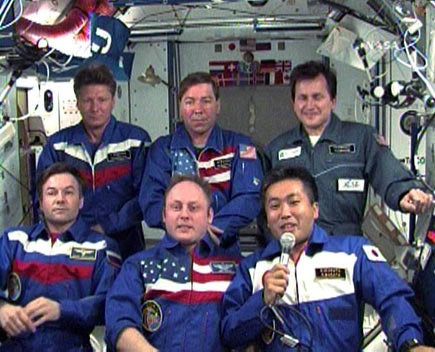
There maybe questions on Earth over which food and bathrooms the multi-national crew ofthe International Space Station can use, but the rule in orbit is share andshare alike, an astronaut said Wednesday.
NASAastronaut Michael Barratt said that each of the space station?s American,Russian and Japanese crewmembers has their own private sleeping quarters, buteverything else is open to all.
?Other thanthat, the rest of this big space station is pretty much communal,? Barratt, wholaunchedto the station last week, told reporters Wednesday via a video link fromthe orbiting laboratory.
Barratt?scomments come after recent reports from Russia that morale aboard the spacestation is lowered by terrestrial bickering over which food, space toilets andother facilities U.S., Russian and other international astronauts can and can?tuse.
In aninterview with Russian language newspaper Novaya Gazeta, the spacestation?s newest cosmonaut commander Gennady Padalka reportedly lamentedrestrictions that prevented Russian cosmonauts from eating food or using gearmade by the U.S. or the 14 other partner nations involved in the $100billion space station project.
"Whatis going on has an adverse effect on our work," Padalka told NovayaGazeta, according an Associated Press story publishedMonday.
Padalkareportedly attributed the problem to a 2003 decision by Russia?s Federal SpaceAgency to charge other agencies for the use of its resources on the station. Hearrived at the space station on Saturday with Barratt and spacetourist Charles Simonyi, and will command the outpost?s crew for the nextsix months.
"Cosmonautsare above the ongoing squabble, no matter what officials decide," Padalka toldthe newspaper, according to the AP wire story. "We are grown-up,well-educated and good-mannered people and can use our own brains to createnormal relationship. It's politicians and bureaucrats who can't reachagreement, not us, cosmonauts and astronauts."
Padalkareportedly used back-and-forth decisions over whether he could use a newAmerican exercise machine to illustrate his point in the Novaya Gazeta,but did not comment during Wednesday?s video link on how resources are usedaboard the station.
Barrattstressed that aboard the orbiting laboratory, everyone pitches in each of thespace station?s different modules.
The stationis made up of a series of connected modules built by the U.S., Russia, Europeand Japan. It is currently home to two Russian cosmonauts, two Americanastronauts, a Japanese astronaut and an American space tourist.
?I wouldsay that with the exception of your small, personal space, it?s pretty much agroup effort,? Barratt said.
Padalka andBarratt joined Japanese astronaut Koichi Wakata, who was already aboard thestation, when they arrived last week to begin theoutpost?s Expedition 19 mission. Wakata arrived at the station earlier thismonth aboard NASA?s shuttle Discovery to join the outpost?s Expedition 18 crew —NASA astronaut Michael Fincke and Russian cosmonaut Yury Lonchakov.
Fincke andLonchakov are due to return to Earth with space tourist Simonyi next week. Simonyi,the world?s first repeat space tourist, is paying about $35 million for hissecond trip to the station under an agreement between Russia?s space agency andthe Virginia-based firm Space Adventures. He last visited the station in April2007.
- New Video - Charles Simonyi: World?s 1st Repeat Space Tourist
- New Video - Expedition 19: Priming ISS for Larger Crew
- New Show - Inside the International Space Station
