


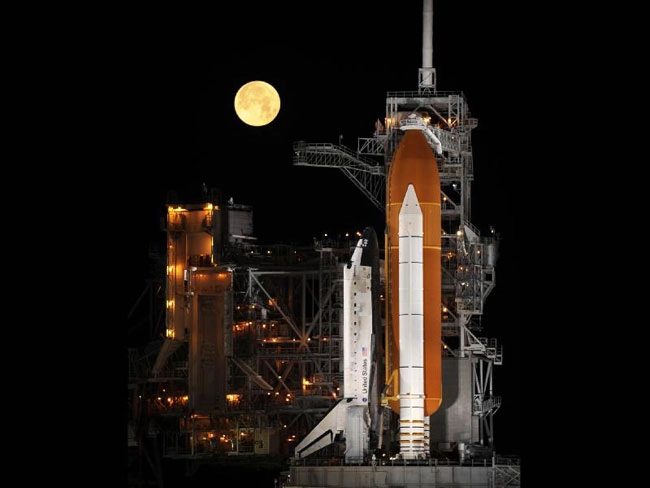
CAPE CANAVERAL, Fla. - The space shuttle Discovery is poised to launch into orbitunder a full moon tonight on a delivery mission to the International SpaceStation (ISS).
Discovery and her sevencrewmembers are scheduled to blast off from a seaside launch pad at NASA?sKennedy Space Center here at 9:20:10 p.m. EDT (0120:10 March 12 GMT) to begintheir two-week construction flight.
Packed aboard the spacecraft is a newset of solar panels to be installed on the station, as well as the finalstretch of the ISS's massive backbone-like girder. Discovery is also due todeliver even more precious cargo: Koichi Wakata, a Japan Aerospace ExplorationAgency (JAXA) astronaut, who is to become his nation's first long-duration spaceflyerwhen he joins the station's Expedition 18 crew as a flight engineer for asix-month stay.
"I feel just lucky to be able to serve as a crew member to completethe assembly of the International Space Station," Wakata said in a NASAinterview. While onboard the orbiting laboratory, he will devote much of histime to working in Japan's Kibo module, which was launched into space lastyear.
Clear skies
The weather appearsto be cooperating for tonight's planned launch, with shuttle weatherofficer Kathy Winters estimating a 90 percent chance of "go" weatherconditions.
Ground crews plan to begin filling the space shuttle's giant orange fueltank with its liquid oxygen and liquid hydrogen propellant at 12:05 p.m. EDT(1605 GMT).
If for some reason Discovery is unable to launch tonight, missionmanagers have said they can try again up until March 16, though pushing theliftoff that late would mean cutting a few days off the planned 14-day flight.
This mission has been delayed for nearly a month because of concernsover suspect fuel control valves in the shuttle's main engines. During the lastshuttle launch, Endeavour's November 2008 liftoff, a valve on that orbitercracked, though it did not affect the flight. To be on the safe side, engineersreplaced all three valves on Discovery with a new set known to be damage-free.Mission managers said they feel confident the issue poses no threat to theshuttle or its crew.
Teacher astronauts
Discovery?s STS-119 crew, commandedby Lee Archambault, also includes pilot Tony Antonelli and missionspecialists Joseph Acaba, Steve Swanson, Richard Arnold, and John Phillips.
First-time spaceflyers Acaba and Arnold are both educator astronauts.Before joining NASA, the two men taught math and science. They have said theyhope their trip to space will serve as an inspiration to students.
"If you look at our crew, we all come from very diversebackgrounds, different parts of the country, different experiencesprofessionally, different family experiences," Arnold said in a preflightinterview. "Yet, the one thing we do have in common is that education wasa really important part of who we were growing up and even as adults. Thosedreams are all out there for these kids that are sitting in school today torealize."
Acaba and Arnold are set to be the first teacher astronauts to walk inspace when they help install the new hardware on the station during themission's four planned spacewalks.
Home improvements
Discovery's payload represents the last major U.S. contribution to thespace station, which will be 81 percent complete after the installation of thenew girder. The $298 million Starboard-6 (S6) truss will finish the backbone ofthe station, extending it to the length of an American football field.
Once installed, the new solar array panels should boost the spacestation's power generating ability by 25 percent - an important step towardexpanding the station's crew size from three to six, planned for this summer.
Discovery is also ferrying up a replacement part for a failed processorin the station's urinerecycling system. The machine, which was delivered to the ISS in November2008, was designed to turn the astronaut's pee into drinkable water, though ithas been malfunctioning since the start. Mission managers said they hope thespare part being carried up by Discovery will do the trick to fix the system,which is also essential for hosting double-sized crews on the space station.
SPACE.com is providing continuous coverage of STS-119 with reporterClara Moskowitz at Cape Canaveral and senior editor Tariq Malik in New York. Click here for missionupdates and SPACE.com's live NASA TV video feed. Live launch coveragebegins at 4:00 p.m. EDT (2000 GMT).
- New Video - Meet Discovery's STS-119 Shuttle Astronauts
- New Video - Discovery's Mission: Space Station Power Up!
- New Show - NewSpace: The Orbital Industrial Revolution
