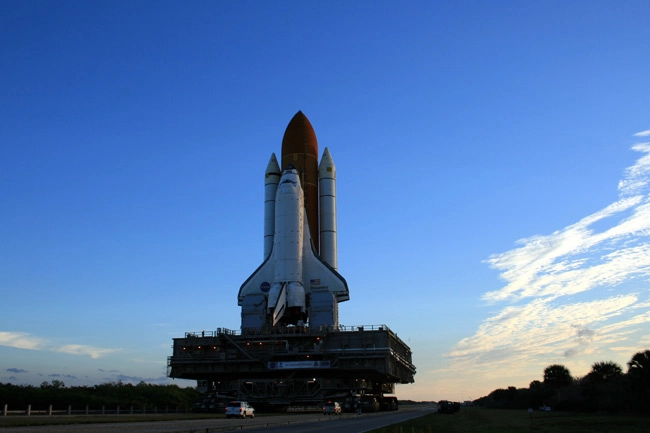
The spaceshuttle Discovery rolled out to its Florida launch pad Wednesday, whereengineers will prime the spacecraft for NASA?s first manned spaceflight of theyear.
Riding atopNASA?s Apollo-era carrier vehicle, Discovery completed the slow, seven-hourtrek to its seaside launch pad 39A at 12:16 p.m. EST (1716 GMT), bringing itone step closer to a plannedFeb. 12 blast off from the Kennedy Space Center in Cape Canaveral,Fla.
?We had noissues once we started rolling,? NASA spokesperson Allard Beutel told SPACE.comfrom the spaceport. ?It was a beautiful rollout.?

Discoverywill carry a crew of seven astronauts and the last pair of U.S. solar arrays forthe International Space Station when it launches next month. The two expansivesolar wings are the fourth and final set to support the space station?s powergrid. They are attached to a girder-like Starboard 6 (S6) segment, the lastpiece of the 356-foot (109-meter) main truss that serves as the orbitinglaboratory?s backbone.
?The S6truss is the last major piece of U.S.-built hardware to go to the spacestation,? Beutel said.
Commandedby veteran spaceflyer Lee Archambault, Discovery?s STS-119 mission is scheduledto launch at 7:32 a.m. EST (1232 GMT) on Feb. 12 and land about two weekslater. Four spacewalks are planned to install the space station?s new solararrays and perform other maintenance work.
Discoverywill also ferry Japanese astronaut Koichi Wakata to the International SpaceStation, where he?ll replace NASAastronaut Sandra Magnus as a member of the outpost?s Expedition 18 crew.
Wakata isthe first long-duration spaceflyer for the Japan Aerospace Exploration Agencyand will oversee the station?s Japanese Kibo laboratory among his other flightengineer duties. Magnus will return to Earth aboard Discovery after spendingmore than three months aboard the space station.
Spaceshuttle engineers will install Discovery?s 32,000-pound (14,514-kg) solar arraytruss segment inside the orbiter?s payload bay on Saturday. Archambault and hiscrew, meanwhile, are due to arrive at the Kennedy Space Center next week for alaunch dress rehearsal, Beutel said.
Discovery?sFebruary launch is the first of five NASA shuttle missions planned for 2009. Oneflight will carry astronauts to pay a final service call on the Hubble SpaceTelescope, with the other four to bring the decade-oldInternational Space Station closer to completion.
?Every timewe get to the launch pad, it gets us one step closer to flying the shuttle,?Beutel said. ?This is the beginning of our final push to complete theInternational Space Station.?
- Video - Space Shuttle Bloopers!
- Images - Stunning Night Launch for Shuttle Endeavour
- Video - Drinking Water From Space Urine
