


When itcomes to Mars missions, NASA?s twin rovers Spirit and Opportunity seem to bethe robots that never quit.
The two plucky probes were each builtfor a 90-day romp across the Martian surface, a mission that began when Spiritbounced to a stop on the planet?s expansive Gusev Crater five years ago today.Opportunity touched down on the other side of Mars a few weeks later and now - afterhalf a decade - both rovers are stillexploring the red planet after surviving more than 20 times their plannedlifetime.
"The American taxpayer was told three months for eachrover was the prime mission plan," said Ed Weiler, NASA?s associateadministrator for science missions at the agency?s Washington, D.C.,headquarters, in a statement. "The twins have worked almost 20 times thatlong. That's an extraordinary return of investment in these challengingbudgetary times."
The rovers reportedly cost about $20 million to operate eachyear since their 2004 arrivals on Mars.
Roving Mars
Spirit setdown at Gusev Crater on Jan. 3 at 11:35 p.m. EST (8:35 p.m. PST), where itovercame initial computer glitches and went on to scale nearby hills and bravethe frigid Martian winter year after year.
Opportunitybounced to a stop inside what scientists later dubbed Eagle crater just aftermidnight (EST) Jan. 25 in an interplanetary hole-in-one on the vast Martianplains of Meridiani Planum. Since then, the rover has spotted a Martianmeteorite, visited the heat shield cast off during its landing and exploredever larger craters as it makesit way toward Endeavour, a monster crater 14 miles (22 km) across.
?We keep setting the bar higher for what these rovers cando," said Frank Hartman, a rover driver at NASA?s Jet PropulsionLaboratory in Pasadena, Calif., which manages the mission. "Once it seemedlike a crazy idea to go to Endeavour, but now we're doing it."
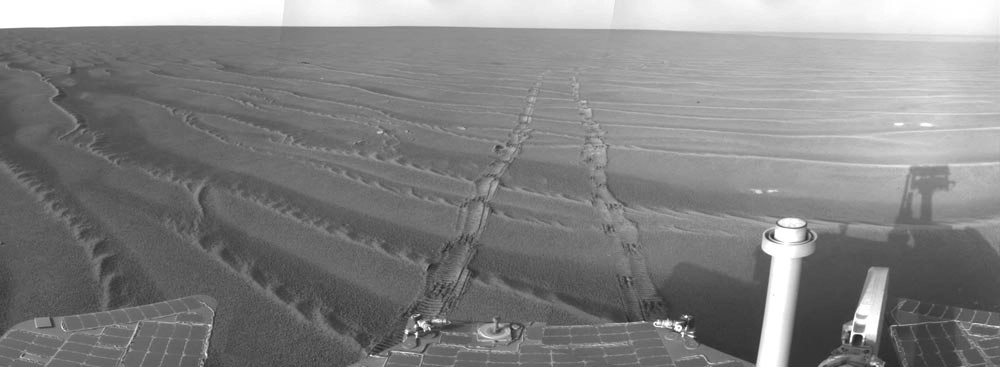
Both rovershave weathered glitches from old age, with Opportunity digging its way out of aMartian sand dune that threatened to halt its red planet exploration. Sincetheir mission began, Spirit and Opportunity have returned a veritable feast ofinformation on the composition of Mars? surface and history of water at theirlocal landing sites.
Altogether,the rovers have driven across more than 13 miles (21 km) of Martian terrain,taken some 250,000 photographs and beamed more than 36 gigabytes of data toEarth. They?ve also been the stars of film and televisiondocumentaries lauding their unexpected long life.
"These rovers are incredibly resilient considering theextreme environment the hardware experiences every day," said John Callas,NASA?s rover project manager at JPL. "We realize that a major rovercomponent on either vehicle could fail at any time and end a mission with noadvance notice, but on the other hand, we could accomplish the equivalentduration of four more prime missions on each rover in the year ahead."
After third winter, new science ahead
Spirit came close to achilly demise this year as power levels dwindled in the dim Martian winter,mission managers said. But the rover has bounced back after surviving theseason, its third winter in the planet?s southern hemisphere, which ended inDecember.
"This last winter was a squeaker for Spirit,"Callas said. "We just made it through."
Scientists plan to send Spirit to a pair of interestingspots about 600 feet (183 meters) away from its current perch atop a rocky plateaucalled Home Plate, which the rover has been studying since 2006. One target isa mound that may hold the key to determining if Home Plate is the remains of alarger expanse of volcanic material. The other is a depression called Goddard,an immense pit the size of a house.
"Goddard doesn't look like an impact crater," saidSteve Squyres, principal investigator for the rover science instruments at CornellUniversity, in Ithaca, New York. "We suspect it might be a volcanicexplosion crater, and that's something we haven't seen before."
Meanwhile,Spirit?s twin Opportunity is chugging along toward Endeavour Crater. The crateris 20 times larger than Opportunity?s last destination, Victoria Crater, whichcommanded the rover?s attention for nearly two years. The new target sits justseven miles (12 km) from Victoria, but Opportunity must drive much farther tozigzag around obstacles and inspect loose rocks along the way.
?This has turned into humanity's first overland expeditionon another planet,? said Squyres. ?When people look back on this period of Marsexploration decades from now, Spirit and Opportunity may be considered mostsignificant not for the science they accomplished, but for the first time wetruly went exploring across the surface of Mars."
- Video - Mars Rover Team Ponders Mission?s End
- The Most Amazing Mars Rover Discoveries
- The 10 Best Mars Images Ever
