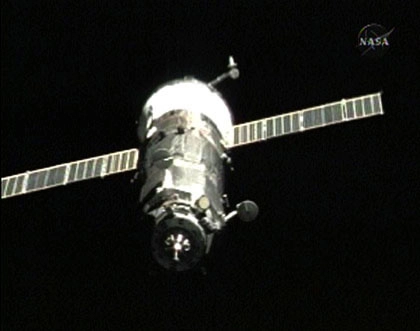
An unmannedRussian-built cargo ship is headed for oblivion after casting off from the InternationalSpace Station (ISS) on Monday.
The automatedspace tug Progress 29 undocked from an Earth-facing berth on the station?sRussian Zarya control module Monday afternoon at 3:46 p.m. EDT (1946 GMT) tobegin a week of engine tests before destroying itself in the Earth?s atmospherenext week, officials with Russia?s Federal Space Agency said.
?It wentvery well, exactly as planned,? NASA spokesperson Kelly Humphries toldSPACE.com from the Johnson Space Center in Houston.

FederalSpace Agency officials said Progress 29 will stay in space until Sept. 9 inorder to perform a series of experiments designed to study the plasma environmentsurrounding its rocket engines. Then, the disposable spacecraft will becommanded to burn up in the Earth?s atmosphere over the southern Pacific Ocean,they added.
Russia?sunmanned Progress spacecraft are routinely used to deliver food, water,equipment and other vital supplies to astronauts living aboard the spacestation. Once their supplies are spent, the space tugs are filled with trash,waste and other unneeded items, and then jettisoned from the station to bedestroyed upon reentry.
Progress 29launched toward the station from the Central Asian spaceport of BaikonurCosmodrome in Kazakhstan on May 14 and arrivedat the orbiting laboratory two days later. The spacecraft delivered about2.3 tons of fresh supplies to the station?s three-man crew, which currentlyconsists of commander Sergei Volkov and flight engineer Oleg Kononenko - both ofRussia - and NASA flight engineer Greg Chamitoff.
The cargoship?s Monday undocking is the first of two planned space station departuresthis week. The cargoship Jules Verne, the first Automated Transfer Vehicle built by theEuropean Space Agency, is due to undock from its perch at the aft end of thestation?s Russian-built Zvezda service module on Friday at 5:30 p.m. EDT (2130GMT).
- Video - Hubble Service Mission 4 Countdown
- Video - Suborbital Rocket Test Explodes
- Video - Life inside the Jules Verne Cargo Ship
