


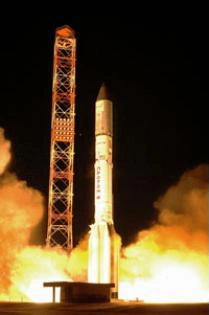
PONTEVEDRA, Fla. - The third and last Inmarsat 4 mobile-broadband satellite wassuccessfully placed into orbit Tuesday by an International Launch Services(ILS) Proton Breeze M rocket, ILS and Inmarsat announced.
Thelaunch completed a decade-long, $1.5 billion investment by London-basedInmarsat and returned ILS to commercial service fivemonths after a failure that forced a redesign of the Proton Breeze M upperstage.
The13,139-pound (5,960-kg) Inmarsat 4 F3 satellite will be operated from 98degrees west. Once its operations begin there, the two other Inmarsat 4satellites will be moved to new orbital slots to optimize global broadband dataservices from the three-satellite system. Moving these two satellites willcause partial shutdowns of Inmarsat broadband services for a five-week periodas the Inmarsat 4 F2 is moved from 53 degrees west to 25 degrees west, and thenfor a three-week period during the relocation of Inmarsat 4 F1 from 64 degreeseast to 143.5 degrees east.
Operatingthree satellites in geostationary orbit will permit Inmarsat to offer broadbanddata and hand-held telephone access globally, except for the polar regions. Thetwo previously launched Inmarsat 4 satellites, in orbit since March and November2005, have provided services to 85 percent of the Earth's land mass buthave left broad coverage gaps in the Pacific Ocean region.
Inmarsat,whose stock is traded on the London Stock Exchange, had been under closeinvestor scrutiny following its decision tobe the first customer for the ILS Proton Breeze M rocket after the Marchfailure, which left a commercial satellite in a useless orbit. Inmarsat Chief ExecutiveAndrew Sukawaty told investors Aug. 6 that the Inmarsat 4 F3 launch was fullyinsured and that the two operational Inmarsat 4 spacecraft covered the world'sland areas sufficiently well to assure continued service even if aeronauticaland maritime coverage growth depended on the third satellite being in orbit.
Sukawatyalso said Inmarsat, which has ordered a large new satellite design, calledAlphasat, from Astrium Satellites for launch in 2012, could use Alphasat toreplace the third Inmarsat 4 in the event of a launch failure.
Reston,Va.-based ILS is majority-owned by Khrunichev State Research and ProductionSpace Center of Moscow, which is the prime contractor for the Proton Breeze Mrocket. The company has an active launch schedule for the coming months, as doits two principal competitors in the commercial launch industry, theArianespace consortium of Evry, France, and Sea Launch Co. of Long Beach,Calif.
- Video - Falcon 1's Third Flight
- Video - Coming Soon: The Final Flight to Hubble
- Images - 20 Great Rocket Launches
