





This story was updated at 12:19 p.m. EDT.
Crewmembers aboard the International SpaceStation (ISS) welcomed the arrival of a Russian spacecraft bearing theirreplacements and South Korea?s first astronaut early Thursday.
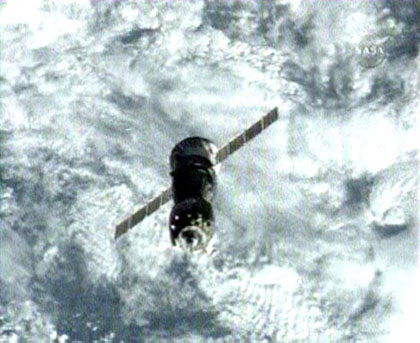
Russian cosmonauts Sergei Volkov and OlegKononenko, and South Korean spaceflyer So-yeon Yi pulled in at the stationaboard their Soyuz TMA-12 spacecraft, which docked with the outpost?sEarth-facing Pirs module at about 8:57 a.m. EDT (1257 GMT). The two vehicleswere flying over northern Kazakhstan when they connected.
"Helly Peggy, Hello Yuri!" Volkovsaid to current space station residents Peggy Whitson and Yuri Malenchenko afterthe docking.
The three rookiespaceflyers launched on April 8 at 7:16 a.m. EDT (1116 GMT) from theCentral Asian spaceport of Baikonur Cosmodrome in Kazakhstan.
Yi?s journey represents a landmark achievementfor her country.
?We are proud to have our first Korean astronaut,? said Hong-yul Paik, head ofthe state-run Korea Aerospace Research Institute, at a press conference at Russia'sISS Mission Control after the docking. ?Ibelieve that through this program, the cooperation between Russia and Koreawill be strengthened? It?s a great moment.?
The crew opened the hatches between the space station andthe Soyuz spacecraft at 11:40 a.m. EDT (1540 GMT). Shortly afterward,the six spaceflyers gathered for a welcoming ceremony where they spoke withinternational dignitaries at the Russian mission control center outside Moscow.
Volkov, the first second-generationspaceflyer to reach space, received congratulations in Russian from his father,famed cosmonaut Alexander Volkov.
Yi also received well-wishes from Koreanspaceflight representatives.
?I feel really great,? she said. ?I will tryto do my best and I will spend all my energy for Koreans.?
After speaking with a family member in Korean, she made aheart shape with her arms above her head.
Whitson, who served as ISS Expedition 16commander, and Yuri Malenchenko, Expedition 17 flight engineer, will berelieved by Volkov and Kononenko. The third current station inhabitant, U.S.astronaut Garrett Reisman, will stay onboard as a flight engineer for the newExpedition 17.
"It will be breaking in a new crew ofmyself plus Sergei Volkov, will be the new space station commander, and OlegKononenko, who will be the new flight engineer, along with myself,"Reisman said in a preflight NASA interview. "We also have coming up aspart of that taxi crew, the first South Korean astronaut, so it's a veryexciting time with lots of people coming and going as you can tell."
He will officially become a member of the newmission when he exchanges his custom-made Soyuz seat cushion with Yi, who isdue to ride back to Earth with Whitson and Malenchenko April 19 on a SoyuzTMA-11 spacecraft.
The almost 11-daycrew-swap period will be a busy time, filled with science experiments andtraining activities for the new crew.
"Actually I expect it?s going to be avery interesting but a hard time, really a hard time," said Volkov, whowill serve as commander of the new Expedition 17 mission, in a preflight NASAinterview.
Yi, a 29-year-old mechanical and bioengineer,will stay onboard for the handover period as part of a $25 million commercialarrangement between Russia and South Korea. During her stay she will performscience experiments and educational activities.
South Korean President Lee Myung-bak watchedthe launch of his country's first astronaut in a live broadcast from Seoul CityHall's outdoor plaza, according to South Korean news agency Yonhap.
He said Yi's mission "will be used as astepping-stone for the country's aim to become a top-seven space power within10 years' time, and would help South Korea launch its own space vehiclecarrying its own satellite by 2020," according to Yonhap.
Yi, Malenchenko and Whitson are slated toland on the steppes of Kazakhstan next week after a 3 ?-hour journey home fromthe space station.
Whitson, the firstfemale ISS mission commander, and the record-holder for the woman with themost spacewalking time under her belt, will be returning home after a six-monthstay aboard the orbital outpost.
The new Expedition 17 members will be thefirst crew to begin their stay on a space station that includes hardware fromall of the participating countries. Their mission will serve to help installthe new Japanese Kibo laboratory on the station, prepare the orbital lab tohost larger six-person crews in 2009 and oversee the departure of Europe'sAutomated Transfer Vehicle (ATV) Jules Verne.
"I think one of the most exciting parts[is that] we are going to undock ATV, that I think the whole program has beenwaiting for a very long period of time," Volkov said in a preflightinterview.
The mission marks the first trip into spacefor both Volkov, who is a second-generation spaceflyer (his father was famedcosmonaut Alexander Volkov) and for Kononenko.
"As far back as I remember myself Ialways wanted to become a cosmonaut," Kononenko said in a preflightinterview. "After I graduated from high school I made a conscious decisionto go to the aviation institute and I wanted to become a cosmonaut. Maybe for ahuman it?s not so very good to have just one goal in life, but so it is withme."
The Korean news service Yonhap contributed tothis report.
- NEW VIDEO: Europe's First ISS Cargo Ship Arrives
- VIDEO: ISS Commander Peggy Whitson Takes Charge
- Complete Space Station Mission Coverage
