





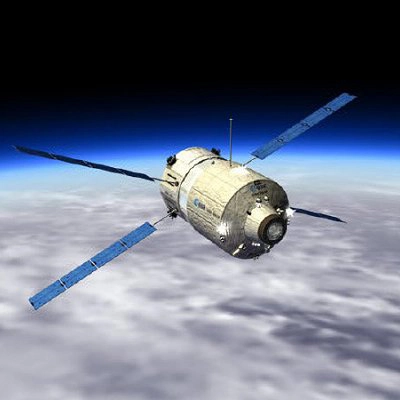
HOUSTON - Europe?sfirst cargo ship bound for the International Space Station (ISS) has caught upto the orbiting lab and parked itself off the outpost?s bow.
Launchedlate March 8, the European Space Agency?s (ESA) unmanned spacefreighter Jules Verne caught up to the station on Wednesday, appearing as a distant,bright dot as it passed by the ISS toward a parking spot 1,200 miles (2,000 km)ahead of the orbiting lab.
The 21-ton cargoship, the first of a new ESA fleet of AutomatedTransfer Vehicles, is awaiting the departure to NASA?s space shuttleEndeavour, which is docked at the ISS for a record 12-day stay. The shuttle?s seven-astronautcrew is wrapping up work to deliver a new crewmember, Japanese room and a Canadianmaintenance robot to the high-flying lab.
"The spacecraft is functioning perfectly, the team isvery well trained and we are looking forward to an excellent first dockingattempt on 3 April,? said ESA mission director Alberto Novelli, of the ATV ControlCenter in Toulouse, France, in a statement.
Endeavour?sastronaut crew is slated to undock from the ISS late Monday, March 24, clearingthe way for two demonstrations of Jules Verne?s automated rendezvous systems.
On March29, ESA flight controllers will maneuver Jules Verne to a spot about 11,482feet (3,500 meters) away from its docking port at the aft of the spacestation?s Russian-built Zvezda service module. If all goes well, the spacecraftwill be cleared for its second demonstration on March 31, where it is expected toclose within about 40 feet (12 meters) from its berth, back way, then executean escape maneuver to be commanded by flight controllers and astronauts aboardthe station.
Only afterpassing both tests will the unmanned Jules Verne supply ship be approved forits April 3 docking, mission managers said.
Launchedatop a European Ariane 5 rocket, the 1.3 billion euro ($1.9 billion) JulesVerne is the first of up to seven ATV spacecraft to haul supplies to the ISS.
The massivespacecraft is about the size of a London double-decker bus and can carrythree times the amount of food, equipment and other vital supplies thanRussia?s unmanned Progress freighters. Shaped like a cylinder with X-wing-likesolar arrays, the new cargo ship is 32 feet (10 meters) long and almost 15 feet(4.5 meters) wide.
The vehicleis in good health despite a propulsion system glitch that shut down four of its28 rocket thrusters early in the flight. Mission managers switched thespacecraft to a backup system to recover the thrusters.
Astronautsaboard Endeavour, meanwhile, had a day off Wednesday as they prepared for aThursday spacewalk to test a space worthy goo gun for shuttleheat shield repairs. Mission Control has sent the astronauts several notesabout Jules Verne?s progress, including a Wednesday message hinting at therobotic spacecraft?s impatience to dock at the ISS.
?Oh and by the way, ATV/Jules Verne has arrived in itsparking spot, 1,000 miles in front of you, and is eagerly awaiting yourdeparture so it can make its approach,? flight controllers wrote Wednesday.
- VIDEO: Part 1: Europe's First ISS Cargo Ship
- VIDEO: Part 2: Jules Verne, Europe's First ISS Cargo Tug
- VIDEO: Columbus: Europe's Orbital Lab at ISS
