


Thisstory was updated at 2:49 p.m. EST (1949 GMT).
Twospacewalking astronauts brought the International Space Station (ISS) a stepcloser to full power Wednesday after replacing a broken motor at the base ofone of their orbiting lab?s wing-like solar arrays.
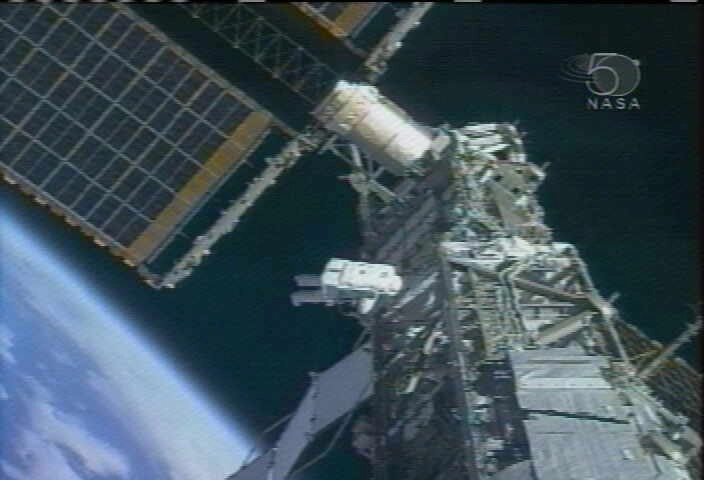
Takinggreat care to avoid electrical shocks, station commanderPeggy Whitson and flight engineer Dan Tani successfully restored the vitalelectricity-producing wing to full operations during their seven-hourspacewalk.
?It's animportant step for us to get that power generation back up to where it?soptimized,? Whitson said before the repair.
The spacestation?s power grid has been afflicted by a pair of major glitches centered onits starboard side since last fall. In late October, Tani discovered metaldebris contaminating a massive, 10-foot (3-meter) wide gear that rotates theoutpost?s starboard solar wings like a paddlewheel to maximize power productionby continuously track the sun.
The secondmalfunction, which station astronauts fixed today, occurred in early Decemberwhen a garbage can-sized motor that pivots its solarwing on a different axis than the larger gear suffered three differentelectrical failures. The new motor, known as a Bearing Motor Roll Ring Module,successfully performed 360-degree test spin during today?s spacewalk.
?Yay, it works!? cheeredWhitson as she and Tani watched the solar wing turn. ?Excellent,outstanding?isn't that cool??
Without thenew motor, the station could support NASA?snext shuttle mission — set to launch a European lab to the ISS on Feb. 7 —but not much more, space station managers said. But the motor?s successfulactivation should allow the station to host shuttle flights delivering new Europeanand Japanese lab modules through this summer.
?We hadclean sweep today,? said Expedition 16 flight director Kwatsi Alibaruho afterthe repair. ?The [spacewalk] went flawlessly.?
NASA hopesto launch up to five shuttle flights to the ISS this year to add European andJapanese laboratories and prepare the station for larger, six-person crews.
In additionto the motor repair, Whitson and Tani also performed another inspection — thefourth so far — of the station?s starboard Solar Alpha Rotary Joint, the gearcontaminated with metal debris. The spacewalkers evaluated damage from thedebris and collected samples from areas previously unseen.
Alibaruhosaid the new debris samples will help shape future repair plans for the largergear later this year. They will be shipped back to Earth along with the brokensolar wing motor aboard one of the next NASA shuttles to fly, he said.
Wednesday?s spacewalk beganat 4:56 a.m. EST (0956 GMT) and marked the fifth excursion of the station?scurrent Expedition 16 mission, as well as the sixth career excursion for bothWhitson and Tani.
A communications glitchleft the spacewalkers without direct contact to Mission Control in Houstonbriefly, but a backup system worked fine during the seven-hour, 10-minuteexcursion. Russian cosmonaut and flight engineer Yuri Malenchenko remainedinside the ISS during the spacewalk and served as a go-between during the shortglitch.
Riskyrepair
Whitson andTani used extra caution during today?s spacewalk because of the added risk ofelectrical shock near the starboard solar wing.
Each U.S.solar wing extends produces about 160 volts when awash in sunlight and feedspower through the so-called beta gimbal assembly that houses the motor replacedin today?s orbital work. To avoid shocks and electrical arcs, Whitson and Taniworked only in safe, 33-minute periods of darkness as the station orbited theEarth.
?This is anincredibly tricky box that has to be changed out,? said Keith Johnson,Expedition 16?s lead spacewalk officer, of the 200-pound (90-kg) motor. ?Neverwas it considered a task that a station-based team would do.?
Because ofthe tight timing, most mission planners assumed a heavily trained shuttle-basedspacewalking team would be required, he added.
Whitson,who squeezed inside the station?s starboard truss girder to swap out the brokenmotor, said there was also the risk of accidentally disconnecting vital latchesthat anchor the 115-foot (35-meter) solar wing to the space station.
?That wouldlose us a whole lot of style points,? Whitson said before the spacewalk, thoughthe actual repair appeared go smoothly.
Wednesday?sexcursion marked the final planned spacewalk of the Expedition 16 mission andthe 101st dedicated to space station assembly and maintenance. The spacewalkalso marked the sixth career excursions for both Whitson and Tani, whorepeatedly commented on view of Earth and space.
?It?sbeautiful,? Tani said as the station passed over South Africa. ?Reds, blacks ?such colors.?
Tani alsobeamed an orbital good morning call down to his wife Jane and two daughters,Keiko and Lilly, on what he expected to be the last spacewalk of his mission.He is scheduled to return to Earth next month with the STS-122 crewaboard NASA?s Atlantis shuttle.
Thespacewalk was Tani?s first since the unexpected death of his 90-year-old motherRose in a car accident before Christmas last month. ISS flight controllers saidTani has coped with the tragic loss admirably and that it has not affected hiswork.
Whitson,who holds the world record for most spacewalking time by a female astronaut,closed the excursion with a new total 39 hours and 46 minutes. Tani, meanwhile,concluded with 39 hours and 11 minutes of spacewalking time under his belt.Together, Whitson and Tani rank 15th and 16th among the world?s mostexperienced spacewalkers.
?Fivespacewalks in three months, that?s been fantastic,? said Tani, as he thankedflight controllers and engineers on Earth for their help planning today?sspacewalk. ?It?s been a great run here.?
- VIDEO: ISS Commander Peggy Whitson Takes Charge
- Top 10 Spaceflight Stories of 2007
- SPACE.com Video Interplayer: NASA's STS-122: Columbus Sets Sail for ISS
