


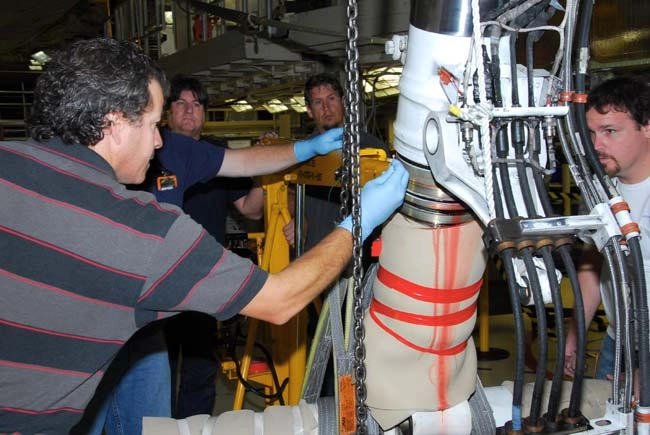
Engineers workedto fix a leaky hydraulic seal on NASA's space shuttle Discovery Wednesday asthe agency weighs a possible delay for the spacecraft's planned October launch.
Discoverywas slated to leave its hangar and move to the cavernous Vehicle Assembly Building(VAB) at NASA's Kennedy Space Center in Florida today to be attached to itsexternal tank and rocket boosters. But a leak in one of four hydraulic seals onthe orbiter's rightmain landing gear strut prompted mission managers to hold that move andawait repairs. ?
"We'regoing to replace all four seals," Allard Beutel, a NASA spokesperson atKSC, told SPACE.com Wednesday. "They expect to have that wrapped uptoday."
Commandedby veteranshuttle flyer Pamela Melroy, Discovery's STS-120 mission is slated tolaunch Oct. 23 to deliver a vitalconnecting node to the International Space Station (ISS). Mission managersare keeping a close watch on Discovery's hydraulic seal repairs to determinewhether the extra work will delay the planned launch by a few days.
NASA detectedthe leak Thursday in a strut that serves as a shock absorber during landings.Engineers had to remove the right main landing gear tires, wheels and brakes toreplace the faulty seal and three others with the help of contractor BFGoodrich, Beutel said.
Tests toensure the new seals are in proper working order could begin as early asThursday, with Discovery's move into the 52-story VAB at NASA's Cape Canaveralspaceport slated for sometime next week, the space agency said.
NASA hasfive days of reserve time in its schedule to ready Discovery for the planned14-day STS-120 mission. Once the orbiter moves into the VAB, it traditionallytakes about a week for shuttle workers to attach the vehicle to its boostersand fuel tank for transport to the launch pad.
While a slightlaunch delay is possible for Discovery, NASA officials remain optimistic thatthe seal repairs will be completed in time for an Oct. 23 liftoff.
"It'sstill absolutely a possibility given the way the work is proceeding," Beutelsaid.
Melroy andher six STS-120 crewmates plan to perform five spacewalks at the ISS to installthe new connecting node and relocate an old solar array segment to station's port-mostedge. The new node, dubbed Harmony, will serve as the attachment point forfuture international laboratories at the space station.
- SPACE.com Video Interplayer: NASA's STS-118 Shuttle Mission
- IMAGES: NASA's STS-118 Mission in Pictures
- Complete Space Shuttle Mission Coverage
