


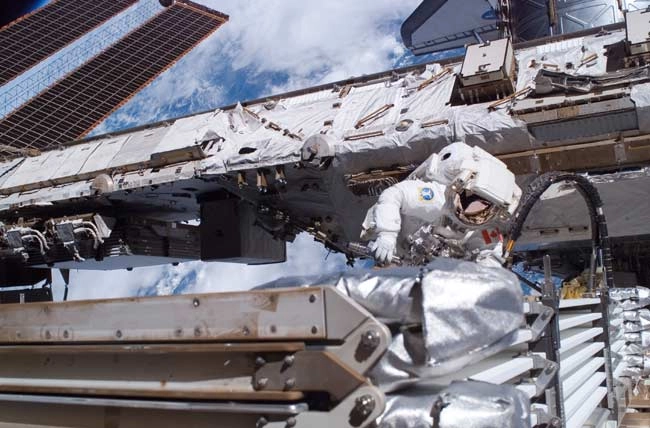
HOUSTON --Two spacewalking astronauts will step outside the International Space Station(ISS) Monday to replace a broken U.S. gyroscope while shuttle mission managersdiscuss a deep gouge in the Endeavour orbiter's underbelly.
Endeavourshuttle astronauts Rick Mastracchio and Dave Williamsare due to begin their 6.5-hourorbital repair job at about 11:31 a.m. EDT (1531 GMT) from the station'sQuest airlock.
The entirespacewalk is dedicated to replacing a failed control moment gyroscope, one offour used in the space station's U.S. attitude control system that orients theorbital laboratory without firing rocket thrusters.
"Thegyro, essentially, is a spinning disk that conserves momentum," Williams,a Canadian Space Agency astronaut, said before flight. "It's used tostabilize the station."
The spacestation trades off between propellant-less U.S. gyroscopes and Russianthrusters to orient itself in Earth orbit. ISS flight controllers shut down oneof the station's four gyroscopes in October 2006 when it began tovibrate excessively.
While thestation can control its position in space with only two functioning gyroscopes,all four are preferred to be operational as new truss segments and modules areadded to the ISS during its construction.
Monday'sspacewalk will mark the second for both Mastracchioand Williams, who successfully helped install a newstarboard truss segment to the ISS during an Aug. 11 excursion.
While Mastracchio and Williams toil in space, engineers on Earthare expected to performa detailed thermal analysis on a 3 1/2-inch (nine-centimeter) long divotacross two of the heat-resistant tiles on the shuttle Endeavour's belly-mountedheat shield. A baseball-sized piece of fuel tank foam carved the gouge duringEndeavour's Aug. 8 launch, penetrating through the entire 1.12-inch(2.5-centimeter) thick tile and prompting concerns that a spacewalk repair maybe needed to address the damage.
"Wehope the analysis will turn out that we don't have to go to a repair," saidJohn Shannon, chairman of Endeavour's mission management team, adding thatsince the 2003 Columbia accident NASA has developed new heat shield modelingand repair methods to meet such tile damage challenges. "We have reallyprepared for exactly this case since Columbia."
Commandedby veteran shuttle flyer Scott Kelly, Endeavour's seven-astronaut crew ishauling about 5,000 pounds (2,267 kilograms) of cargo to the ISS, along with anewly installed starboard side truss segment and a still undelivered spareparts platform. The crew also includes formerIdaho schoolteacher Barbara Morgan, who first joined NASA's as the backupto Teacher in Space Christa McAuliffe before the 1986 Challenger shuttleaccident.
Gyroscopeswap
Monday'sspacewalk will mark the second of four planned spacewalks for Endeavour'sSTS-118 spaceflight. Mission managers decided Sunday to extend the shuttleflight three extra days based on the successful performance of a new powertransfer system that allows Endeavour to draw on the space station's solarpower grid for electricity rather than its own fuel cell resources.
Duringtheir spacewalk repair, Mastracchio and Williams willfirst remove the faulty gyroscope from its mount in the station's Zenith 1 (Z1)truss and set it aside, and then retrieve its replacement from Endeavour'spayload bay. To do that, Williams will ride down to the shuttle on thestation's robotic arm.
"WhenI'm on the end of the arm going down to the payload bay, I'll have nothing inmy hands," Williams told SPACE.com before flight, adding that themoment is one he's been looking forward to most on the mission. "I willhave this majestic view of the planet Earth?it's just going to be anincredible, incredible experience."
Thespacewalkers will temporarily stow the new gyroscope on an older spare parts platformto prepare it for installation, with Williams then due to haul the 600-pound(272-kilogram) flywheel to the Z1 truss at the tip of the space station'sCanadian-built robotic arm to lock in place.
The older,defunct gyroscope will be stowed on one of the station's spare parts platformsfor later return to Earth, leaving the ISS with a fully functional U.S.attitude control system.
"Obviouslywe want the fourth one in case another one fails or has problems," Mastracchio said of the new gyroscope. "So it'sbasically for redundancy."
NASA is broadcasting Endeavour's STS-118 mission live on NASA TV. Click here for mission updates andSPACE.com'sNASA TV feed.
- VIDEO: STS-118 Mission Profile: Second Spacewalk
- VIDEO: Teaching the Future: Teacher-Astronaut Barbara Morgan
- Complete Space Shuttle Mission Coverage
