





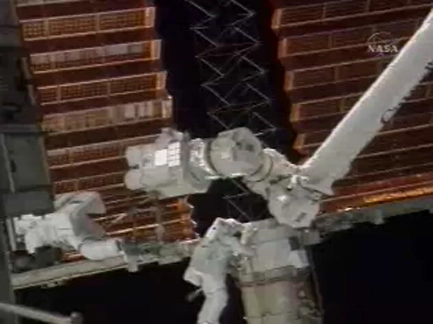
HOUSTON -- Two spacewalking astronauts partially furled anold solar wing outside the International Space Station (ISS) Wednesday, thenfaced down tough bolts and crossed wires to help prime the outpost?s newestarrays to track the Sun.
Atlantisshuttle astronauts Patrick Forrester and Steven Swanson began their seven-hour,15-minute spacewalk poking, prodding and fluffing the nearly seven-year-old solar array partway back into itsstorage boxes before moving on to other tasks.
?We wereable to get to about just-not-halfway retracted,? said Kelly Beck, NASA?s leadISS flight director for the STS-117 mission.
Theremaining portion of the 115-foot(35-meter) solar array, which reaches starboard from the station?stower-like Port 6 (P6) truss, will be retracted during a later extravehicularactivity (EVA) by Atlantis? STS-117 crew.
?Pat and Steve left them in anice [configuration] for EVA attempts later on,? said Atlantis? STS-117commander Rick Sturckow.
Forrester and Swanson used a setof improvised tools - includinga so-called ?hockey stick? named for its shape - wrapped in translucentorange Kapton tape to free stuck grommets, snip off loose spring leaders andfeather the P6 solar panels so that they would retract properly.
?Now thisis a view to remember right here,? said Forrester, who handled the tools whileperched at the end of the station?s robotic arm.
Mission managers have alreadyset aside more time later in the STS-117 crew?s mission to complete the solararray retraction, with additional efforts set for Thursday and during a Fridayspacewalk.
?It was always the plan togive us several days to retract the arrays,? said Mike Suffredini, NASA?s ISSprogram manager, after the spacewalk.
During Wednesday?s EVA, shuttlemanagers also decide to add an anticipated Atlantis heatshield blanket repair to the docket of the STS-117 crew?s Friday spacewalk.A corner of the blanket pulled free of its position on Atlantis? leftaft-mounted Orbital Maneuvering System (OMS) during the shuttle?s June 8launch.
Forrester and Swanson began theirspacewalk from the station?s Quest airlock at 2:28 p.m. EDT (1828 GMT), about20 minutes later than planned, due to communication difficulties betweenthemselves and crewmates aboard Atlantis helping to choreograph their work. Thespacewalk also ran longer than the initially planned 6.5 hours, leaving theastronauts a bit low on some spacesuit supplies by the excursion?s end.
Near-ready to rotate
By the end of today?s spacewalk,astronauts and flight controllers reeled in the P6 solar array enough to allowthe station?s newstarboard solar wings to rotate and track the Sun, but spacewalkers foundan apparent wiring mix-up with two gears to drive that rotation.
Forrester encountered the wiringerror as he installed a Drive Lock Assembly gear to drive a 2,500-pound(1,133-kilogram) Solar Alpha Rotary Joint (SARJ) to rotate the station?s new Starboard4 truss and its two solar wings like a Ferris wheel to track the Sun. Thegear is one of two that drive the SARJ?s rotation.
?It looks like the wires werecrossed,? NASA astronaut Megan McArthur, serving as spacecraft communicator inMission Control here at the Johnson Space Center, told the spacewalkers aftersome tests by flight controllers found commands meant for one gear were goingto its counterpart.
The hardware was later installedsuccessfully, though more work on a later spacewalk will be required to repeatthe fix on the second SARJ gear.
To keep the SARJ from rotating,Forrester and Swanson left a one of a series of launch locks in place to secureit. They also loosened the torque on a series of launch restraint bolts thatwill now be removed on a later spacewalk. The locks and restraints secured theSARJ and S3/S4 truss inside Atlantis? payload bay during its June 8 liftoff andare no longer needed.
Wednesday?s EVA marked thesecond of four planned for the STS-117 mission, the 85th dedicatedto space station construction or maintenance, and the 57th originatefrom the ISS itself.
The spacewalk also marked thefirst career EVA for Swanson and the third for Forrester.
?Thanks to the help from you andthe ground,? Forrester told his crewmates. ?That was wonderful.?
NASA isbroadcasting the space shuttle Atlantis' STS-117 mission live on NASA TV. Click here for mission updates andSPACE.com's video feed.
- VIDEO: A Look at STS-117?s Second Spacewalk
- SPACE.com Video Interplayer: Space Station Power Up with STS-117
- STS-117 Power Play: Atlantis Shuttle Crew to Deliver ISS Solar Wings
- Complete Shuttle Mission Coverage
