





This story was updated at 10:03 a.m. EDT.
A Russian spacecraft carrying anAmerican billionaire and two professional astronauts returned to Earth Saturdayafter a record-setting spaceflight to the International Space Station (ISS).
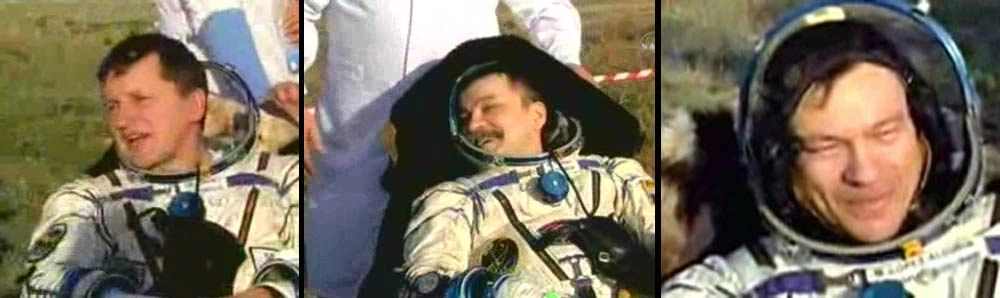
The Soyuz TMA-9 capsule touched downon the remote Central Asian steppes of Kazakhstanat about 8:31 a.m. EDT (1231 GMT) to ferry U.S.entrepreneur Charles Simonyi -- the world's fifth space tourist to the ISS-- back to Earth alongside Expedition 14 commanderMichael Lopez-Alegria and flight engineer Mikhail Tyurin.
"It's good to be back, to be back onEarth," Simonyi said after landing. "It's fantastic."
With the landing, Lopez-Alegria seta new U.S.record for the longest single spaceflight after the 215-day Expedition 14mission. He and Tyurin surpassed NASA's previous spaceflight record of about196 days, set by astronauts Carl Walz and Dan Bursch during 2002's Expedition 4mission, earlier this month.
Simonyi, too, set his own durationrecord -- about 14 days -- for the longest space tourist trek to the ISS.Previous private tourist flights were around 10 days or less.
"It's a bittersweet moment for allof us," said Simonyi, who is paying between $20 million and $25 million for histrip, said during a farewell ceremony peppered with hearty hugs, handshakes andsmiles. "We are very sad leaving the station but we are looking forward, all ofus, to continuing our work on Earth."
Simonyi's flight, like four previousspace tourist treks to the ISS, stemmed from an agreement between Russia'sFederal Space Agency and the Virginia-based firm Space Adventures, which hasbrokered each of the five private spaceflyer flights. He is chronicling hisexperiences via his Web site: www.charlesinspace.com.
The Soyuz and ISS undocked from oneanother at 5:10 a.m. EDT (0910 GMT) as they flew 220 miles (354 kilometers)above Eastern Asia to make what Tyurin described later as a "clockwork"landing.
Lopez-Alegria and Tyurin left theISS in control of its new Expedition 15 crew, with veteran Russian cosmonautFyodor Yurchikhin in command and first-time flyer Oleg Kotov as flight engineer.NASA astronaut Sunita Williams, who arrived at the station as a flight engineerin December, joined the Expedition 15 mission for its first stage.
"It's been amazing watching you comeaboard as a clumsy rookie, and as I leave you, you're a steely eyed ace,"Lopez-Alegria told Williams, who is making her first flight, this week. "It'sreally been a privilege."
Williams and her crewmates aboard theISS watched video of their crewmates landing via a NASA uplink.
"Thisis unbelievable and great, thank you so much for the video," said Williamsafter the successful landing. "It's hard to believe that we were just havingtea with them a couple of hours ago."
Saturday's landing activities werenot impacted by events Friday at NASA's Johnson Space Center in Houston, hometo the space station's U.S. Mission Control center, where a gunman took twopeople hostage, killingone man and then himself, according to police.
Records galore and living in space
For Lopez-Alegria, the Expedition 14mission has been one of shattering spaceflight records.
In addition to setting NASA's newsingle spaceflight benchmark, he also racked up five more spacewalks during theseven-month flight for a career total of 10 excursions and more than 67 hoursof spacesuit-ed work time, both U.S. records in their own right. Williams, too,became the most experienced female spacewalker in history with four excursionsstaged during the mission. She is expected to breakLopez-Alegria's U.S.single spaceflight duration record later this summer.
But breaking records in space,Lopez-Alegria said, is largely a game of chance.
"I liken us to be more like the guyin the stands who catches the ball, we just happen to be in the right place atthe right time," the astronaut, an avid baseball fan, told ABC News thisweek. "It's with a certain humility that we have to admit that we were justlucky."
During Expedition 14, astronauthosted a visiting space shuttle mission -- December'sSTS-116 station assembly flight -- and staged five spacewalks. Three ofthem overhauled the station's cooling system in February, while a pair ofRussian spacewalks included a round of orbital golf and the unplanned repair ofa stuck cargo ship antenna.
It is the unplanned work, such asthe antenna repair and the wrangling of a recalcitrant solar array into storageboxes during the STS-116 mission that Lopez-Alegria said he is most proud of.But the simple acts of day-to-day life, rather than work, will be among hismost precious memories, he added.
"This has been living up here, wecertainly work hard when we're working but we also have time to relax, we havea little bit more time to think about things," Lopez-Alegria told reportersduring the station crew swap. "I can say that I've lived in space, not justworked, and I think I'm going to miss that sensation of just having this be myhome."
Lopez-Alegria said that after sevenmonths in orbit with a repeating in-flight menu, he was looking forward to oncemore feeling gravity's embrace, seeing his family and the variety of foodsavailable on Earth.
"I'm kind of looking forward to agood single malt scotch and I'm looking forward to seeing my son again," theExpedition 14 commander told Florida Today.
Tyurin too, who last flew aboard theISS as part of the Expedition 3 crew, said he is sad to leave the station, buthopes one day to return.
"Of course I would like to continuemy experience staying here on board and take part in future missions becauseit's not only my specialty, my job," Tyurin said. "It's a big part of my life."
Space tourist's trip
For Simonyi, 58, his 14 days inspace have been packed with science experiments, Earth observations and aseries of radio and video sessions to relate his experience with students andthe public.
"Thank you very much for thehospitality," Simonyi told flight controllers and astronauts Saturday beforeundocking. "I enjoyed working here with the excellent commanders."
Reaching for space has been alifelong pursuit for the Hungary-born Simonyi, a former Microsoft softwaredeveloper and co-founder of the firm Intentional Software Corp., whorepresented his country as a Junior Astronaut at age 13 during a trip to Moscow. He performed aseries of space radiation measurement for the Hungary Space Office using aHungarian-built dosimeter, tested high definition video cameras for the JapanAerospace Exploration Agency, and participated in several biomedicalexperiments for the European Space Agency.
Simonyi launched towards the ISS onApril 7 with the Expedition 15 crew, and received several bonus days in orbit.Two extra days were added to his flight to ensure he and the Expedition 14astronauts landed in daylight. Russian flight controllers added a third extraday to the flight Tuesday in order to switch to a backup landing site afterheavy rains flooded the primary target.
"I think it's excellent to have thisextra day," Simonyi said in his last radio broadcast from the ISS posted to hisWeb site Friday. "I don't know how we would have done without it."
But it was the feedback from his Website, where some questions from visitors were answered by the space touristduring radio or video sessions, and the HAM radio sessions with schools thatSimonyi found surprisingly successful. He hopes to add written commentary abouthis flight to his blog, and reflect on his spaceexperiences in upcoming days.
"I think that was probably the mostsuccessful part of this mission," Simonyi said. "It's really beyond anything Icould have imagined."
- VIDEO: Space Tourist Charles Simonyi, Expedition 15 Crew Launch into Orbit
- Complete International Space Station Mission Coverage
- Space News TV From the 23rd National Space Symposium
